3 work improvements to help your teams get more from AI
Every day, I speak with enterprise leaders, from heads of people to chief technology officers. They come from unique backgrounds but share an urgent need: equipping their people to get more from AI.
Our conversations rarely centre on just technology. Instead, we explore how to align systems, culture, and people so employees can do their best work.
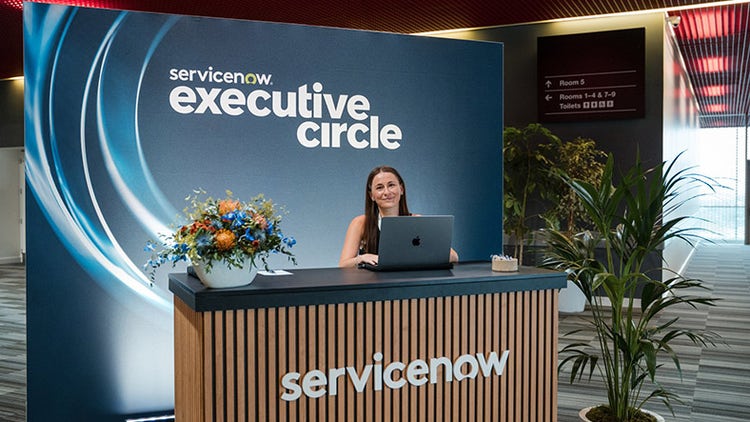
I recently had the pleasure of discussing these dynamics with more than 100 attendees at a ServiceNow Executive Circle event in London. Senior leaders from diverse industries gathered to discuss their insights on AI and business strategy. Three work improvements suggested in the room have stayed with me.
1. Break down silos and think in systems
According to a Gartner® survey “Only 22% of organisations have successfully scaled AI across multiple business units or adopted an AI-first approach.”1 Working collaboratively takes effort. Teams retreat into what feels familiar rather than looking at how functions work together to steer the business.
The most successful enterprises I work with solve problems together. Leaders evaluate challenges through a shared lens and consider how the wider enterprise operates end to end.
You can start bringing teams out of silos by making it easier to work across functions. Equipping employees with integrated data, clear AI governance, and structured change management can remove daily friction.
Show people what becomes possible when they work with AI across functional lines. Attendees at Executive Circle heard how one financial services organisation combines signals from IT, security, and their managed services provider to predict and prevent major security incidents.
A collective approach to AI is systems thinking in action. When teams join hands across functions, they can solve challenges no single team could handle alone.
2. Make it safe to experiment
According to PwC, just 30% of global CEOs felt confident about revenue growth at the beginning of 2026. More than half (56%) reported no revenue or cost benefits from AI. Technology alone won't create AI value. It needs a culture that gives people the confidence to find the best ways to use it.
To rethink how work gets done with AI, employees need psychological safety. It isn't enough for people to trust their leaders. They need to feel trusted by them. In practice, that means a safe space to test, play, and fail fast without repercussions.
When an AI pilot fails to generate a clear return, hold the underlying system or process accountable—not the individual. Removing blame can give people permission to solve big problems rather than chasing small, everyday gains.
For example, giving employees the tools and permission to become citizen developers can help undo a bottleneck in application prototyping. Technology creates the opportunity. People create the impact.
Trust also grows when people know where the guardrails are. An AI governance team to oversee policies and protocols gives people clarity on where they can experiment safely. The AI-mature enterprises I meet have laid foundations for people to experiment and identify AI use cases that deliver the most value to their work.
3. Give your people room to do their best work
Enterprises stand at a crossroads between workforce displacement and a human renaissance. This is where teams and AI agents work together, guided by people's judgement, empathy, and creativity.
While AI promises to free up time for human work, leaders tell me they spend hours in AI steering meetings or reviewing machine outputs. That cognitive tax can drain mental reserves, leaving little space for the judgement and creativity that make us distinctly human.
In a human renaissance, the value of AI lies in what it gives back to people. When technology absorbs manual, repetitive work, employees are free to focus on strategy, relationship building, and creative problem-solving—not busywork.
To protect human work, I recommend managing capacity across three distinct layers:
- Physical stamina: Are your teams getting enough time to recharge when workloads surge?
- Mental clarity: Do your employees have space for deep focus, reasoning, and strategic problem-solving?
- Purpose: Can people see how their efforts influence business outcomes?
By assessing how your teams use the capacity AI creates, you can ensure technology serves the workforce rather than multiplying workloads. In roles where AI handles the bulk of day-to-day execution, explore how to redesign roles and reskill people to focus on value-added work.
Fall in love with problems
You don't need to know how to maximise AI's value across your enterprise on day one. Organisations get the most from AI when they build those answers together, across systems, culture, and people.
Leaders have an enormous amount to learn from one another, which makes partnering across the business vital. My advice is to lead with empathy. Take time to understand others' challenges and how technology can help them. AI delivers value only when it solves real problems for people.
Find out how ServiceNow can help you automate busywork and unleash your talent.
1Gartner Press Release, Gartner Survey Finds Only 22% of Organizations Have Successfully Scaled AI Across Multiple Business Units, September 1, 2026
GARTNER is a trademark of Gartner, Inc. and/or its affiliates.