4 ways to improve AI execution
Organisations across Europe, the Middle East, and Africa (EMEA) are investing in agentic AI, but autonomous work is still out of reach for most, according to the ServiceNow Enterprise AI Maturity Index 2026.
AI maturity in EMEA has risen to 51 out of 100, up from an average of 34 last year. Spending in the region has surged by 113% over the same period. Yet AI execution isn’t keeping pace.
While more than half (57%) of the EMEA organisations we surveyed have deployed agentic AI, only 9% have made significant progress using it to create autonomous, multi-step workflows.
Most organisations now have the agentic technology. Few have reached genuine autonomy, where AI executes multi-step work end to end without human hand-offs. Siloed automation projects aren’t enough to close that distance. To get ahead, organisations must transform their underlying architecture. Here are four strategies to improve AI execution.
1. Focus on outcomes, not automation
Most enterprises buy AI to speed up individual tasks, one tool and one department at a time. That can deliver marginal productivity gains in the short term. But buying tools isn’t the same as building the architecture that changes how the work gets done.
Amit Zavery, president, chief product officer, and chief operating officer at ServiceNow, argues that how organisations invest matters more than how much, and that the real test of any AI investment is whether it changes outcomes for the people doing the work.
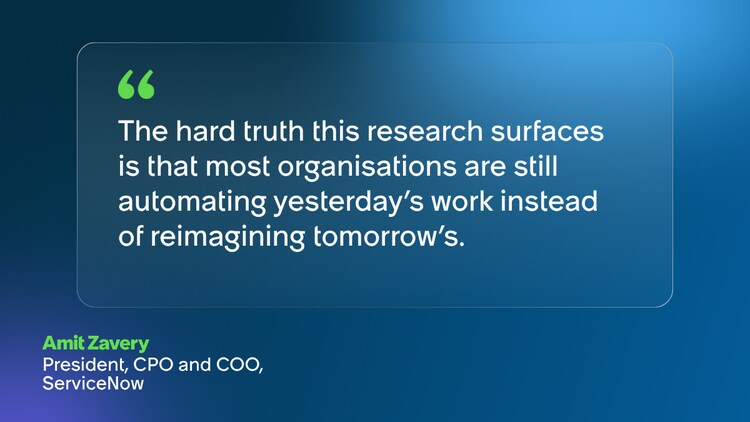
He says: “Technology matters only when it delivers real outcomes for real people—not technology for its own sake. Outcomes. And the hard truth this research surfaces is that most organisations are still automating yesterday’s work instead of reimagining tomorrow’s.”
Leaders must transition to end-to-end outcome orchestration. Coordinating AI agents, data, and decisions across the enterprise allows you to automate complex, cross-functional processes. This frees workers from low-value, repetitive tasks so they can focus on work that requires human judgment.
2. Replace your fragmented tech stack
Our research found that nearly three-quarters (73%) of EMEA executives reported inadequate data accuracy, access, and management as their biggest hurdle. But just 15% of organisations in EMEA have replaced fragmented legacy systems with an integrated platform. Most are bolting AI onto a foundation of broken infrastructure.
When systems are disconnected, AI lacks enterprise context. Without that context, a basic tool logs a network outage as an isolated IT ticket. With it, AI can identify affected customers and orchestrate communications automatically.
Integrating your tech stack on a single, unified platform can give agentic AI the high-quality data it needs to execute processes reliably. That’s the approach that Pacesetters—the most AI-advanced enterprises—take.
Nearly two-thirds (62%) of EMEA Pacesetters use digital technologies to integrate and optimise their data, compared to 14% of other organisations. As a result, Pacesetters reap up to five times greater productivity, and they’re six times more likely to create new services and revenue channels with AI.
3. Build proactive AI guardrails
Many leaders hesitate to grant AI systems true autonomy because of safety and compliance risks. Only about two in 10 (19%) organisations in EMEA have implemented AI testing, auditing, and risk assessment processes.
That’s a problem for the majority of organisations. Without a clear way to govern automated decisions, scaling AI can lead to AI chaos. AI agents can take unwanted actions across connected, multi-system workflows, spreading operational errors, data bias, and compliance breaches across the enterprise. operational errors, data bias, and compliance breaches across the enterprise.
Organisations need strong governance controls to contain that risk and build the trust required to scale autonomy. ServiceNow AI Control Tower can provide full visibility into AI assets. It senses context, decides on the appropriate action, acts across systems, and secures action.
4. Prepare workers for agentic collaboration
Only 14% of EMEA organisations have built long-term HR plans to support AI, according to our research. By contrast, forward-thinking leaders are already offering ongoing AI training and redesigning operating models for human-and-AI collaboration.
Business reinvention in the AI era demands workforce transformation that keeps pace with tech transformation. Yet only 20% of organisations have formally assessed skills across the enterprise to understand where AI upskilling would have the most impact.
If people aren’t ready to work with agentic AI, leaders risk losing employee engagement and trust. Workers who feel bypassed by automation rather than empowered by it may push back against adoption, stalling the gains organisations are working to capture.
The factors behind workforce anxiety vary across regions. In Saudi Arabia, a workplace culture of risk aversion can make employees more cautious about adopting AI. In the UK, concern centres more on the risk of job loss. Ongoing personalised training programmes can help transform the perception of AI from a threat to an empowering, collaborative partner.
According to our data, 52% of EMEA Pacesetters offer upskilling programmes, compared to just 4% of others.
The connection imperative
EMEA leaders can’t buy AI in parts and expect it to perform as a whole. Bolting advanced technology onto fragmented systems will only scale inefficiency. To improve AI execution, organisations must connect their workflows, data, and AI on a unified platform that enables true autonomous work.
Find out how ServiceNow can help you unify data, AI, workflows, and security.