5 best practices for agentic security
Nine out of 10 organisations implementing agentic AI in Europe, the Middle East, and Africa (EMEA) have experienced an agentic security incident in the past year, according to recent ServiceNow research. Only 36% of them contained it within 24 hours.
ServiceNow and Phronesis Partners surveyed more than 3,700 senior security and technology leaders across 20 countries, including 1,265 in EMEA, about their approach to AI governance, visibility, and accountability. The results show that controls aren't keeping pace with deployment when measured against five critical domains:
- Attack surface
- Security by design
- Visibility
- Audit readiness
- Accountability
Agentic security requires a new approach
Leaders are using AI agents to make decisions and execute complex tasks across the enterprise. Each agent accumulates new permissions and access paths for security teams to manage. Without visibility into which agents are running, what data they can access, and how they behave, risk multiplies before the security team can react.
In the past year, 24% of EMEA security teams identified unregistered AI agents running in production. Unknown agents are a form of shadow AI that's often discovered after it's already running.
Even where AI agents are known, governance is uneven. Only 40% of EMEA enterprises have a framework that explicitly covers documentation and audit trails for agent activity. Even fewer (32%) have a mandatory automated gate that blocks deployment until an AI agent passes a security check.
Organisations are attempting to solve the agentic security problem using controls built for a pre-AI world. Legacy security frameworks assume a human takes responsibility for every decision, which is no longer the case in the agentic enterprise.
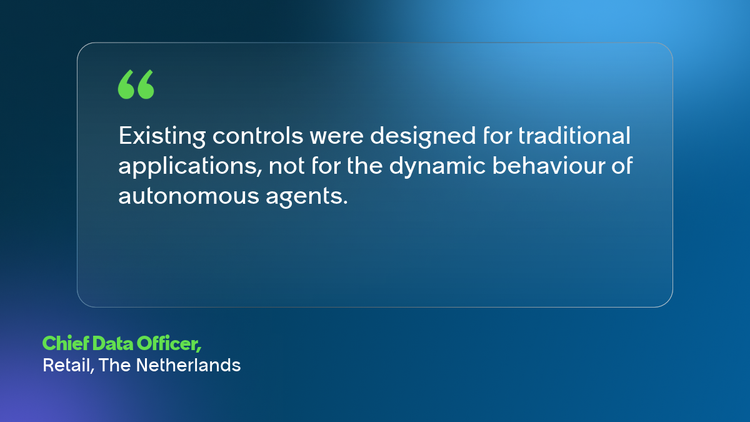
“Existing controls were designed for traditional applications, not for the dynamic behaviour of autonomous agents,” explains a chief data officer in our research.
Let's explore how leaders can implement agentic AI controls to help protect business continuity, reputation, and intellectual property.
1. Create an AI agent system of record
More than half (58%) of EMEA organisations say they keep a full inventory of every AI agent and have a process to track changes. Yet only 38% automatically register new agents using a technical control at deployment.
Automating AI agent discovery and oversight can help prevent untracked access paths from expanding your attack surface. As soon as an agent enters production, establish a system of record to track:
- The data an agent touches
- The systems an agent connects to
- The permissions an agent holds
- The agent's owner
2. Design for security
Less than half (44%) of EMEA organisations bring security in before or during AI agent design, according to our research. The rest are reactive by design.
Security teams can help shape AI agent design from day 1. Defining controls in the initial brief can help ensure agent permissions and boundaries are set before any code runs, avoiding costly retroactive fixes.
3. Build a unified view of AI agent activity
Just one in five EMEA enterprises has a unified view of AI agents. Less than a quarter (23%) of organisations can see more than 90% of their agents in real time.
Relying on manual spreadsheets or disconnected data for AI oversight can create blind spots. By the time the security team aggregates logs across fragmented environments, the view is already outdated.
A single platform built on a unified data model, such as ServiceNow® Super Intelligence Control Tower, can help provide a complete picture of AI agent activity, identities, and security posture. This gives security teams real-time visibility to respond to threats effectively.
Organisations using unified platforms report stronger security outcomes than others. According to our research, 43% of unified platform users in EMEA auto-remediate AI agent exposure or policy violations, compared to 25% of others.
4. Capture and retain evidence
Traditional audit logs record that an event occurred but can often lack the reporting granularity that modern compliance requires. Less than half (48%) of EMEA enterprises can produce a complete evidence package on demand.
As regulations such as the EU AI Act evolve, security leaders should be able to answer:
- What was the AI agent scoped to do?
- What action did the agent take?
- Who approved the exception?
- How did the agent reach its decision?
Failing to retain these details can leave organisations unable to justify an agent's actions. Security teams must capture and store complete execution logs for as long as regulation and internal policy require.
5. Assign a named owner of agentic governance
Security teams can lose momentum when accountability for agentic governance is divided across business units. While 56% of EMEA enterprises rate their agentic security as established, just 19% have a single named owner.
Strong controls require a designated leader responsible for risk frameworks, review gates, record keeping, and incident response. If the chain of responsibility needs reconstructing during an incident, mitigation can stall, expanding the blast radius. Formal accountability for agentic governance can help ensure security under real-world pressure.
Leading a secure agentic workforce
Globally, every organisation we surveyed runs AI agents in production, but just 13% have a defensible security posture. Risk and security leaders must establish controls to detect and contain threats, prove regulatory compliance, and scale agentic AI on a stable foundation.
Get more insights on the state of agentic security.