Agentic lending: capturing the €30bn growth potential at no added cost

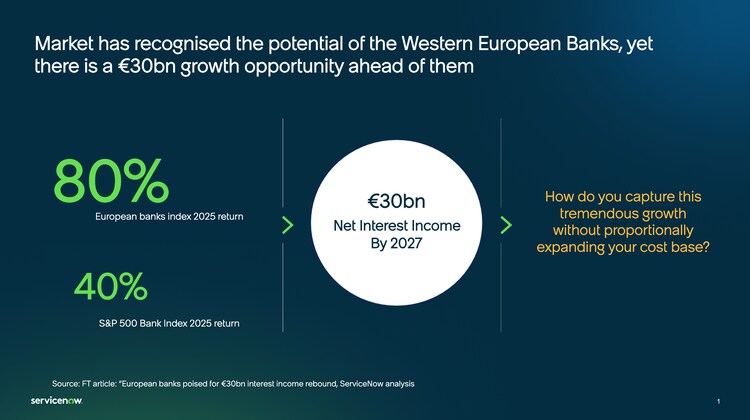
European banks are entering a period of renewed momentum. Markets have recognised the sector's potential, with European bank shares rising approximately 80% through 2025, outpacing their US peers (approximately 40%).1
Recent UBS research projects €30 billion in additional net interest income over the next two years, driven by 4% loan growth and structural hedging strategies, offsetting potential upcoming rate cuts by the European Central Bank.2
Traditional European banks already operate at cost-to-income ratios above 60% on average, while challenger banks like Revolut run at 45% or below.3
This creates an operational paradox: How do you capture this tremendous growth without proportionally expanding your cost base?
Are you transforming or just automating?
The technology already exists to deliver 80% faster decision cycles, 90% automation for standard products like credit cards, and 40% to 60% lower operational costs in service centers. The barrier to achieving these results isn’t technology; it's strategy.
The key question is: should you use AI to perfect yesterday's lending model, or will you use it to build the autonomous, intelligent, scalable lending workflow that makes traditional processes obsolete?
Success requires answering fundamental questions such as:
- Why touch every application when AI can handle routine cases and flag only what needs human judgement?
- Why do credit checks, fraud checks, and compliance reviews happen sequentially when they could run simultaneously?
- Why do applications wait in first-come, first-served queues when AI can prioritise by risk profile and business value?
Agentic lending is the answer. This isn't incremental improvement; it's a fundamental reimagining of how lending works.
What is agentic lending?
Agentic lending is autonomous and goal-seeking. It can orchestrate the entire lending lifecycle, from application intake to disbursement, making multi-step decisions within defined business and risk parameters and escalating only when genuine complexity demands human judgment.
How does agentic lending work?
Picture a Know Your Customer (KYC) agent or ops agent as a digital workforce, augmenting human intelligence rather than replacing it.
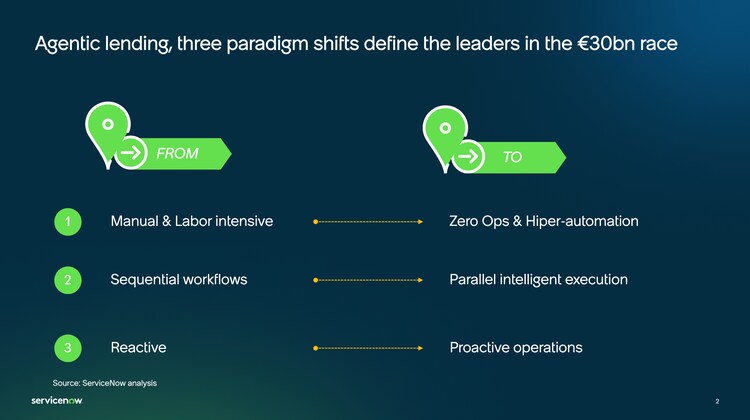
Agentic lending rewrites the rulebook. AI agents pull information from banking systems, documents, emails, and third parties without human intervention. They execute KYC checks, draft lending agreements, and communicate directly with customers.
Sequential processing gives way to parallel execution. Different AI agents simultaneously retrieve client data, perform credit analysis, and assess risk profiles.
The transformation extends beyond speed. Agentic AI systems shift lending from reactive to proactive operations. Triage AI agents prioritise cases by product type and risk profile rather than arrival time, determining the optimal path for each application. Capacity automatically rebalances across products and channels based on real-time demand.
The result is a dynamic lending business journey that optimises business outcomes.
Workflow orchestration as competitive advantage
Most banks approach AI as a series of point solutions, such as chatbots, duct-taped across fragmented systems. This creates a patchwork that delivers marginal gains while compounding technical debt.
Agentic lending demands an orchestration layer that connects the front, middle, and back offices into a unified workflow platform. The ServiceNow® AI Platform operates as this connective tissue, running north-south across the entire IT stack and east-west across organisational silos.
Unlike foundation model platforms that exist in isolation or systems of record that merely store data, ServiceNow makes AI operational within end-to-end workflows. It grounds autonomous decisions in business context while maintaining the control, security, and governance that regulators demand.
5 ways ServiceNow enables agentic lending
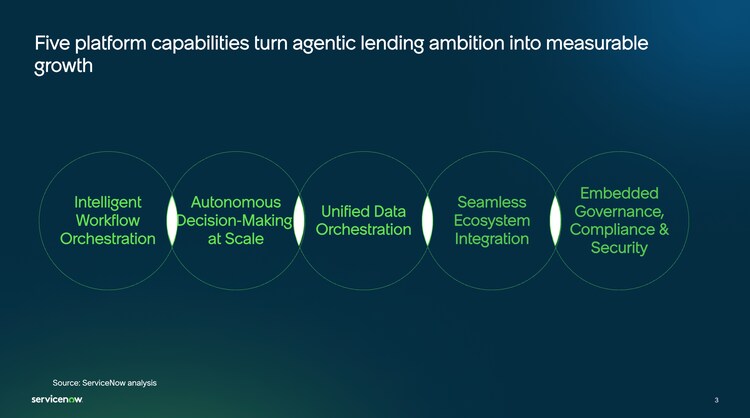
The ServiceNow AI Platform includes five capabilities that can help transform lending from manual, sequential workflows to automated, intelligent parallel processing at scale.
1. Intelligent workflow orchestration
Most banks haven’t achieved full straight-through processing for lending. They still rely on sequential processing, First-in, First-Out (FIFO) queuing, and manual handoffs to process lending applications, creating bottlenecks.
ServiceNow helps eliminate these constraints through intelligent workflow orchestration. Document verification, compliance checks, and approval workflows that previously required significant manual effort can now be streamlined through intelligent automation, turning lending into programmable flow. The platform doesn't just automate tasks; it redesigns how work moves through an organisation.
This allows teams to redirect their attention from routine, low-value activities to high-value customer interactions. Processes are also monitored to identify areas of improvement.
2. Autonomous decision-making at scale
Traditional lending requires human judgement to orchestrate workflows, creating capacity constraints and inconsistent decision-making.
ServiceNow AI Agents can provide banks with a digital workforce to triage lending cases, verify income information, recommend next steps, and draft credit decisions within defined parameters and risk policies.
Using these AI agents, risk assessment and eligibility verification activities, among others, execute autonomously, with humans invoked only when exceptions arise. The system learns from patterns, spots emerging risks, and maintains consistency across thousands of simultaneous evaluations.
Banks can even scale agentic lending by packaging “agentic lanes” (e.g., low-risk versus high-risk customers).
3. Unified data orchestration
Customer information is often scattered across core banking, customer relationship management (CRM), document management, and third-party data providers. This requires manual reconciliation and introduces operational risk that can compound through the lending lifecycle.
ServiceNow creates a single pane of glass by connecting existing systems. Whether data resides in legacy mainframes or modern cloud applications, the platform provides one unified view.
Sales representatives, underwriters, and operations teams all work with the same information in real time. This helps eliminate version control issues that plague traditional lending journeys.
4. Seamless ecosystem integration
Traditional modernisation programs often fail because they demand rip-and-replace transformations that institutions can't sustain. The reality is that legacy core banking systems will coexist with modern loan origination platforms and third-party data providers for years.
ServiceNow operates as an orchestration layer that doesn't force architectural decisions. Whether integrating with mainframe systems via APIs or connecting modern microservices, the platform enables progressive modernisation. Banks can transform at their own pace, without wholesale system replacement.
5. Embedded governance, compliance, and security
Autonomous systems create regulatory challenges centered on explainability. The EU AI Act classifies credit scoring as high-risk AI, requiring comprehensive documentation of AI-driven decisions.
ServiceNow builds this accountability into the platform architecture. Every decision, every data access, every escalation gets logged with full auditability. The system does more than just meets regulatory standards. It anticipates them, providing the explainability and oversight that turn autonomous operations from regulatory liability into competitive advantage.
How do banks successfully deploy agentic AI?
Capturing this opportunity requires bimodal execution: automating existing operations while simultaneously investing freed capacity into customer-facing innovation. Banks creating sustainable advantage run these strategies in parallel in a self-reinforcing cycle: Phase 1 efficiency gains fund Phase 2 competitive differentiation. Companies at the forefront of AI adoption are expected to experience 2.1 times higher revenue growth and a 1.4 times lower cost base.4
However, platform deployment alone won't deliver results. Seventy percent of AI transformation value comes from organisational change, not technology, according to BCG. The institutions winning this race are building cross-functional teams that bridge business context with technical execution.
Find out more about how ServiceNow helps put AI to work for banking.
1 Author analysis: February 2026: Total return of STOXX Europe 600 Banks versus S&P500 Bank Index, source: CapitalIQ, S&PGlobal
2 Simon Foy, FT, European banks poised for €30bn interest income rebound, 6 Jan 2026
3 Author analysis: January 2026: Analysis of top 20 Western European banks by total asset size, 2024 data
4 BCG, The Widening AI Value Gap, September 2025