AI Summit: How to overcome 4 AI barriers
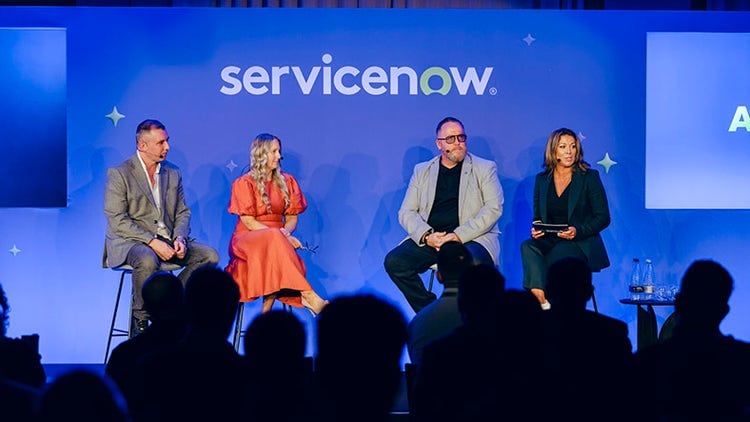
Putting AI to work for people means going from ambition to action. But that involves addressing four AI barriers, according to speakers at the recent ServiceNow AI Summit in London.
Technology leaders from a range of industries shared practical strategies for implementing agentic AI across the enterprise. What are the main challenges, and how can leaders address them? Let’s explore four takeaways from the event.
1. Address shadow AI by accelerating safely
Shadow AI is a growing concern for organisations implementing AI strategies. According to IDC’s Global Employee Survey from April 2025, “39% of Europe, Middle East, and Africa (EMEA) employees are using free AI tools at work. Another 17% use AI tools they privately pay for.”1
Shadow AI can result in security vulnerabilities, slow down centralised AI adoption, and make it difficult for AI leaders to understand and maximise the enterprise’s AI estate.
“Strong and responsive AI governance is essential to enable organisations to both move fast and stay in control,” explained Max Duval, vice president of solution consulting at ServiceNow, in the keynote session.
A new way for AI leaders to do just that is by using ServiceNow AI Control Tower. This architecture is designed to oversee AI systems across the enterprise, to help ensure the tools are governed, compliant, and aligned with the company strategy. It is the trust layer that makes autonomy possible at scale.
Leaders can see their overall AI estate in one place, from the AI agents deployed to the models and skills being used. Importantly, it’s possible to detect breaches, review usage against the company strategy, and maximise the value of the tools in place. AI is embedded inside the operational fabric of the enterprise, grounded in workflows, assets, relationships, and history.
“As an IT leader, you can see everything that’s happening and measure what is actually working,” Raana Christopher, senior solution consultant at ServiceNow, explained. “It’s a way of mitigating risk and helping ensure that the right bets are being placed. Because with the right governance, speed becomes your best friend—and a true asset.”
2. Overcome AI reticence with feedback
Slow adoption of AI tools remains a concern for business leaders across sectors. The uptake of tools can follow a J-curve, making it take longer than anticipated.
Competing priorities are often an issue. “Adoption will grow, but getting new tools out there is hard—especially in a business like ours, with seasonal priorities,” explained Jon McKenna, director of service experience for home improvement company Kingfisher. “The challenge is finding the right slot on the runway.”
For Rachel Cameron, vice president of performance and improvement at Rolls-Royce, approach is key: “AI is often treated as a software deployment, when actually it’s a cultural shift. You have to consider lots of things, from concerns about job security to skills gaps, which slow everything down.”
Finding a single friction point where AI can clearly add value is a helpful approach. Rolls-Royce launched Merlin, an AI-powered virtual agent, in August 2025 and went from 800 monthly employee conversations to 10,000, with a 54% deflection from the IT service desk.
“We had early adopters test our agent before it launched and continued with that group to ensure we had a feedback loop in place. We could respond quickly to what wasn’t working and show the value we were delivering,” Cameron explained.
Benefits are often qualitative rather than quantitative, which may be difficult to measure initially but can also help to promote adoption. “People can be your biggest accelerator when adoption is done well,” Cameron concluded.
3. Avoid scaling inefficiencies with automation
In some organisations, AI has yet to deliver the productivity gains anticipated. “Teams are still drowning in busywork,” noted Duval from ServiceNow. from ServiceNow.
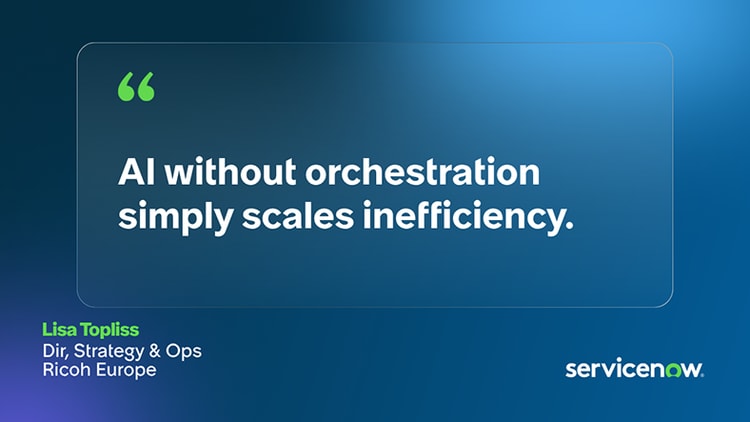
A common challenge is introducing AI without assessing the overall workflow. “That means you end up adding intelligence without fixing the execution,” noted Lisa Topliss, director of strategy and operations at Ricoh Europe.
Without a layer of orchestration to connect disparate tasks, AI only accelerates fragmented processes rather than solving them. “AI without orchestration simply scales inefficiency,” states Topliss.
Rather than considering how to automate tasks, it’s important to explore how to automate outcomes with end-to-end workflow execution. From an individual perspective, that means building autonomously completed tasks into the flow of work.
ServiceNow® EmployeeWorks gives workers a personalised front door for prioritising and completing work with the support of agentic AI. It enables employees to take tasks and turn it into finished work, from complex cross-functional processes to small admin asks.
The single AI interface provides a search box where employees can enter prompts in natural language. And it proactively surfaces areas where human expertise is needed with feeds and alerts.
As Duval explained, “This is about reducing the noise. We can change the paradigm of how work gets done to not only stop people falling behind but help them to get ahead.”
4. Address data fragmentation for AI value
A common challenge from even the most advanced organisations is getting data right. “Data is the piece that keeps me awake at night,” noted McKenna at Kingfisher.
Introducing AI often exposes data silos and fragmentation, according to leaders from many sectors.
The speakers in the keynote panel session emphasised that any organisation looking to introduce AI must start with data. McKenna stressed the need for a strategy to get the foundational data structure correct.
According to Cameron at Rolls-Royce, it’s a continual process. “We’ve done a lot of work on our data foundations, and we continue to mature our approach. You never reach a Eureka moment where the data problem just goes away. Currently, our focus is a culture of data-driven decisions. Unless you have people using data regularly, it’s almost worthless.”
AI built on enterprise data can unlock huge benefits for the organisation. As Duval at ServiceNow explained, “Public LLMs are trained on internet data. And that’s fine when you want advice on fixing a scratch on your car, but you don’t want your business decisions to be influenced by Dave on Reddit.”
With a strong data foundation, AI moves beyond providing simple information to driving decisions based on relevant information within the organisation—a level of intelligence that can’t be replicated.
The ServiceNow blueprint to agentic business shifts the focus from stand-alone models to an integrated stack. When AI is anchored inside workflows with deep operational context and strong governance, it provides a platform for autonomous workflows at enterprise scale.
Find out how ServiceNow provides the blueprint for agentic business.
1 IDC blog, “Shadow AI: How stealth productivity is strangling enterprise AI adoption. And creating a security nightmare…” July 3, 2025\