How to get ahead of rising customer expectations
In my conversations with business leaders, one tension keeps coming up: the gap between what customers expect and what organisations can actually deliver.
Our latest customer experience (CX) research puts a hard number on it: Consumers in the UK spend the equivalent of an entire working day every year navigating broken service experiences. The problem isn't a lack of AI investment. It's that AI layered onto fragmented systems doesn't fix broken experiences—it accelerates them. The real shift is rethinking the structure behind the service.
To understand the scale of the challenge, ServiceNow partnered with ThoughtLab to survey 2,000 customers, 265 executives, and 200 customer service representatives in the UK. The findings reveal a hidden productivity tax: hours lost on hold, information repeated across channels, and issues left unresolved for days.
These aren't isolated frustrations—they're symptoms of a customer relationship management (CRM) platform built to record interactions, not resolve them. Closing the gap means reimagining CRM as a system of action.
At the same time, customers are demanding more speed and empathy from service interactions. To retain brand loyalty, organisations must bridge the gap between service capabilities and rising customer expectations. Let’s look at three considerations to address that gap.
1. Speed is the baseline, not the goal
In the age of instant responses, half (51%) of UK consumers now expect enhanced speed and efficiency from AI in customer service. More than three in four (76%) confirm they’d prefer self-service before speaking to a representative. Yet 82% say they still want the option of a phone call.
This presents the question: What’s stopping AI from helping businesses deliver seamless interactions that enrich customer relationships for everyone?
Delay is a large part of the problem. On average, customer issues across the UK take three to four days to resolve. Turnaround times are even longer in sectors with factors like complex supply chains or production lead times, such as manufacturing, where consumers are forced to wait nearly a whole working week for a resolution.
According to Kantar, consumers regularly use AI for everyday tasks such as getting answers to questions, generating creative ideas, and managing their schedules. But whilst AI helps accelerate these routine activities, people don't always feel the benefit in customer service.
The growing disconnect between expectations and reality is eroding customer relations. Our research shows that 53% of UK consumers would switch to a competitor as a result of slow service. Customers expect speed: instant responses, 24/7 availability, and transactions completed in seconds.
To compete, organisations must respond to their queries at pace. By combining an intelligent CRM platform with autonomous AI for self-service, organisations can enable their customers to get the support they need for simple issues, at speed. And this is all while freeing up service reps for more complex enquiries.
2. The empathy gap is wider than you think
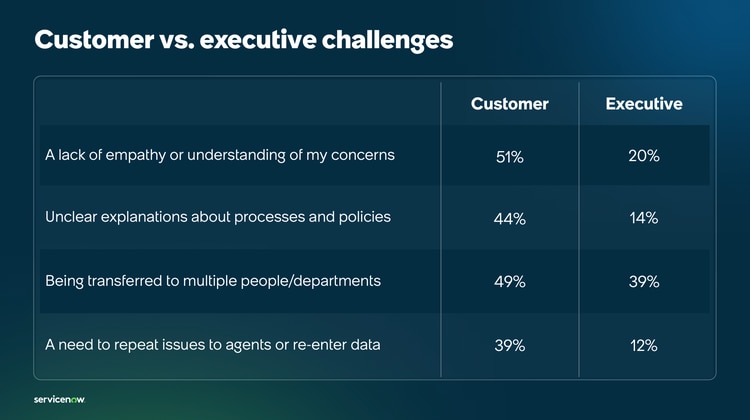
There’s a gap between what executives are prioritising and what customers need. Many customers in the UK simply want to be understood: 51% cite a lack of empathy in interactions as their top frustration. Yet only 20% of executives say they see this as a customer challenge.
Executives and customers are particularly divided over whether they rate these matters as challenges:
The mismatch extends to communication channels. Our research shows that although 82% of UK customers value phone calls, just 9% of executives intend to prioritise this channel in the next three years.
Instead, leaders are pivoting towards digital channels, such as social media, self-service portals, and intelligent chatbots. This may prove problematic, as 45% of customers say that current chatbots don’t understand their questions and concerns.
To forge the strongest relationships, customer preferences need to be the driving force behind channel strategies. That means striking the right balance between humans and technology for different needs, particularly as AI is still developing. As AI technologies improve, customers may be more willing to use self-service for complex issues.
3. Match AI to what customers want
The consumers we surveyed made their main priority clear: human connection. Customers revealed a clear preference for interacting with technology in these scenarios:
- Making purchases or payments
- Receiving loyalty and reward offers
- Getting offers for products and services
They expect their queries to be seamlessly escalated to a human in more complex interactions, such as engaging in a client relationship, obtaining advice and recommendations, and making an enquiry.
When AI is used to help free time for customer service representatives to spend with customers—by handling administrative tasks, for example—it can help build trust.
Currently, only 48% of UK reps’ time is spent addressing customer issues and follow-up. Instead, their time is spent on tasks AI could complete, such as admin (16%), reporting (11%), and summarising call notes (8%).
As customer expectations continue to evolve, businesses must balance technology with human expertise. That means using AI for speed, accuracy, and administrative tasks—while empowering service reps to deliver high-value interactions that build empathy and trust.
What the data tells us is something I believe many leaders already sense: Technology alone will not close the gap. The organisations that get this right will be those that use AI to amplify their people, not replace them. Connecting AI, data, and workflows on a single platform such as the ServiceNow AI Platform is how that balance becomes operational—and how long-term customer loyalty becomes achievable.
Gain more insights in the complete 2026 CX Shift report.