AI makes human potential your biggest growth opportunity

I spend every day with ServiceNow customers who know where every penny of their tech budget goes. When I ask them how much they invest in their people, they often grow quiet.
Leaders can’t focus only on technology. Humans set organisations apart by putting AI to work so that they can make a bigger impact.
It’s time to start investing in human potential by setting clear objectives, measuring value, and improving conditions for learning and development (L&D)..
AI is a step change
From digital to cloud to mobile, the working world has navigated countless changes. Now AI agents are transforming work and reshaping roles, skills, and professional identities. That’s real change.
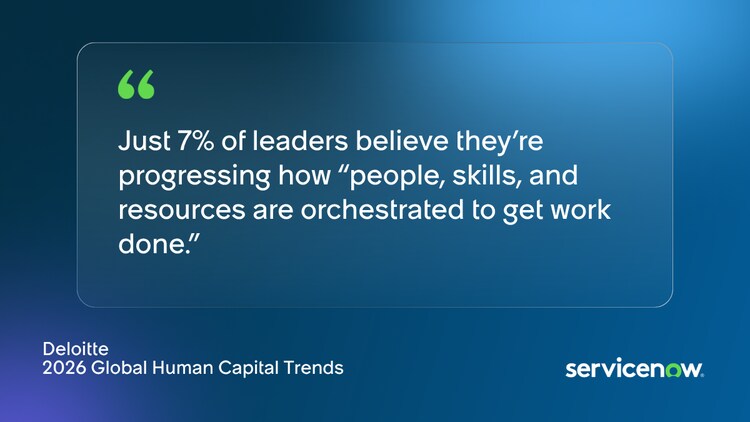
The leaders I meet say the most challenging aspect of AI transformation is reshaping the workforce, but their anxiety isn’t translating to action. According to Deloitte, just 7% of leaders believe they’re progressing how “people, skills, and resources are orchestrated to get work done.”
That disconnect is trapping immense value. According to an IDC Analyst Brief, “By 2026, more than 90% of global organisations will grapple with skills shortages, costing up to $5.5 trillion in product delays, quality problems, impaired competitiveness, and lost revenue.1 To deliver with AI, we need to support people.
Human skills are critical
Technology alone won’t unleash the human renaissance. Organisations must invest in human skills, because done right, AI doesn't shrink the human role. It expands it.
The proof is in the data. Global demand for mentorship, collaboration, and team management is accelerating, according to the latest ServiceNow Workforce Skills Forecast. Organisations urgently need employees with the skills to connect with people, nurture talent, and manage evolving roles.
Skilled workers are offloading process-driven, manual tasks to machines. When used properly, AI doesn’t dehumanise work; it makes it more human, by handing time back to people to focus on creativity and empathy.
Take the IT service desk, for instance. AI agents like those on the ServiceNow AI Platform can help triage and resolve routine requests, giving workers the bandwidth to stop firefighting and start strategising. They can meet colleagues to discuss their IT needs, run AI training sessions, and develop infrastructure to support a hybrid workforce of people and AI agents.
My question for leaders is this: Are you developing human skills as fast as you need to? The skills gap will close only when we stop treating personal development as an afterthought to tech investment.
Staying sharp in the age of AI
One thing I'm hearing from our people, especially early-career talent, is concern that over-reliance on AI could prevent them from developing skills such as critical thinking, creativity, focus, and judgment. They're worried they'll miss the chance to flex those cognitive muscles early on, when the foundation matters most.
This concern isn’t theoretical. According to BetterUp, we’re already seeing a £1.7 trillion ($2.2 trillion) global productivity deficit tied to a decline in cognitive flexibility. That's exactly why we're building mind gyms into ServiceNow University: structured spaces where people practice decision-making, problem-solving, and judgment in safe environments.
We're not letting AI weaken our cognitive muscles; we're deliberately strengthening them. At ServiceNow, we use L&D to equip employees with the cognitive fitness to solve complex, structural challenges. We instil courage to have difficult but necessary conversations about AI security and governance. And we prioritise relationships with humans over technology.
This helps our people reframe AI from “threat to my job security” to “springboard for my career.” We take the experiential learning approach to build skills across the organisation: evaluate, educate, experiment, and experience.
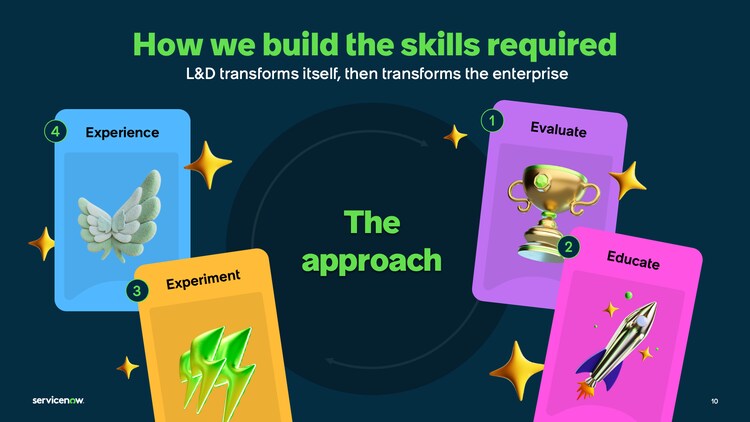
ServiceNow University maps each person’s skills to understand what they need to learn next. Every individual gets a talent signature, a unique fingerprint that updates as they grow. AI recommends personalised learning paths around the precise technical, functional, and human skills their role demands—no generic training and no wasted time.
Colleagues can test new AI capabilities in simulated environments with AI coaches, where failure costs nothing. Then they reinforce what they’ve learned through job placements. That’s where it stops being a course and starts being a career.
4 conditions for unlocking human potential
Your organisational culture determines whether L&D succeeds or fails. Business expert W. Edwards Deming famously said, “A bad system will beat a good person every time.”
Leaders must create the conditions that encourage employees to build their skills, or they’ll waste their potential—and the L&D investment. Here are four conditions for driving high motivation and performance.
1. Clear direction
How clearly could each employee within your organisation tell you the direction it’s moving? Leaders must guide their people through change and ensure everyone knows what they’re working towards.
This includes mapping future roles, updating performance metrics, and helping individuals identify which new skills they need to succeed.
2. High-quality experiences
The individual makes the whole. It’s vital to understand what your employees need so you can make informed decisions that improve their experiences and motivate learning.
3. Work that flows
Your people want to get work done. That’s what they were hired for. But if the system doesn’t work for them, that goal becomes impossible.
Processes need to flow. Start by eliminating friction from work cycles and approval chains. Make tools available and innovation possible. You’ll quickly see how people can thrive when they’re given the necessary resources.
4. Psychological safety
People are often scared of getting the “new thing” wrong—especially AI agents, which make headlines when they go rogue. Employees need a safe environment to try, fail fast, and try again, without repercussions. That’s what builds trust. And trust empowers people to stop resisting change and start defining it.
Balancing tech and talent
AI agents are the future of work because they free your people to focus on what makes them human. The AI advantage is the human advantage. The leaders who miss this are trading long-term capability for short-term efficiency.
Keep exploring AI use cases that work best for your industry. Continue improving your digital estate to speed up operations. Successful organisations build a strong technological foundation; leading organisations build exceptional people. Can you say yours does both?
Find out how ServiceNow can help you unlock human potential.
1 Source: IDC Analyst Brief, sponsored by Workera, Closing the Gap: Verifying AI Skills in the Enterprise (Doc #US53203225, February 2025)