3 AI journeys to inspire your deployment

Most of the organisations I see struggling with AI have invested heavily in it. After many conversations with leaders across the Europe, Middle East, and Africa region, several patterns emerged.
One matters more than the rest, and it has nothing to do with industry, size, or budget: The leaders who are winning with AI did not prioritise AI first. They prioritised what AI needs in order to perform, building those conditions deliberately so that when they deployed AI, it delivered.
I spoke to three leaders recently to find out how they did it.
1. Streamlining 1.7 million annual IT requests
Siemens AG, the global technology and engineering group, set out to streamline and improve IT support across the organisation. Working with ServiceNow over more than two years, Siemens focused on cleaning and standardising its data foundation to enable more consistent, scalable support.
A new, enhanced data structure has enabled Siemens to scale agentic AI across the IT function, powering AI driven efficiency. This is the backbone of a one-stop shop for user support called MyIT.
The transformation has enabled consistent, high-quality support across the business and freed Siemens’ IT agents to focus on more complex tasks.
Jayant Deulgaonkar, General Manager at Siemens IT, explained how the organisation uses AI to reduce incidents: “Our approach is first, avoid any incident in the first place. It’s predictive. If that doesn’t work, we go prescriptive, meaning an agent can resolve it autonomously.”
That layered architecture—predicting issues before they arise, resolving them autonomously where possible, and escalating to a human agent only when genuinely needed—depends entirely on the quality of the data underneath it.
Siemens’ next goal is to enable workforce with AI possibilities. The team plans to use automation to give even more of the workforce time back to focus on growth. When employees are no longer carrying the burden of constant demand, they regain the headspace needed to innovate.
2. Enabling access to high-value services
SLB, the world’s largest oilfield services company, uses AI to deliver scientific expertise to enterprises in more than 80 countries. Its high-end customer support is facilitated by the ServiceNow AI Platform.
Previously, SLB’s time-poor customers were getting stuck in a support loop, talking to IT rather than the specialists who could solve their problems. “A geologist with a geology problem wants to speak to other geologists,” explains Mark Gerrard Douglas, vice president of digital services at SLB.
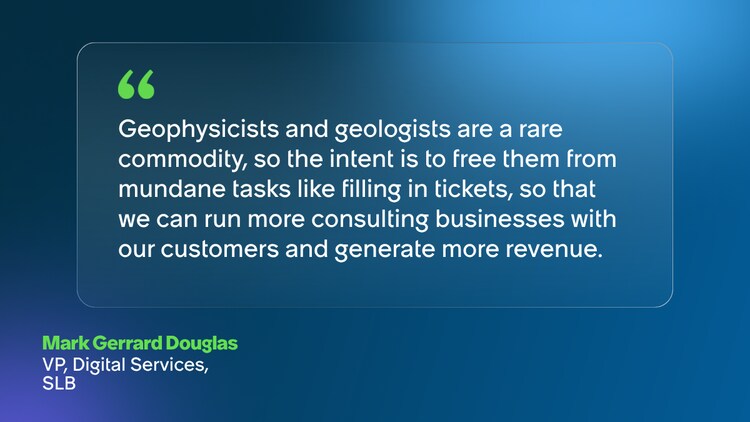
Revising this workflow unlocked massive value. “Geophysicists and geologists are a rare commodity, so the intent is to free them from mundane tasks like filling in tickets,” Douglas says. By accelerating its experts, SLB can “run more consulting businesses with [its] customers and generate more revenue.”
SLB adopted an approach to customer-facing support that Douglas calls Carry Context. Instead of 7,000 tickets going into a generic pool, AI routes each one directly to a relevant SLB geologist or geophysicist. This eliminates the need for customers to provide a password, originating region, and type of need each time they get in contact.
The strategy has delivered a substantial uplift in customer satisfaction, strengthening SLB’s customer relationships and business impact. It also unlocked valuable consulting capacity already embedded within the business, enabling greater impact.
Most organisations have more capacity than their workflows allow them to use. The SLB story shows what can happen when AI is used to surface that capacity rather than add another layer on top of it.
3. Empowering a multi-country workforce
Unlocking human capacity is just as vital on a busy shop floor as it is in a specialised engineering environment. Rossmann, one of Europe’s largest drugstore chains, sees its physical stores as its biggest growth opportunity.
Before the transformation, every time something went wrong in store, a manager had to step away from the floor, call headquarters, sit on hold, and work the issue through over the phone. A single case averaged nine minutes of human labour across departments. Keeping 5,200 stores working required a single platform that could connect them all.
Rossmann used the ServiceNow AI Platform to deploy agentic AI for incident classification, prioritisation, and resolution. “The AI agent independently analyses, prioritises, and implements the measures to close the ticket,” says Christian Metzner, managing director of HR and IT at Rossmann. “What could once take up to nine minutes of back-and-forth now takes less than five seconds. It’s effectively instantaneous.”
Rossmann is also creating an AI model that defines the next-best action for employees based on sensors and real-time sales data. “This could be accepting a truck coming in with goods or cleaning up flour dropped in an aisle,” explained Metzner. “It’s a huge lever for us because retail operations are such a big cost element.”
Frontline bottlenecks are a constant pain point for the retail and operations leaders I meet. Rossmann demonstrates how connecting real-time data with autonomous workflows can transform employee experience for 60,000 in-store colleagues.
The argument these three make together
A global engineering company, an oilfield services firm, and a European drugstore chain—three entirely different industries and markets—arrived at the same insight. None of them led with AI. Each led with an outcome in mind: stronger customer experience and a more capable workforce.
That’s only possible with a unified platform, clean data, redesigned workflows, and connected operations.
Find out how ServiceNow can help you put AI to work for people.