4 AI foundations for UK organisations

The UK doesn’t lack AI budget or ambition. What it lacks is the operating system to put AI to work, according to the ServiceNow Enterprise AI Maturity Index 2026.
The research rates the UK’s overall AI maturity score at 51 out of 100, matching the average across Europe, the Middle East, and Africa (EMEA). AI spending in the UK has jumped 102% year on year, and 63% of organisations are using agentic AI, outpacing the global benchmark of 59%.
However, adoption doesn’t reflect execution. Just 6% of UK organisations are building autonomous, multi-step workflows—where AI agents independently complete complex tasks end to end—compared to 9% across EMEA and global markets.
Leaders need to build the infrastructure to unlock meaningful AI value. Here are four AI foundations to turn ambition into action.
1. Clean, high-quality data
AI is only as effective as the data behind it. For most leaders, data quality is a roadblock to AI value.
The majority (73%) of UK executives we surveyed cited inadequate data accuracy, access, and management as a problem. When data is scattered across disconnected business units and systems, AI lacks the context to deliver accurate, trustworthy outputs.
Without high-quality, centralised data, AI may give partial answers, struggle with complex reasoning, and fail to execute workflows. The cost of inaction is steep. Gartner® predicts that “through 2026, organisations will abandon 60% of AI projects unsupported by AI-ready data.”1
The most AI-advanced enterprises in our study, which we call Pacesetters, understand the risk. Globally, 64% of this leading group use digital systems to connect and enhance their data, compared to 14% of others.
UK organisations must start treating data modernisation as a prerequisite for AI implementation. Leaders can get ahead by:
- Setting clear policies around data ownership
- Breaking down data silos
- Using tech to enhance how data is migrated, created, and managed
A high-quality data layer can help give AI accurate data in the correct context at the moment of action.
2. An integrated AI platform
Bolting AI onto legacy infrastructure can leave enterprises with a scattered collection of digital assistants. According to our research, only 17% of UK organisations have updated their legacy tech with a unified platform to orchestrate AI.
Without an integrated platform, AI often lacks the complete, real-time context needed to act reliably. Use cases are disparate and hard to scale.
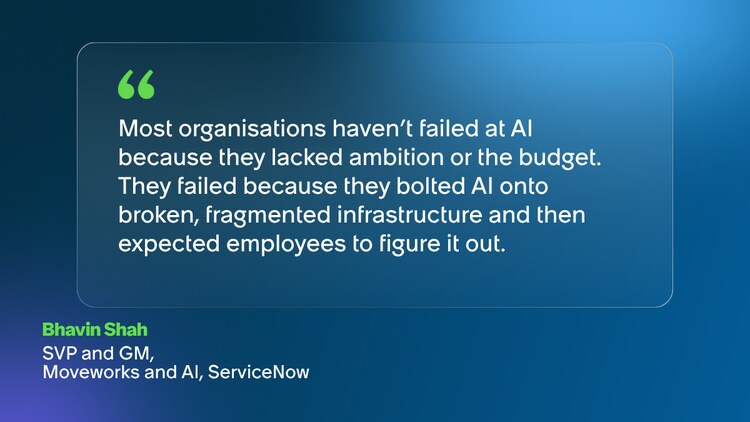
Bhavin Shah, senior vice president and general manager of Moveworks and AI at ServiceNow, explains: “Most organisations haven’t failed at AI because they lacked ambition or the budget. They failed because they bolted AI onto broken, fragmented infrastructure and then expected employees to figure it out.”
With access to the right context, AI agents can reliably communicate and orchestrate cross-functional workflows. Unlocking end-to-end performance requires a single platform to unify data, AI, workflows, and security.
3. Strong governance standards
AI speed without control is a risk waiting to surface. One in five UK organisations has implemented AI testing, auditing, and risk assessment into its processes. Enterprises must establish clear guardrails to mitigate the AI chaos brewing beneath implementation.
Strong governance can help UK enterprises move from risky AI point solutions to autonomous execution. Most global Pacesetters (69%) embed trust and transparency into AI operations, compared to 16% of others. These market leaders have a 2.7 times greater ability to scale than other organisations and are 2.6 times better at reducing risk.
Organisations can establish better governance standards by setting up a dedicated AI governance team with defined roles, policies, and oversight procedures. Consider introducing formal audit practices and creating frameworks for responsible AI implementation across the enterprise.
4. An AI-ready workforce
A lack of workforce planning can fuel concerns over job security if employees lack visibility on how their role may be affected. According to Randstad, more than a quarter (27%) of UK workers believe their jobs could disappear within five years due to automation.
Compounding the problem, our data suggests that AI is progressing faster than workforce readiness. More than half (54%) of UK organisations are missing long-term workforce plans to foster human and AI collaboration.
Leaders in the UK have an opportunity to better prepare people for AI adoption. One way to reassure employees is to separate the tasks where human judgement is irreplaceable from tasks where AI agents can safely execute.
Another way is to help employees develop skills to use AI effectively. In EMEA, 52% of Pacesetters provide tailored AI training, compared to 4% of non-Pacesetters. Organisations that invest in developing human oversight alongside AI skills can build a workforce that embraces AI to augment work.
Shifting employee mindsets can even support performance. Gartner estimates that “employees with a positive outlook toward AI are 3.4 times more likely to be highly productive.”2
Shifting from AI ambition to execution
The UK has the capital, talent, and appetite for AI. What it needs is the architecture. Resolving the execution paradox—high investment paired with low workflow automation—requires leaders to start by connecting their data, AI, and workflows on a single platform so that people can put AI to work.
Find out how ServiceNow can help you unify data, AI, workflows, and security.
1 Q&A with Roxane Edjlali, Lack of AI-Ready Data Puts AI Projects at Risk, 26 February 2025
2 Gartner Press Release, Gartner Predicts by 2027, 50% of Enterprises Without a People-Centric AI Strategy Will Lose Their Top AI Talent, 13 May 2026
GARTNER is a trademark of Gartner, Inc. and/or its affiliates.