4 key takeaways for AI from World Forum Amsterdam
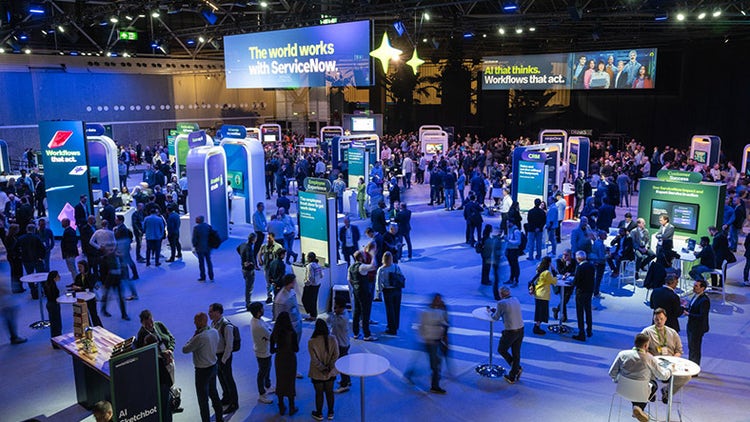
“We need AI that thinks and workflows that act,” announced Jayney Howson, chief learning officer at ServiceNow, at World Forum in Amsterdam. That statement encapsulates a key challenge: Organisations need to effectively translate the capabilities of AI into tangible value.
To achieve this, AI solutions must go beyond merely making suggestions. They need to be given context on how an organisation functions and authority to independently execute appropriate actions within clearly defined parameters.
In practice, this is no simple task. Only 16% of the organisations worldwide have replaced their legacy systems with platform systems, according to the ServiceNow Enterprise AI Maturity Index 2026. The difference between these front-runners and organisations that have yet to see a sufficient return on their AI investments largely stems from how AI is implemented, integrated into business processes, and scaled.
Four insights from World Forum in Amsterdam can help organisations move from experimenting with AI to deploying AI that actually gets work done.
1. Security and governance are prerequisites
Security was one of the key themes during World Forum Amsterdam. As AI is expanded across a business, so is an organisation’s digital attack surface. With the emergence of AI agents—which perform tasks and access systems with greater autonomy—the need for robust security has become more critical. Organisations therefore require security measures capable of responding at machine speed.
This begins with visibility:
- Which AI applications are being used within an organisation?
- Which AI agents are active?
- What data and systems can they access?
After all, as Marielle Lindgren, group vice president for Europe, the Middle East, and Africa (EMEA) North at ServiceNow, stated, “You can’t manage what you can’t see.”
Governance is essential for establishing clear boundaries and responsibilities. Through well-defined frameworks and guardrails, organisations can determine which actions AI agents are permitted to carry out independently and when human intervention is required. In this sense, governance doesn’t act as a brake on innovation; it serves as a prerequisite for deploying AI securely, confidently, and at scale.
2. AI requires context to be truly valuable
High-quality data is essential for successful AI, but access to data alone is not enough. To deliver genuine value, AI should also be taught how an organisation functions. Connecting various data sources and making them accessible is an important first step.
Beyond this, an AI agent needs the context of business processes, roles, responsibilities, and existing agreements. Only then can AI go beyond merely making suggestions and instead act autonomously with the right grounding in business reality.
During his keynote, Gaurav Rewari, executive vice president and general manager of data and analytics products at ServiceNow, emphasised that there’s a significant distinction between seeing and understanding.
An AI model with access to information alone may lack the context necessary to make its decisions independently. By combining data, business knowledge, and insight in workflows, it becomes possible to deploy AI agents that do far more than simply answer questions or summarise information.
3. Deploy AI where it solves the biggest problems
Organisations shouldn't be asking “Where can we apply AI?” Instead, they should be asking:
- What problems do we want to solve with AI?
- Where do processes get stuck?
- Which recurring tasks consume a significant amount of employees' time?
- Where can AI and automation truly make a difference?
By starting with concrete use cases, organisations can deploy AI in areas where its added value is immediately apparent. ServiceNow® AI Workflow Factory can help teams find those starting points. It shows where a process falls short and what’s causing it so they can implement the fix most likely to move a key metric first.
This helps not only to generate a better return on AI investments, but also to build support among employees. When they see that AI reduces repetitive work and creates space for more valuable activities, employees see the technology as a helpful tool rather than a threat.
AI drives change across many dimensions: job roles, responsibilities, daily tasks, and required skills. Therefore, organisations must involve employees in the introduction of new technology and help them learn how to work alongside it.
4. Start small and scale responsibly
How do you translate these insights into a concrete approach? During his keynote, Rewari offered practical advice: Select one workflow, establish clear guardrails, and then prove the added value before scaling further.
By beginning with a single, well-defined workflow, organisations can test the impact of AI in a manageable way. They gain insight into what works and where adjustments are needed. Based on the results, they can gradually expand to other processes. AI Workflow Factory can carry that same loop from one workflow to the next.
A key component of this is Shift Zero, a security paradigm that shifts the focus from solving problems after they arise to helping prevent them by addressing issues before they can impact the organisation. By integrating security into daily work processes, organisations can identify and address risks before it escalates.
World Forum Amsterdam taught us that successful AI implementation requires more than just the right technology. Organisations must establish secure frameworks, provide AI with appropriate business context, and start by addressing specific, concrete challenges. Scaling up in a controlled manner helps lay the foundation for AI agents that can do more than just think; they can also take action.
Find out how ServiceNow can help you transform AI capabilities into tangible value.