4 lessons on AI in the public sector
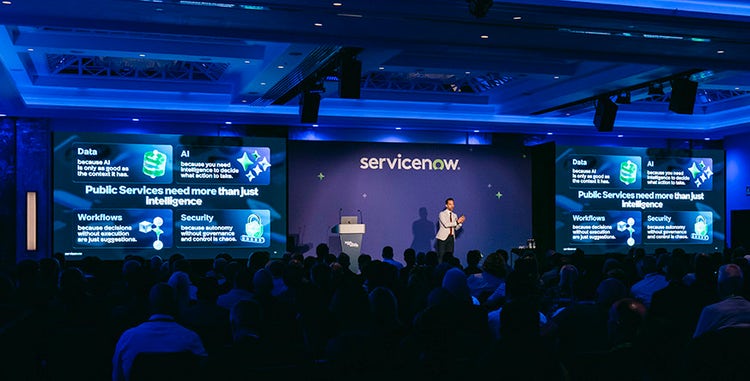
Building a foundation for AI in the public sector can help civil servants deliver better services. But for leaders in government, the NHS, and education, the key ingredients for success are often missing: unified data, an AI-first culture, and strong governance.
Public sector leaders also face more regulations and complexity in delivery than their peers in the private sector. To find a way forward, public sector leaders gathered at the recent ServiceNow Public Services Summit in London. Here are four lessons speakers shared about deploying AI.
1. The foundation needs fixing
Public sector organisations are battling technical debt accrued by heavy customisation and a reliance on legacy infrastructure. According to the UK Government, 28% of digital systems in central government are outdated. In some police forces, that figure is up to 70%.
Disparate systems and data can make it challenging to innovate with AI because models lack the context needed to make accurate decisions. At the same time, leaders tell me they face pressure to add to the AI stack with every new and improved large language model (LLM) released.
It can be tempting to bolt a generative AI chatbot onto the front end of a 20-year-old database. But doing that won't fix a broken foundation; it will expose it. Layering shallow intelligence over flawed systems only scales inefficiency.
"We had to get rid of legacy systems and sort our data flows out," explained Simon Brown, Acting CEO at the Met Office. "The market is changing, and the Met Office needs to keep up."
Implementing AI in public services requires a fundamental transformation. As Max Duval, vice president of solution consulting at ServiceNow, put it: "We need to eliminate the patchwork of fragmented systems and unify AI, data, and workflows on a single platform."
2. Siloed teams are a roadblock
The UK Government allocated £26 billion to digital and data projects in 2023, but less than 20% of this—roughly £5 billion—was spent on permanent employees. Meanwhile, £14.5 billion was funnelled towards contractors, service providers, and IT consultants.
External expertise is valuable, but it doesn't build long-term institutional capability. PJ Hemmaway, chief information officer at the University of Manchester, argued that teams need greater cross-pollination to deliver value from within the public sector.
"IT is no longer just a technical team fixing the network," noted Hemmaway. "We've been invited into other areas to increase productivity."
Everyone needs to embrace digital tools, not just technical teams. "You have to really understand both customers and technology," said Hemmaway. When employees can align operational needs with the best-fit tech, they can create better solutions.
The Met Office's Brown agrees that you must "get business teams together" to build effective services. The Met Office addresses this by using multi-disciplinary teams—including developers, solution architects, and technologists—to design services.
External partners still provide value when they're well integrated. "You have to embed experts into operational and delivery areas so they aren't a separate entity," advised Brown. "That gives them the autonomy to be disrupters, to innovate, and to challenge the organisation's thinking."
3. Governance unlocks innovation
AI models are probabilistic, which means they guess the next best action based on patterns. But guesswork isn't good enough for public services. There's too much risk for things to go wrong if AI takes an incorrect action.
Public sector transformation requires the probabilistic output of agentic AI combined with the deterministic control of workflows. Duval explained this as "the difference between an LLM that summarises a security incident and an autonomous AI agent that assesses its severity and puts the guard back up."
Connecting models to digital assets, from benefits systems to NHS records, helps deliver autonomous workflows. "Integration enables AI to understand the reality of your organisation," Duval added. "When AI is grounded in your knowledge, rules, and permissions, every decision made is the one you intended."
Some public servants have concerns about giving AI access to critical systems. To ease that anxiety, every single AI agent must be accountable, and every decision they make must be explainable.
End-to-end AI governance is now possible with tools such as ServiceNow® AI Control Tower. It's the enterprise control and governance plane for AI, helping organisations discover, secure, observe, and measure AI. It enables leaders to govern any AI system across any cloud.
Good governance gives public servants the confidence to scale AI use cases. It should accelerate AI transformation in the public sector rather than act as a brake. As Brown put it, "We have a tendency to over-govern things because of the risk. Governance has to be built in to enable innovation."
4. It's best to build with the future in mind
Consumer experiences have raised the bar for public sector interactions. "When you have a great customer experience anywhere, that becomes the expectation everywhere," observed Duval.
Government organisations must deliver seamless experiences to a new generation of service users. These citizens have little tolerance for friction, which requires designing systems for the future rather than using templates from the past.
"We're making sure we've got platforms ready for 2030, not 10 to 15 years ago," said Hemmaway. While it can be challenging to plan for technology that doesn't exist yet, it's important to continually invest in new capabilities.
Hemmaway applies this ethos to his work at the University of Manchester. "We were one of the first universities to have AI security leads and agentic engineers," he added. "It's allowed us to future-proof for where we're going next and challenge ourselves by working with partners like ServiceNow."
Take the plunge on AI in the public sector
Public services in the UK are working towards a future without friction. Citizens don't want to notify government departments when there's an error in their tax bill. They want systems that resolve the problem before they notice it.
This is the promise of an autonomous, human government. AI agents can handle the mundane tasks and coordinate complex, cross-functional workflows to free public servants to focus on human interactions.
Brown's closing advice was a call to action for every public sector leader to take the plunge on AI: "There's always a reason to stop, whether you're too busy or there's a new crisis on," he said. "The worst leader is one who just won't start."
Find out how ServiceNow can help you put AI to work for the public sector.