How is the UK workforce evolving?

Hybrid work and squiggly careers have become the norm for workforces in recent years. But what’s shaping the talent landscape in the second half of the decade?
The latest Workforce Skills Forecast by ServiceNow and Pearson reveals that by 2030, more than 1.63 million roles in the UK will be impacted by agentic AI. The rise of agentic AI is being fuelled by several technologies transforming work:
- Virtual agents: sophisticated tools capable of high-level, context-aware conversations with users
- Simple chatbots: systems designed for basic conversations and the automation of repetitive tasks
- Robotic process automation (RPA): technology that handles entire sequences of tasks to streamline employee workflows
As these technologies become embedded in the fabric of work, roles will be augmented, redefined, and redeployed. Although agentic AI is expected to reduce the number of roles in the UK, this decline is projected to be offset by economic growth and the creation of new digital transformation roles. Overall, the UK workforce is forecast to expand, sustaining demand for human talent.
Let’s take a look at how the UK workforce is changing and what it will take to build tomorrow’s skills today.
What’s driving change in the UK workforce?
We forecast the UK labour force will expand by 0.93 million workers by 2030, driven by economic growth, technological innovation, and digital transformation.
Economic development is expected to generate demand for an additional 3.39 million jobs. Some 1.33 million roles could be displaced and redeployed due to innovations in non-agentic technology. A further 0.49 million new roles will be added to the labour market to support digital transformation.
The rise of the tech worker
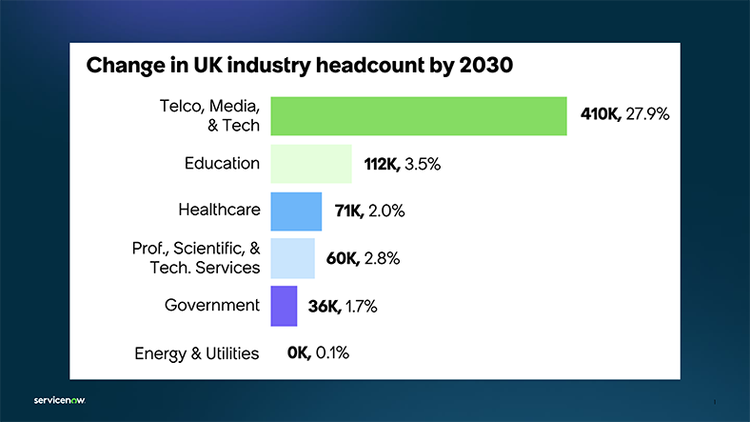
CompTIA estimated there were 2.2 million tech workers in the UK’s workforce in 2025, following a fifth consecutive year of growth. Our research suggests this number will continue to rise as additional jobs are created to implement, support, and maintain new technologies.
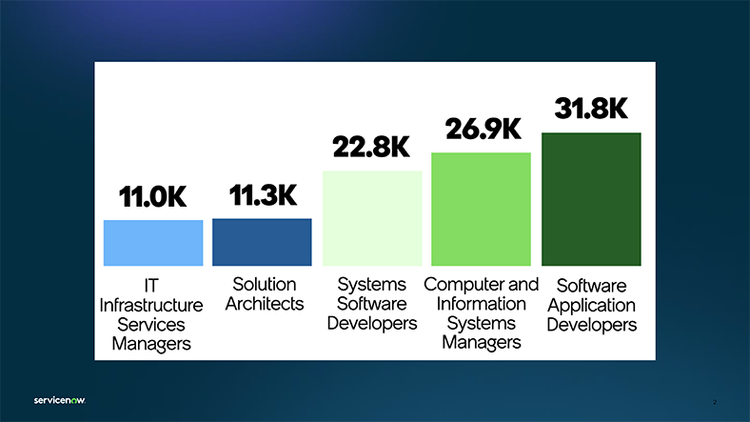
Across all industries, we predict the UK’s tech job growth rate will reach 39.5% by 2030, compared to 2.8% for the total workforce. These are the fastest-growing tech roles in the UK, based on their projected headcount expansion by 2030:
- IT infrastructure services manager (+11,000)
- Solutions architect (+11,300)
- Systems software developer (+22,800)
- Computer and information systems manager (+26,900)
- Software application developer (+31,800)
How UK businesses can win the future of work
Forward-thinking business leaders are taking action to prepare for the future. As the talent pool expands and becomes increasingly tech-focused, organisations must strategically invest in technology, governance, and reskilling for AI.
There’s an opportunity for leaders to build internal skill sets and implement tools that augment employee capabilities. This can empower people to supercharge their work and advance into new, high-impact roles—helping meet the UK’s demand for tech talent.
Our research identifies three critical areas for business leaders to focus on:
- Deploying agentic AI: Prioritise implementing agentic AI in industries and job roles with the greatest potential for transformation. In the UK, retail is expected to experience the most significant impact as AI transforms customer service and inventory management roles.
- Upskilling and reskilling: Develop learning paths that enable employees affected by agentic AI to expand their technical capabilities. This can help prepare workers to adapt to new roles while closing skills gaps in UK industries.
- Establishing good governance: Embed AI governance skills across the organisation, building a workforce fluent in data ethics, compliance frameworks, and risk management. Governance supports growth without compromising trust—and aligns UK businesses with regulatory frameworks that may affect them, such as the EU AI Act.
Gain more insights in the complete Workforce Skills Forecast report.