World Forum London: 5 takeaways on scaling AI
The business leaders I speak to have stopped asking whether to adopt AI. Instead, they’re asking, “How do we scale AI safely and reliably?”
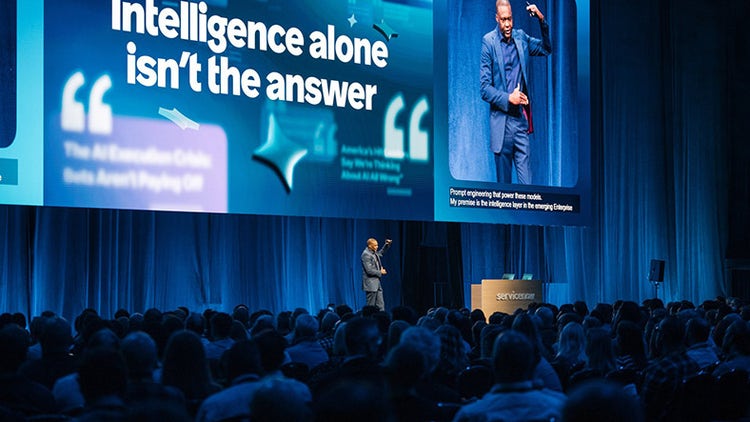
At ServiceNow World Forum in London, 5,000 people gathered to explore practical answers to that question. The standout success stories shared a clear differentiator: Organisations had united data, AI, workflows, and security on a single platform.
“AI is the biggest bet organisations are making and the most impactful platform shift of our generation,” said John Aisien, senior vice president of central product management at ServiceNow. “Businesses deserve AI that thinks, coupled with enterprise workflows that act and the ability to execute work safely.”
Here are five takeaways on scaling AI that ServiceNow leaders shared with attendees at World Forum London.
1. Strong foundations help create AI value
UK enterprises increased their AI investments as a percentage of overall revenue by 102% year over year, according to the ServiceNow Enterprise AI Maturity Index 2026 research. However, only 6% have progressed towards building autonomous, multi-step workflows.
Delivering end-to-end value from agentic workflows requires more than better prompt engineering. Organisations must build AI on a single platform to give AI agents the context required for autonomous action.
When data, AI, workflows, and security come together, organisations can realise value that wasn’t previously possible. Global technology brand Lenovo is resolving cases 35% faster with the ServiceNow AI Platform. Easy access to case histories, summaries, and recommended resolutions helps Lenovo’s IT service fulfillment team work faster.
2. Governance is the key to scaling AI
New enterprise AI use cases are emerging as models mature. “Three years ago, AI could draft you an email. Today it can open a case in a complex, highly regulated organisation and orchestrate execution across incumbent systems,” Aisien said. “There’s no slowing down.”
As autonomous agents are deployed in new areas of the business, the need for strong AI governance deepens. AI agents must perform as expected, deliver measurable value, and comply with regulations such as the EU AI Act.
ServiceNow® Super Intelligence Control Tower gives the people who govern AI one view of every AI agent, model, and tool. With ServiceNow Otto, the AI assistant for work in Super Intelligence Control Tower, AI stewards can identify which AI agents are deployed and which ones deliver the most value.
ServiceNow AI Passport helps organisations validate which tasks an AI agent can run and what data it can access, gating specific workflows as required. Multiple layers of governance empower leaders to scale agentic AI without increasing the risk of rogue execution or compliance failures.
3. Employees need a shared AI vision
AI agents are disrupting how work gets done, but without effective coordination, they can create friction rather than efficiency. To gain lasting value, leaders must unite the workforce behind a clear AI strategy.
When leaders define AI objectives, key use cases, and benefits for the enterprise’s customers, teams can deploy AI with confidence. Leaders who explain the AI vision give teams a common goal.
Combining a strong AI strategy with upskilling helps prepare employees for the agentic future. World Forum attendees heard how BT supported its AI vision by creating 1,000 apprenticeships to equip employees with practical data and AI skills.
4. AI must be secured at the source
According to ServiceNow research on the state of agentic security, nine in 10 global organisations implementing AI agents experienced an agentic security incident in the last year. Only 36% of those businesses contained the incident within 24 hours.
Organisations have a responsibility to control access to assets, secure vulnerabilities in agentic workflows, and eliminate blind spots in their AI security posture. Super Intelligence Control Tower helps employees safely deploy AI agents by applying guardrails at the moment of action and enabling them to pause, redirect, or stop an AI agent mid-task.
ServiceNow Identity and Access Security helps strengthen oversight by mapping permissions across existing systems and automatically enforcing least-privilege access. Alongside it, ServiceNow Context Engine unites asset telemetry, regulatory policies, and vulnerabilities to expose potential attack paths before adversaries exploit them.
Together, these controls power Shift Zero—where organisations embed security into operations to help prevent breaches, rather than react to them after they happen. “When visibility and control come together, and people trust AI enough to use it, that’s what gets you governance and scale,” explained Jayney Howson, chief learning officer at ServiceNow.
5. Agentic AI starts with one workflow
Deciding where to begin with AI agent implementation can challenge even seasoned leaders. According to Howson, the best strategy is to:
- Redesign one process
- Prove measurable value
- Apply the learnings to the next process redesign
Howson advises leaders to pick a single, high-impact workflow where handoffs stall, such as IT incident alerts or cross-functional HR requests. She recommends building momentum by tracking early gains.
“Identify early what signals you’re looking for—such as hours saved, tickets deflected, and how confident your people feel—and use them to target the next workflow,” Howson said. “You’ll soon have autonomous workflows running across the organisation.”
The leaders I met at World Forum have straightforward goals for enterprise AI, from closing cases faster to improving employee experience. By scaling AI on a single platform, they can achieve their ambitions.
Find out how ServiceNow can help you put AI to work for people.