Move from AI roadmap to implementation in 5 steps

As business leaders chart their roadmaps for AI implementation, many are wondering where to start. While it may feel daunting, there’s no universal formula for crafting an AI roadmap. The challenges and opportunities faced by every organisation will differ depending on where AI can create value.
Many follow the “crawl, walk, run” approach, beginning with basic automation projects to enhance one part of the business and then scaling up to more complex AI initiatives that affect multiple functions.
Examining the effects of AI on your people is one place to start—focusing on the benefits for productivity and employee experience. Revenue is another area where you may be looking to find efficiencies in the ways work gets done and improve AI return on investment (ROI).
An AI roadmap can help establish focus areas for your organisation as it moves from walking to running with AI. Let’s explore the components of building an effective AI roadmap to get your AI implementation moving.
1. Identify high-value, low-complexity use cases
Prioritise simplicity and value, and generate early momentum with AI use cases that require low effort. Examples include using AI to create case resolution notes, knowledge base articles, or email replies. Focusing on these simple-to-execute use cases can build trust for teams using AI without making them feel overwhelmed.
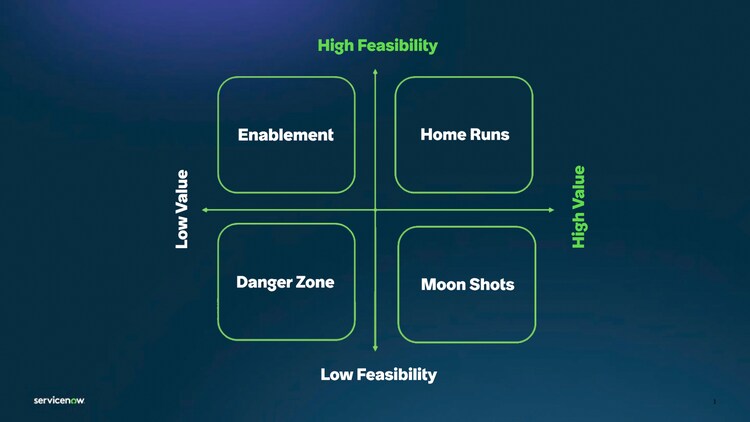
Finding jobs for AI that are high value and high feasibility—the home runs—will be the immediate focus for many. These can be treated as individual, discrete projects and reviewed quickly.
At the other end of the spectrum are low-feasibility, low-value items—which leaders should not pursue. These could include monitoring brand reputation in real time with AI or scoring employee engagement based on the tone of employees’ emails and their contributions in meetings. These are ideas that will take a significant amount of time and resources, potentially slowing the momentum of your AI implementation.
2. Evaluate data and technical foundations
AI is only as powerful as the platform and data it's built on. Evaluate data readiness and the technical foundation at the beginning of the project to determine if your data and infrastructure are prepared to support scaling AI.
That means checking data for cleanliness, accuracy, and completeness while also considering data accessibility, data relevancy, and governance. For the technical foundation, assess the infrastructure, software tools, and in-house skills to understand your capabilities.
ServiceNow can support with an AI readiness assessment to understand which departments are AI-ready, helping to inform where your organisation should focus its efforts in future rollouts.
3. Assess performance while you scale
Effective measurement of your AI implementation can help scale the use cases making an impact.
ServiceNow AI Control Tower can help you evaluate deployed capabilities—tracking adoption metrics such as usage and completion rates, as well as impact metrics, including time saved, resolution accuracy, and deflection rate.
Additionally, speaking to users and teams about their experiences can help you understand AI usability and trust. Remember to document what works and what doesn't, as this can fuel learnings for other areas of the implementation.
4. Enable your workforce to drive change
AI roadmap implementation success requires championing change and inspiring innovation with your people. Upskilling employees with AI capabilities alongside an understanding of its limitations can also help.
It’s important to use language and metrics your stakeholders understand. Use cases should align with their strategic priorities and demonstrate how you’ll measure success.
Focus on the core problem AI will help solve and quantify the ROI. At this stage, communicate the why behind AI initiatives and show distinct escalation paths for any AI-related issues.
Taking it a step further, appointing AI champions—passionate early adopters serving as go-to resources for their peers—creates a focal point for best practices. These “super users” can help others overcome problems and find new ways to use AI in their day to day while also acting as a bridge between users and technical teams.
5. Optimise your AI roadmap continuously
Transformation is a journey, not a destination. Building in learning loops—such as encouraging people to reflect on the new skills they’re developing—gives everyone a stake in AI while embedding a culture of continuous improvement.
To uncover further opportunities, Process Mining can give all employees the licence to suggest areas or workflows AI can enhance.
On the road to success
By setting out a clear AI roadmap, it’s possible to prioritise the use cases that are most feasible and can deliver the biggest impact to your organisation—so you can start running with AI.
Strong governance is critical to ensuring AI initiatives are carefully controlled and overseen as they scale. ServiceNow AI Control Tower provides a holistic view of the organisation’s AI deployments, with in-depth compliance insights and end-to-end workflows to manage AI systems.
By implementing governance protocols before scaling AI programmes, your business can safely take AI initiatives from walking to running.
Find out more in our webinar “Getting Started with AI: From Vision to Value.” And see how much value you could unlock with the AI Agents Economic Value Calculator.