michaelmalc

ServiceNow Employee
Options
- Subscribe to RSS Feed
- Mark as New
- Mark as Read
- Bookmark
- Subscribe
- Printer Friendly Page
- Report Inappropriate Content
01-20-2016
10:59 AM
Welcome to the part four of five in our series on Geneva's enhanced Change Management application.
Part 2 - Geneva: Take Control Of Your Low Risk Changes With the Standard Change Catalog
Part 3 - Geneva: Seamlessly Avoid Change Conflicts
This installment was originally going to be called "Three Small Changes with a Big Impact to Change Management" but after reviewing the new enhancements they're maybe not that small at all. The three changes we are going to review in this article are:
- Copy change
- The On hold state
- Form Changes
In the final part of this series we will review the new state model and the implications behind it.
Copy a Change
The new copy change capability allows you to quickly take an existing change and use it as the basis for a new change. You will find the button in the nav bar in Normal and Emergency Changes (regardless of the Change's state). Standard Changes does not offer the "Copy Change" function because once you have published a standard change it's basically making a copy every time.
Once you hit the "Copy Change" button a new change will be created that carries over the basics of the change. The Change isn't actually created until the user hits "Save" or "Update" on the copied change.
There are other caveats that you can read about in the documentation here:
https://docs.servicenow.com/product/change_management/concept/c_CopyAChange.html
Users with the "Admin" role can control via properties whether or not the "Copy Change" function appears, as well as what fields it will copy over, and whether or not attachments should also be included:
On-Hold
There are times when a Change needs to be put on-hold: it could be that there's an external dependency that needs to be resolved or additional information that was supposed to provided prior to the CAB meeting isn't available. With Geneva, you can now put a Change on hold if it's not in a "New", "Canceled", or "Closed" state. Once you put a Change on hold, you just need to provide a hold reason, and then Changes activities will be suspended: approvals (if out there) will be marked as "No Longer Required".
Once you're in the "On Hold" state you can either cancel it or take it out of the "On hold" proceed with the Change. If there were approvals associated to the Change that still need to happen they will be reinstated.
Form Changes
We have talked about a number of the enhancements to Change Management application in the series: Standard Changes, Conflict Detection, and the "On hold" state. All of these changes, including what we will be covering next week with the state model, resulted in a number of changes and enhancements to the form itself.
Here's the Change form circa Fuji:
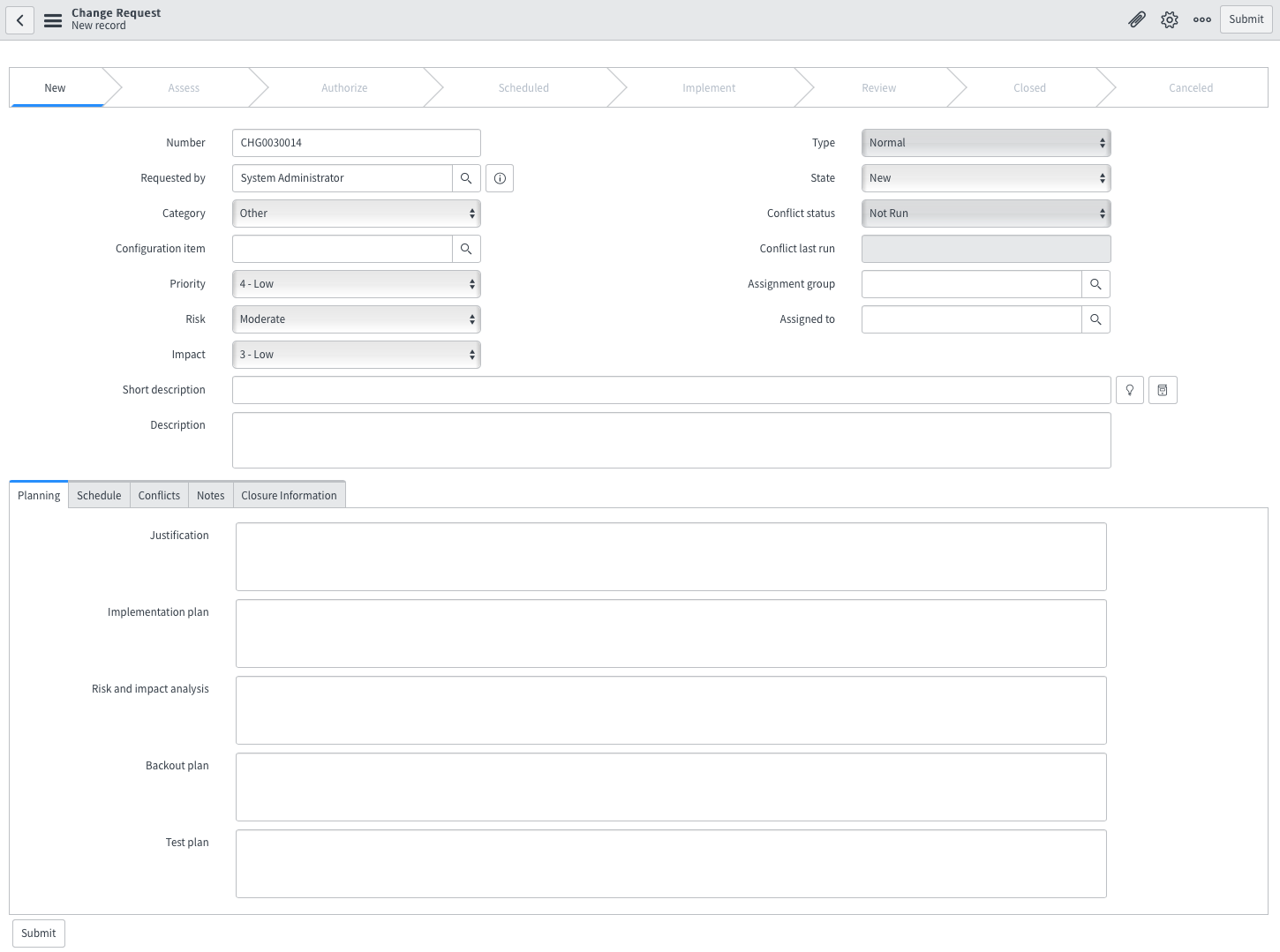
And here's the Change Form in Geneva:
There's the obvious because of the process formatter across the top — we will talk more about the states and what they mean next week because they are tied to the state the model. The other changes are revisiting of the fields and their order; making sure that each field was there for as specific reason. We also took some of the existing tabs and grouped them according to the appropriate activity and purpose: i.e. Planning information in one tab, the Scheduling information in another, etc.
All of these tweaks result in a much more functional and usable Change Management process and form right from the start.
1 Comment
You must be a registered user to add a comment. If you've already registered, sign in. Otherwise, register and sign in.