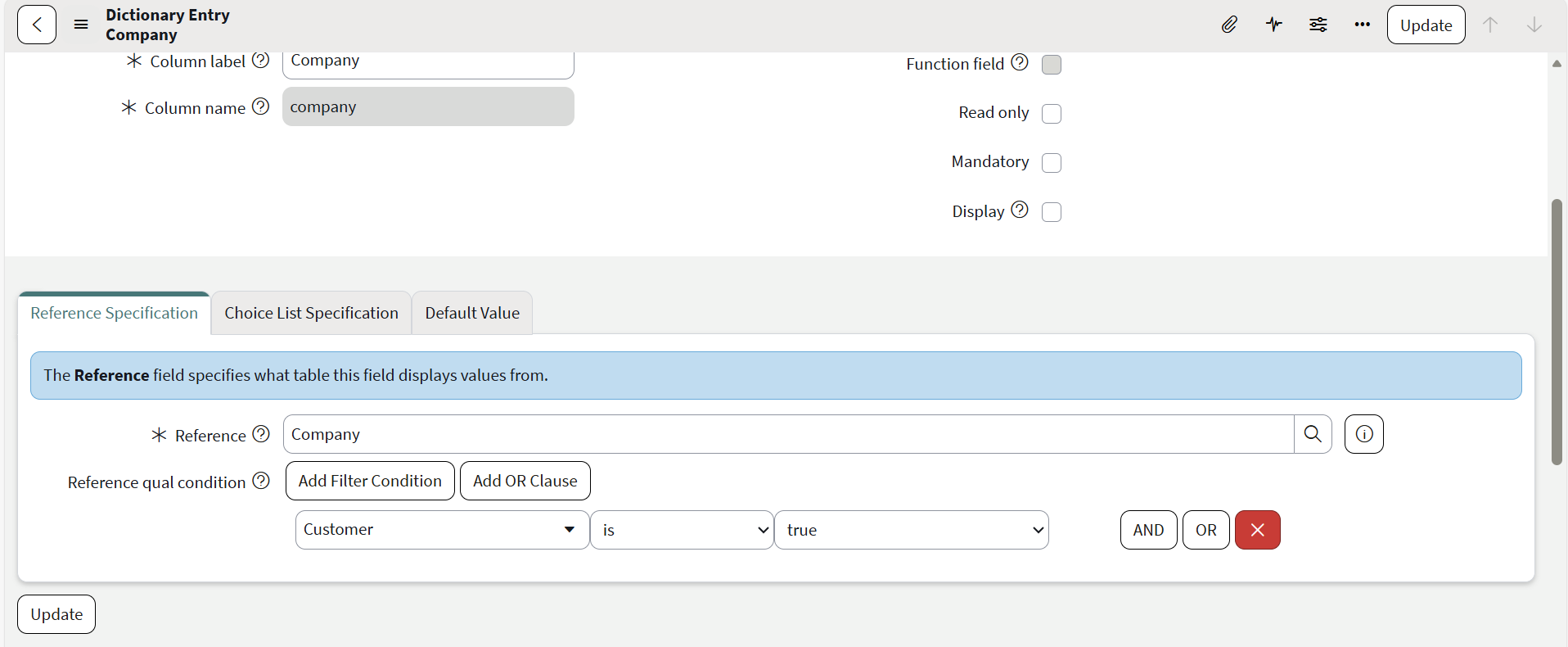
Why does the Company field on Problem ticket use a reference qualifier "customer=true"?

- Mark as New
- Bookmark
- Subscribe
- Mute
- Subscribe to RSS Feed
- Permalink
- Report Inappropriate Content
04-06-2026 09:19 PM
Hi Community,
I've been looking into the Company field on the Problem form and noticed something I'd like to understand better.
The Company field is a reference field pointing to the core_company table, and it has a reference qualifier preset with the condition customer=true. This means the dropdown only shows companies where the "Customer" flag is checked to true.
What is the reasoning behind filtering the Company field to only show companies where customer=true? Is this an OOTB (out-of-the-box) design decision by ServiceNow, and if so, what's the intended use case?

- Mark as New
- Bookmark
- Subscribe
- Mute
- Subscribe to RSS Feed
- Permalink
- Report Inappropriate Content
04-06-2026 09:59 PM
The Problem table extends Task, and the company field is inherited from task. The reference qualifier customer=true on this field is intentionally set because, in ServiceNow's ITSM data model, the Company field on task-based records is meant to represent which customer or business entity is affected by or reporting the issue — not just any organization in the system.
The core_company table holds all kinds of companies: customers, vendors, partners, manufacturers, competitors, and your own organization's divisions. Without the qualifier, users would see every company record in the dropdown, which creates noise and increases the risk of misclassification. By filtering to customer=true, ServiceNow narrows it down to the companies that are actually consuming your services — the ones you'd logically associate with a problem record.
This ties directly into a few ITSM design principles. First, in multi-tenant or MSP (Managed Service Provider) scenarios, the Company field drives assignment routing, SLA selection, and reporting segmentation. Showing only customers ensures the problem gets linked to the right service consumer. Second, it aligns with ITIL's concept that Problem Management exists to find root causes for issues affecting your customers (internal or external), not your suppliers or partners. Third, it keeps the user experience clean — an IT analyst creating a problem record shouldn't have to sift through vendor records to find the affected business unit.