sarah_manning

ServiceNow Employee
Options
- Subscribe to RSS Feed
- Mark as New
- Mark as Read
- Bookmark
- Subscribe
- Printer Friendly Page
- Report Inappropriate Content
12-14-2015
09:38 PM
It's no secret: CIOs are spending more time managing cloud services and less time managing hardware. 38% of CIOs now spend at least half of their time on strategic activities, according to a recent survey from Logicalis. 2016 will undoubtedly be a monumental year for IT leaders.
Our Twitter followers recently predicted that not only will the role of CIO evolve to become more service-oriented, but CIOs will focus increasingly more on privacy, digital security and protecting the organization from security breaches in 2016.
To better flesh out what that means, we invited top IT leaders and CIO experts to a #StateOfWork CrowdChat. Moderated by Dave Wright, ServiceNow chief strategy officer, our a panel of experts included:
- Brian Lillie, CIO, Equinix
- Rob Pickering, CIO, AAA Allied
- Peter Kreztman, veteran IT executive & blog author
- Jason Wojahn, president, ServiceNow Business Unit, Cloud Sherpas
We opened the floor for a lively discussion of how IT leaders should set their agendas around the rapidly-changing IT landscape — including cloud, Internet of Things and Big Data. Here's what we found:
The CIO needs a new job description
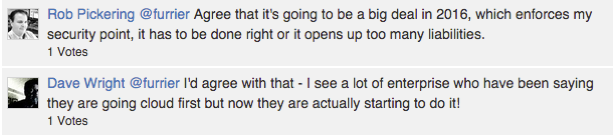
Participants weighed in on the CIO's role in 2016. Some argued that security is the forefront responsibility. Rob Pickering and Brian Lillie believe that protecting company information and providing secure access to cloud service providers should be the first and foremost concern.
Participant John Furrier, CEO, SiliconANGLE Network, lobbied that apps would transform IT the most as data will be orchestrated across multiple channels of engagement.
Many agreed with Furrier's point and felt it enforced other predictions.
The Internet of Everything?
Participants agreed: It's not a matter of if the IoT will connect the enterprise to your life, but when. And in many cases, it's already underway. But the issue at hand for CIOs is privacy—as data sets grow exponentially, so does the room for privacy breaches.
Brian Lillie explained that this accelerated growth would force companies to rethink IT networks entirely:
Chief Productivity Officer
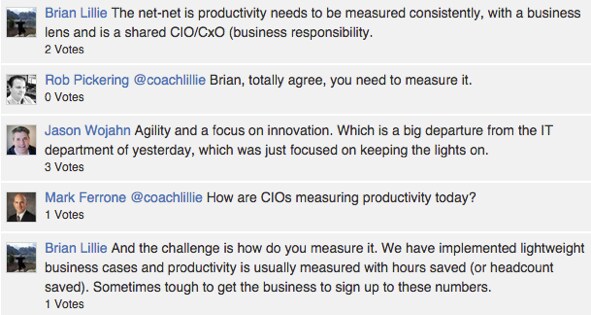
As the role of CIO expands to one that transforms office culture and workflow, what challenges can be expected? Participants agreed that measuring changes in enterprise productivity would be the biggest obstacle.
The question still remains: just how do you measure productivity? (According to the Productivity Drain study, productivity is lost when managers spend too much of their time on repetitive administrative tasks and inefficient processes.)
Introducing the Shared Services Leader
Could a new desk in the C-Suite help break down silos across departments? Maybe. Rob Pickering explained that in order to work, the role would need executive empowerment and focus on communicating the business's value.
Colleen Haikes argued that "just creating titles won't be enough. There needs to be a shift to focus on a company-wide services discipline."
Team Big Data or Small Data?
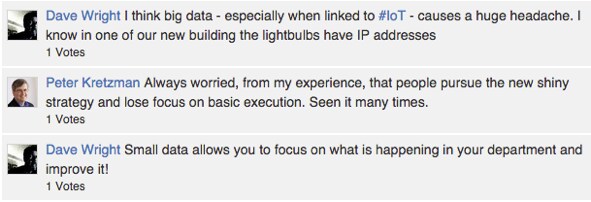
Next, the crowd discussed whether the focus on Big Data overshadowed the need for Small Data that gives insight to operations.
Dave Wright and Peter Kretzman waived their Small Data flags, contending that Small Data is the key to useful information:
Rob Pickering argued that each serves its own purpose and plays off the other:
We enjoyed the opportunity to chat with our audience on what's to come for IT leaders in 2016.
If you'd like to learn more, download the recording of our December 16 webinar with Martha Heller, CIO advisor and president of Heller Search Associates on how CIOs should set their agendas for 2016. Access the webinar recording here.
Thank you again to all of our participants for a lively chat!
You must be a registered user to add a comment. If you've already registered, sign in. Otherwise, register and sign in.