Dan Grady

ServiceNow Employee
Options
- Subscribe to RSS Feed
- Mark as New
- Mark as Read
- Bookmark
- Subscribe
- Printer Friendly Page
- Report Inappropriate Content
3 weeks ago
I have never been to Brazil. But there's one Brazilian experience I've logged enough hours in that I feel qualified to open a release blog post with: the Brazilian steakhouse.
If you've never been, here's the deal. It's called rodízio, and the whole point is that the meat doesn't stop coming. Gauchos circle the room with sword sized skewers of picanha, sausage, whatever's off the fire that minute, and carve off however much you want right onto your plate. And the entire system runs on one small, brilliant piece of cardboard sitting on your table. Green side up means keep it coming. Red side up means giving me a second (or please stop, I don’t think I can stand up at this point).
That's a surprisingly accurate description of what we are shipping for Process Intelligence in Brazil.
Half of this release is about keeping the green side up. We're opening Process Mining insights to more people than ever, so the meaty process improvement opportunities are available to whoever needs it, wherever they happen to already be working. The other half is about handing you the card. Additional governance and controls, so you decide when enough is enough for certain users or types of process data.
It’s a fun analogy but it also maps to how we think about value here: every capability below either gets us to an actionable process improvement opportunity faster or gives you the confidence to roll Process Mining out to more of the organization, closing the distance between what's actually happening in your workflows and improving them.
Let's work through the menu.
Process Intelligence MCP Server: Process intelligence wherever you already work
Process Mining has always required knowing how to interact with the Process Mining workspace. Which breakdown, which filter, which view was going to surface the thing you actually cared about. That's a skill, and most people don't roll out of bed having it, which is why Process Mining historically tends to stay in the hands of a small group of people in organization while everyone else waits for a report.
The Process Intelligence MCP Server changes that.
MCP, short for Model Context Protocol, is an open standard that lets AI assistants connect directly to a system's data and tools instead of requiring you to open a separate application. In Brazil, Process Mining opens itself up through a Process Intelligence MCP Server, which means someone can ask an assistant like Claude, ChatGPT, or whatever other MCP-compatible AI tool your team already relies on about their automation or agentic opportunities or routing inefficiencies, without ever navigating into a dedicated ServiceNow screen.
A conversational experience, that allows someone to ask a plain language question and get an answer grounded in your own process data, not a generic guess at how these things usually go. Ask “where are my agentic opportunities?” and get a ranked list. Ask “why is this process taking so long?” and get the routing inefficiency surfaced directly.
Your process intelligence doesn't have to be a destination. It can just be a capability sitting inside the AI tool your team already reaches for ten times a day.
Example of configuring the tools available via the Process Intelligence MCP Server
And it's still your data, governed the same way it already is inside ServiceNow. Whatever roles and sharing permissions decide who can see a Process Mining project today decide it here too. More doors into the room, not a new room with the lock left off.
If your organization has standardized on an AI assistant, that assistant can now answer process questions too. No new system to buy, no new login to remember.
What I’m personally excited about here is the ability for customers to now take the trusted process improvement data that Process Mining offers and present it in ways their organizations are more familiar with. For example, have a conversation in Claude about a process improvement opportunity and then ask Claude to generate a few slides or briefing document to share with their executive leadership team.
Example of the types of output someone might produce via the Process Intelligence MCP Server based on Process Mining generated data
*Note that this is targeted for the General Availability release in November and will not be in Early Availability
Playbook Enhancements: See exactly how your playbooks run
In the Australia release we introduced Playbook execution data as a data source you could mine just like any other ServiceNow workflow. In the Brazil release we’ve enhanced your ability to interact with the results of mined Playbook data.
A Playbook author can now select any variant in a side panel and instantly see how often it runs and how its duration compares to the base playbook. They can break executions down by attributes of the record that triggered it, like priority, category, or assignment group and see whether a “High” priority case really moves faster than the design intended. And instead of a single average duration per activity, which is exactly the kind of number that hides an ugly outlier, they get the full distribution across every activity and phase with (my favorite) a histogram. If you are looking for a 45 minute deep-dive on the histogram capability you can find that here.
Example of Process Mining project based on Playbook execution data
With hybrid Playbooks becoming more popular in an AI world, this visibility is becoming increasingly important. A hybrid playbook embeds AI agents inside specific steps of a deterministic process flow, so the process guarantees a predictable outcome while AI accelerates the steps within it, which is what actually builds an organization's trust in AI over time. Not familiar with hybrid Playbooks? Learn more here.
Process Intelligence AI Skills for Everyone
If you already have Otto (Now Assist) for Platform, there's good news buried in this release. Some of Process Mining's most useful AI skills used to require Otto (Now Assist) for Creator. In Brazil, they move into the Platform bucket, so they're simply included. In fact, these AI skills are available in the Platform bucket if you are on Zurich Patch 12 or Australia Patch 5.
Example of some of the Process Intelligence AI skills available in the AI skills for Platform section of the of AI Admin Hub
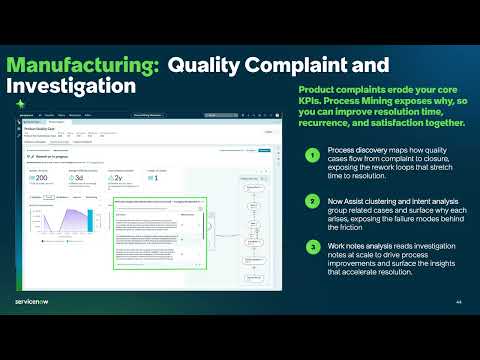
Work Notes Analysis takes the unstructured text people leave behind when they resolve a ticket and turns it into a clear read on why a transition is actually slow. Highlights condenses everything inside an Improvement Opportunity into a short summary, so you get the headline instead of having to dig through the metrics yourself. And Intent and Activity Analysis automatically groups work by the type of request it actually is, then reconstructs the steps people took to resolve each type, exactly the kind of pattern that tells you where automation or an AI agent would help most.
You can learn more about all of the AI Skills available for Process and Task Mining here.
Transition Filter Quick Starters: Get inspired
And once you're actually in the Analyst Workbench, Transition Filters get Quick Starters, so you're not staring at a blank configuration screen wondering where to begin. Instead of building a transition filter from scratch, you get a library of 18 pre-built, named patterns across State, Team, and General categories, things like Stalled Step, Reopened Work, and Automation Opportunity, that pre-fill using your own field mappings. Pick “Automation Opportunity” and instantly see records that completed a state change in five to thirty minutes, fast manual work that's a strong candidate for automation, without writing a single filter yourself.
Example new Transition Filter "Quick Starters"
Learn more about Transition Filters in this Process Mining Academy session.
Getting to first value faster
There are a number of enhancements in the Brazil release that are meant to accelerate a customer’s ability to get to their first process improvement opportunity faster.
Process Mining has always offered up content packs for different workflows like ITSM, CSM, and HR. These come with some out of the box configurations and improvement opportunities to guide and help customers get started. Using one used to mean a manual install from the ServiceNow Store, and someone with the right admin access to actually do it. In Brazil, six content packs load automatically, fully configured, the moment a mineable table gets installed via plugin activation. No install step, no admin bottleneck, no waiting on a project to get scheduled. The pre-built value that used to require setup now just shows up.
The core of the content packs themselves are the configuration records. For every process/table you want to mine it is recommended you have a process configuration record which holds some default values, unlocks advanced investigative features, and houses reusable improvement opportunities. Learn more about process configuration records here.
We provide content packs and process configuration records for our core workflows. But the ServiceNow AI Platform is so vast these days we can’t provide content for everything (and of course we don’t know how you’ve extended the platform to meet your specific needs). For these situations, there is a new “Generate configuration” AI skill. Click the button on any process configuration, and AI pre-fills the setup fields for you, presented in a review screen where you can accept, adjust, or start over. Value isn't capped anymore by which process configuration we happened to pre-build.
Example how a user can validate the values AI is populating in a Process Configuration record
Once your configuration exists, turning on deeper analysis got easier too. Clustering setup used to require an ml_admin role and a trip to the classic Predictive Intelligence interface most users have never opened. In Brazil, anyone configuring a process can turn clustering on directly, with defaults applied automatically.
Example of Clustering setup in a Process Configuration record
Some of you probably weren’t aware that Process Mining templates even exist. But if you did, and you are part of a global organization, you've probably heard this objection before. One template can never fit every region or business unit, so someone always ends up building a workaround. Now they don't have to. A new "Custom" template type lets multiple templates live on the same table, each one built for a different team or geography, backed by a dedicated template management workspace to keep them organized.
Example of the new template management screen
This enhancement will help you scale Process Mining to more parts of the organization while still letting you maintain control.
Blank screens are where some tend to give up, whether that blank screen is a process configuration, project creation guided setup or a filter dialog. Brazil closes those gaps.
Now let's talk about what we've done to help when you want to flip your Brazilian steakhouse card to red.
Meter-based Governance: Time to flip the card
The introduction of consumption-based Process Mining entitlements gave our customers flexibility to start small with Process Mining and grow as more of the organization understood the value and adopted the solution. This consumption-based model also comes with the need for governance and control.
In Brazil we’ve enhanced our meter-based governance to give admins better visibility and control over how Process Mining consumption scales as more teams adopt.
Administrators can now set a hard quota with manual override for the teams that need it, and layer on table level access policies with mandatory filters for tables you want kept under tighter control like HR and Security Incidents.
There is a new warning dialogue that gets surfaced when a project would push past a configured limit, with the option to automatically reduce scope instead of letting it run past that line.
You can now decide the pace of your own rollout, before you're in the middle of it, not after.
Enhanced Project Sharing Controls
Sharing a Process Mining project used to be all or nothing. Give someone access, and they had full access. No middle ground, which meant owners either over exposed their work or kept it locked down entirely just to stay safe.
Brazil introduces granular “Can View” and “Can Edit” permissions, extendable to specific people, groups, or roles at the same time. Editors can dig in, mine, and adjust. But no matter how many editors you add, only the original owner can ever re-share the project or delete it.
Example of the updated sharing dialogue
Evaluation Project Enhancements
We want everyone to be able to taste how delicious Process Mining can be.
Evaluation Projects, the pre-built trial projects that let anyone try Process Mining against their own data with zero setup, in their own production instance, get a real upgrade in Brazil. Incident and CSM projects are now pre-mined automatically, ready the moment you open the Process Mining Workspace, with a guided onboarding tour. There are additional Evaluation Projects for HR cases and Security Incidents. Those are not automatically mined, and they come with additional restrictions and safety controls based on the sensitivity of the data.
Example of the updated Process Mining Evaluation Project screen
If you haven't tried an Evaluation Project yet, this is a good moment to start. Real visibility into your own data, in minutes, tends to be more convincing than any deck we could put together.
Learn more about how to get started with these Evaluation Projects.
Task Mining enhancement: One recording, twice the value
Task Mining gets a genuinely nice quality of life upgrade in Brazil, and it's the kind of thing that sounds small until you've lived through the alternative.
Here's the old world. An SME sits down and records themselves performing a process for documentation purposes. Later, a developer has to re-record the exact same steps to build the automation to capture the technical detail Desktop Actions requires. Learn more about Desktop Actions.
In Brazil, one recording does both jobs. It captures the standard Task Mining steps and the enriched UI element data, at the same time, in the same session. All of the information needed to create a Desktop Action that can be executed by an AI Agent.
No more re-recording the same process twice. One pass, two outcomes. And because the whole thing started with a Process Mining analysis, the ROI case for that new agent walks in the door with it. You're not guessing whether the Desktop Action is worth building. The same data that found the bottleneck is the data that proves the payoff.
A few more things on the table
A few of other enhancements round out the release.
Launching Process Mining from a familiar list view is an easter egg type capability that can be very powerful. Most don’t even know you can create a Process Mining project directly from a list view.
Example of the "Launch Process Mining" button in the upper right of a list view
Imagine you had a score widget on a dashboard that gave you the count of cases that breached SLA, you would likely drill into that widget to get a list of those cases, then in a single click you can create a Process Mining project to mine just those breached cases to get a better understanding of why they were breaching. This capability used to only exist on legacy list views but now it is available in workspace list views as well. You also used to need a template for every table before you could use this. That requirement is gone too.
The visualizations across Summary & Insights and Opportunity Trends now let you toggle instantly between daily, weekly, and monthly views, with an expand to full size option for anything you want to look at more closely.
Example of the additional control you have over the visualizations in the Summary and Insights tab of a Process Mining project
At the end of a real rodízio, you don't tally up every skewer that came by your table. You just know you're full, and that the whole thing worked because the flow never stopped, and you always have control of your own pace (I can say I’ve lost control a few times).
That's Brazil for Process Intelligence too. More of the meaty improvement opportunities constantly flowing around the organization, reaching more people, in more places, but with the control to flip the card to red at any time for those who might be over consuming.
If you haven’t already flipped the Process Intelligence card to green for your organization, now is the time.
If you want to see all of this live, register for our upcoming Process Mining Academy session where we'll walk through these enhancements in more depth with live demonstrations. Register here.
If you are new to Process and Task Mining and you want to get inspired check out this Process Mining in Minutes series.
These short videos cover a number of different types of analysis.
Related Process and Task Mining content
- Guide to getting started with ServiceNow Process Mining
- How to use the Process Mining Evaluation Projects
- Process Mining for Agentic Workflows
- Now Assist Skills for Process and Task Mining
- What's new for Process and Task Mining in the Australia release
- Process Mining FAQ
*This document may include forward-looking statements about ServiceNow's future plans and expectations that involve risks, uncertainties, assumptions, and other factors. Any unreleased features, functionality, or capabilities referenced may not be delivered on time or at all. Customers should make their purchasing decisions based upon services, features, and functions that are currently available.
- 646 Views
You must be a registered user to add a comment. If you've already registered, sign in. Otherwise, register and sign in.