




Last year, ServiceNow created the inaugural Enterprise AI Maturity Index to understand how AI is impacting organizations across the globe. We found that maturity levels were low across all industries, including banking. Organizations were still developing strategies to deploy generative AI (GenAI) and other emerging tools in their tech stack and operations.
This year, we surveyed almost 4,500 executives worldwide—including 477 from banks—to track how maturity levels have changed. The results are surprising. Maturity scores are lower than 2024 and banking is not immune to the slowdown.
On average, banks' maturity score dropped 10 points (from 45 to 35) on our 100-point AI maturity scale, compared to nine points for all respondents. The reason? According to industry research created in collaboration with NVIDIA, banks—like many other organizations—are hard-pressed to stay ahead of trends and integrate the technology safely and profitably as AI continues to evolve at a breakneck pace.
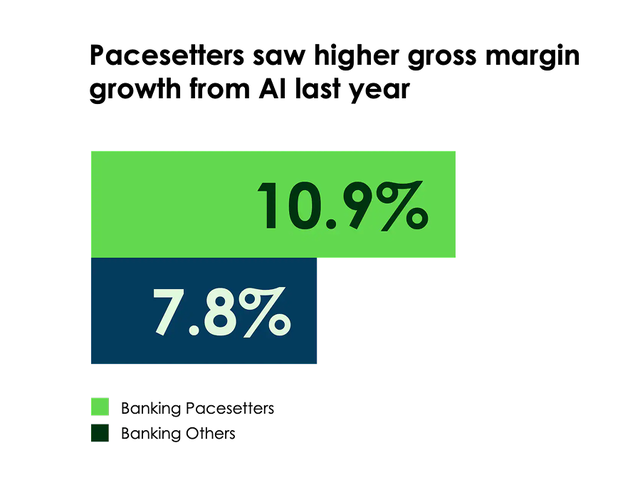
While the decline in maturity is notable, it’s not all doom and gloom. We found the banking sector is second only to the technology sector in overall AI maturity. An impressive 20% of the banks we surveyed are AI Pacesetters.
This cohort has seen higher margin growth from AI than others and leads the pack across all five pillars of AI maturity: AI strategy and leadership, workflow integration, talent and skills, data governance, and realizing value in AI investment.
“Many banks had just begun implementing generative AI when agentic AI became a viable option. They are struggling to keep up,” says Gregory Kanevski, global head of banking at ServiceNow.
Regardless of size, all Pacesetters are achieving increased efficiency and productivity, and they are better able to manage risk and improve experiences than other banks we surveyed.
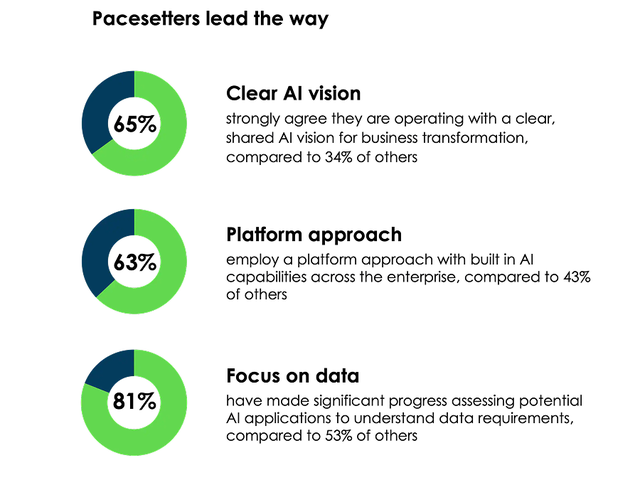
We found that leaders at Pacesetter companies are more likely to create a shared vision for AI transformation. This is a vital first step for banks, says Kanevski. Many large banks appoint senior leaders to drive AI initiatives. This helps provide cohesion and sets the right tone.
Compared to others, Pacesetters are more likely to deploy integrated AI software and applications that span multiple business areas.
“Pacesetters rise above complexity by installing a single modern platform that connects the dots across the whole enterprise,” says Simon Cox, a chief transformation officer at ServiceNow with 25 years of experience in the financial services industry. This enables Pacesetters to break down silos—a problem for many banks, where data and applications are often disconnected.
Our research found that AI Pacesetter banks are laser-focused on managing and governing their data. By contrast, banks that rely heavily on legacy systems and applications tend to struggle with data management.
“AI applications are based on data, so data availability and quality are among the biggest challenges for banks,” says Adolfo Tunon, global transformation banking leader at ServiceNow. “Having a good data lake and data structure are key—as well as proper governance.”
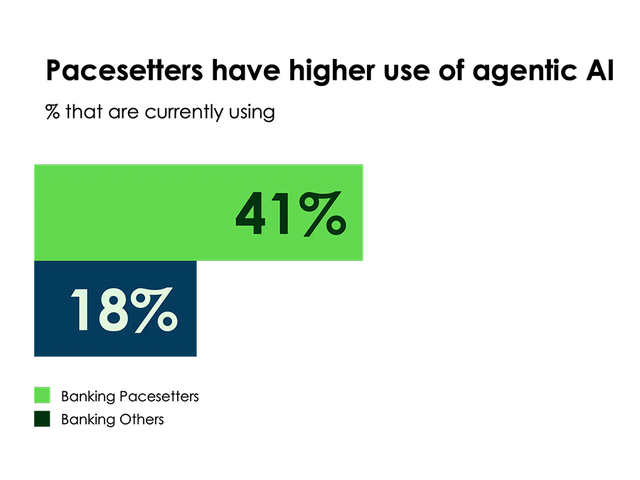
We found that Pacesetter banks tend to be early adopters of so-called agentic AI systems that can pursue goals and make decisions independently. This helps banks assess business risk, improve cybersecurity, and act on customer inquiries.
For instance, CapitalOne’s Chat Concierge deploys multiple AI agents that collaborate to help car buyers compare vehicles, schedule test drives, and explore financing options.
Read the full report on AI maturity in banking.