





Last year, ServiceNow created the inaugural Enterprise AI Maturity Index to measure how AI is impacting organizations across industries worldwide. We found all sectors were grappling with low AI maturity levels. Manufacturing was no exception.
This year, we surveyed 4,473 global executives—including 1,428 automotive, consumer goods, and industrial manufacturers—to track how AI maturity levels have changed year on year.
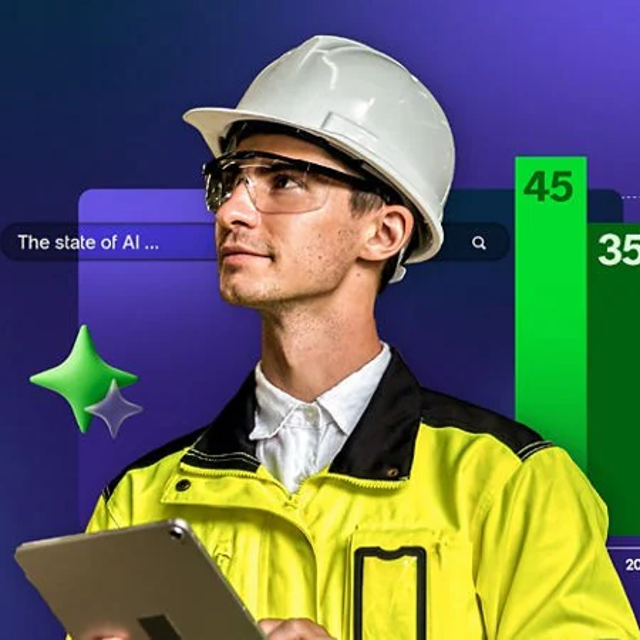
The results surprised us; maturity scores are lower now than in 2024. This year’s average maturity score for manufacturers declined by 10 points, on our 100-point AI maturity scale, from 45 to 35. In comparison, all respondents scored an average of nine points lower overall.
The reason? According to manufacturing industry research created in collaboration with NVIDIA, AI is changing so quickly that manufacturing—like all other sectors—has struggled to adapt and integrate the technology.
“Many manufacturers don’t have the data and IT foundation in place for AI,” explained Hartmut Mueller, chief transformation officer at ServiceNow. “They are not clear how to automate their value chain end to end in a customer-centric way.”
Yet there is reason for optimism. We found manufacturers are already seeing major dividends from their AI investments. A whopping 89% report higher productivity, and almost as many cite cost savings and revenue growth from their use of AI over the past year.
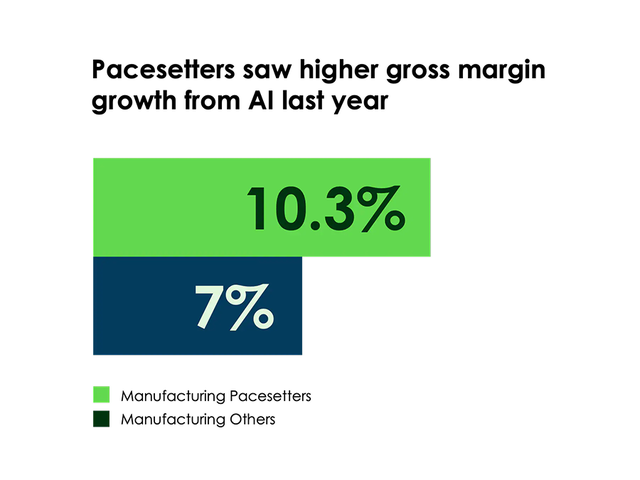
Manufacturers also report an average 7.6% increase in gross margins from AI. As a result of these gains, 82% plan to increase their AI investments over the next year.
Our most mature cohort of manufacturers, which we call Pacesetters (18% of the total), are seeing even higher margin growth from AI than their non-Pacesetter competitors. This cohort leads the pack across all five pillars of AI maturity: AI strategy and leadership, workflow integration, talent and skills, data governance, and realizing value in AI investment.
As a result of their efforts, manufacturing Pacesetters saw greater improvements in productivity, profitability, stakeholder experiences, and speed of innovation than their sector peers.
Here are five best practices that set Pacesetter manufacturers apart from the rest.
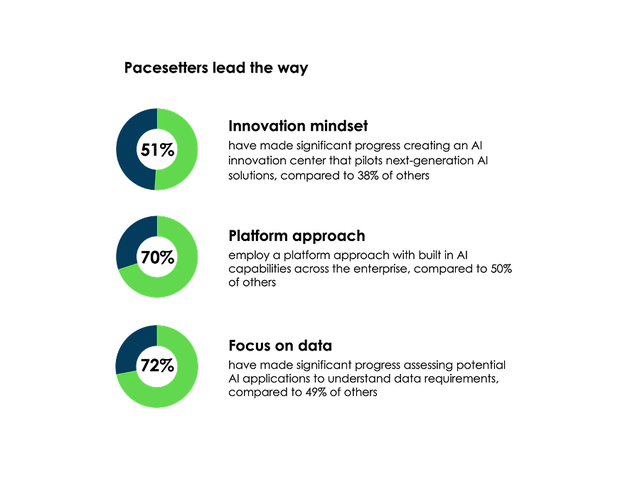
Pacesetters develop a shared AI vision across the C-suite. This vision combines a culture of innovation with an emphasis on continuous improvement. For example, more than half of Pacesetters across industries employ AI innovation centers, versus 38% of others. This enables Pacesetter manufacturing companies to experiment with new AI technologies before rolling them out across the organization.
“The spirit of manufacturing has always been one of continuous improvement,” says Allen Hackman, VP of global manufacturing go to market at ServiceNow. “But becoming an AI-powered manufacturer requires a step change and an innovation culture that gives employees permission to take risks and explore new ideas.”
Pacesetters leverage modern IT platforms that employ AI-powered workflows to connect people, processes, and technology. These platforms break down operational silos, making it easier to deploy advanced AI tools at scale.
Seventy percent of manufacturing Pacesetters take a platform approach to AI deployment, versus 50% of others. About four out of 10 Pacesetters across all industries streamline integrated workflows with AI and are twice as likely as other manufacturers to invent new workflows that draw on AI’s predictive and analytical capabilities.
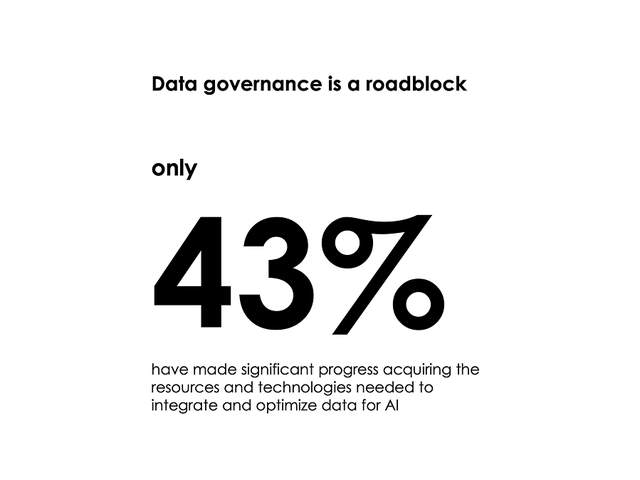
For manufacturers, one of the most significant barriers to AI adoption has been data quality. “Manufacturing executives have long referred to data as the industry’s ‘new oil’ because of its role in driving growth and innovation,” says Mueller. “However, the data management strategies of many manufacturers are still not up to par, which prevents them from fully realizing the value of their AI data.”
Pacesetters start their AI journeys by investing in data management systems that clean, standardize, integrate, and optimize data across the enterprise. More than 70% of Pacesetters across industries have assessed potential AI applications and understand relevant data requirements, compared to fewer than half of others.
Pacesetters build governance frameworks to ensure they are feeding their models with clean, reliable data. They are careful to establish guardrails that minimize bias and mitigate the risk of data breaches.
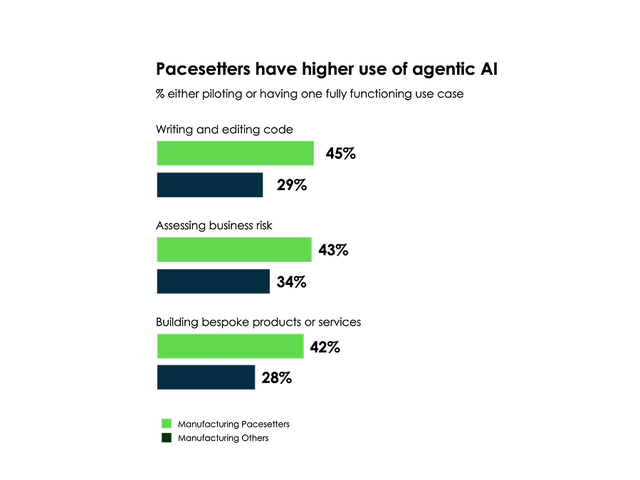
Pacesetter manufacturers are all-in on agentic AI, a type of AI that can make decisions autonomously in pursuit of defined goals, with humans "on” (rather than “in”) the loop to ensure proper governance. Pacesetters are more than twice as likely as others to be very familiar with agentic AI, and many are exploring practical use cases for this emerging technology.
“By using an AI agent to monitor the assembly line, drive predictive maintenance, and assume other tasks handled by humans, manufacturers can make their operations autonomous and very efficient,” says Sridharan Subramanian, global head of GenAI for automotive at NVIDIA.
Manufacturing Pacesetters are most likely to use agentic AI to write or edit code, assess business risks, build bespoke products and services, and manage cybersecurity risks.
Overall, manufacturing Pacesetters understand that building the organization of the future isn’t simply about deploying the right tech. It’s also about employing the right people—and empowering them to do their best work yet.
Download the AI Maturity in Manufacturing report.