




If you’re reading this, chances are customer experience (CX) is already on your agenda. The CX Shift, ServiceNow’s latest report on customer expectations, shows that more than half of business leaders in India rate CX as extremely or considerably important. The investment is real. The interest is genuine.
So why do 56% of customers still rate their service experiences as average or worse?
I attribute it to the CX blind spot, or what I call the execution gap. It’s the difference between the strategy business leaders believe works and the reality their service reps and customers experience every day.
Most organizations have a CX strategy. The problem is that strategy rarely succeeds with fragmented infrastructure, disconnected data, and siloed workflows.
Our research revealed a striking contradiction. Eighty percent of Indian business leaders say their organization plans to have a connected enterprise CX approach in the next three years. At the same time, 80% of service reps say they have to toggle between three to five disconnected systems just to answer a single customer query.
Here’s what that looks like:
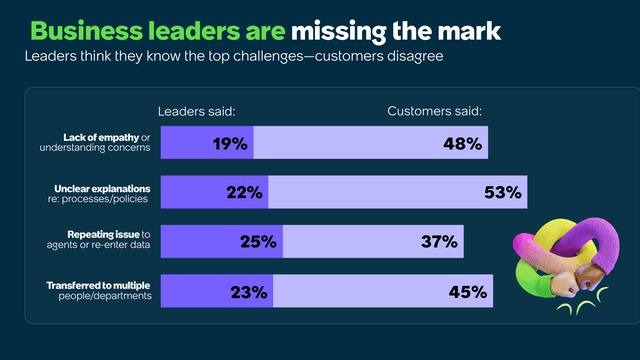
Your service rep picks up a call. The customer has a question. But before the rep can give a clear answer, they're jumping between systems, piecing together a picture that should already be in front of them. The answer that comes back is incomplete, sometimes inconsistent, and occasionally just wrong. And 53% of customers say unclear explanations from service reps are their single biggest frustration.
That's not a service rep problem. That’s an infrastructure problem. Aditya Sudhindranath, chief strategy officer at Deloitte India, put it plainly when we spoke recently:
"The gap between ambition and reality is an infrastructure gap. On the ground, the data is still fragmented. You don't have a single pane of glass for the service rep and the frontline desk to look at and give an answer."
That’s the pattern across the market, not just a handful of clients.
I've had this conversation with a lot of business leaders over the past year. The pattern is consistent: You've invested in a good customer relationship management (CRM) solution, a capable contact center platform, and a self-service portal. Each decision made sense at the time. But what most organizations have built is a set of digital silos, not a connected enterprise.
Your customer doesn't experience your CRM or your contact center platform. They experience a journey, from the first moment they engage with your brand through to resolution and renewal. When data doesn't follow them across that journey, when the service rep can't see what happened in the previous interaction, trust starts to break down.
Your enterprise likely runs across more than 360 applications. When you layer AI on top of that fragmented architecture, you don't get better outcomes. You get faster, more scalable versions of the same broken experience.
AI isn't the problem; AI is making the problem impossible to ignore.
Every organization has access to the same AI models. The differentiator isn’t the model; it’s the business context, connected data, and the ability to apply intelligence in the actual flow of work. Without that foundation, your AI investment will continue to underdeliver.
Our research found that only 19% of organizations have made meaningful progress in building emotional connections with customers through AI. The problem isn’t that the models are inadequate—the infrastructure they're running on isn't connected enough to make them useful where it matters.
Business leaders are currently directing their AI investments toward advanced digital channels. These may be sensible priorities on paper, but set them against what customers say they value most: responsiveness and trustworthiness. In addition, almost half of customers cite a lack of empathy as their top frustration.
The money is going one way, and customer expectations are going another.
When I talk with business leaders about what’s getting in the way, the conversation often starts at the channel level. They ask: How do we improve the call center response time? How do we build a better app? These are fair questions, but it’s the wrong starting point.
Your customers don't see channels. They see a single continuous journey that starts the moment they first engage with your brand. If your systems aren’t connected across every stage of that journey, the experience will fracture at exactly the moments when customers are most in need of consistency and support.
Deloitte’s Sudhindranath frames it well: "You have to move from orchestrating a channel to orchestrating a journey. You have to move from technology implementation to building out the processes. That is where the real transformation happens."
Instead of asking how to improve each touchpoint, ask where data stops flowing and where context gets lost when a customer moves from self-service to live conversation. That honest assessment is where real transformation begins.
Our research tells us that 81% of business leaders plan to integrate customer data across touchpoints in the next three years. At the same time, 70% plan to break down silos to enable better AI integration. The direction is right, but those intentions aren’t yet showing up in the experience customers and service reps are having.
That gap has a cost, and it's not measured in efficiency metrics. It's measured in trust. Trust erodes quietly, through small frictions that accumulate long before they show up in your churn data. Forty-four percent of customers say they'll switch after a single poor experience, but the system lost them long before that.
To see where the gap is widest and what organizations serious about closing it are doing, read the The CX Shift India report.