



The Singapore government’s 2026 Budget Statement was explicit about this. Singapore needs to move “beyond individual pilots and isolated experiments.” That describes where many enterprises still sit today. AI has been adopted and investment is accelerating, but in many organizations, the underlying flow of work hasn’t changed.
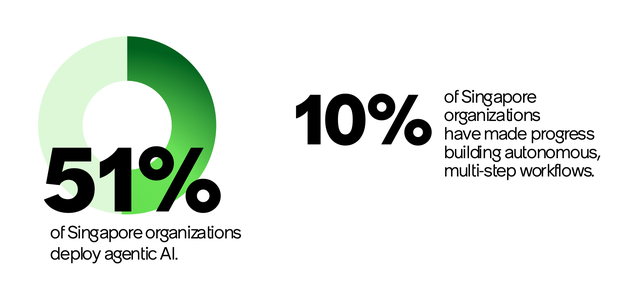
Our research found that the largest single cohort (33%) of Singapore enterprises is using agentic AI mainly to help individual employees work faster. Another 32% of organizations are still exploring or piloting and haven’t yet put AI into production. Only 10% have done the hard structural work of redesigning their business processes so that AI completes multistep workflows end to end.
Buying AI tools and building your organization to run on AI are entirely different challenges. The first is procurement, whereas the second is operating-model redesign. Singapore enterprises are still weighted heavily toward the first. The cost of closing that distance is rising fast.
Singapore's AI budgets surged 108% year on year, according to our research. By 2027, enterprises expect roughly 20% of their IT spending to go to AI. That’s a major shift in capital allocation.
Where exactly is all the extra spend going? The Enterprise AI Maturity Index shows Singapore is ahead of its global peers on the foundations. Singaporeans are:
- Replacing legacy systems faster (23%, versus 16% globally)
- Formalizing risk processes (28%, versus 20% globally)
- Integrating workflows across functions more aggressively (25%, versus 16% globally)
These are important signals that show Singapore enterprises aren’t treating AI casually. The foundations are being built. The weakest dimension is also the most important one: AI-enabled workflows in how the business operates. The reality check is whether the work itself has been redesigned around AI.
Workflow redesign forces uncomfortable choices about roles, processes, and authority. Most organizations avoid them for as long as they can. It’s easier to add AI to existing work than it is to rebuild the work.
However, our research from last year showed that enterprises that redesigned workflows entirely around AI were nearly four times more likely to report significant productivity gains than those that added AI on top of existing processes.
Despite that, Singapore's AI maturity score fell hard in 2025: It dropped 11 points to 34, steeper than the global average. This year, it rebounded 19 points to 53, stronger than the global recovery and above the country’s 2024 peak of 45.
Most people see the rebound as confidence returning. I see something more important: the shape of recovery. The data suggests enterprises strengthened the foundations that let AI scale:
- Governance
- Risk management
- Platform modernization
- Cross-functional workflow integration
In January 2026, Singapore published the world's first agentic AI governance framework. However, only 28% of Singapore enterprises have implemented the formal AI testing, auditing, and risk processes it requires, according to the Enterprise AI Maturity Index.
That work isn’t glamorous and doesn’t usually make headlines. But it matters because AI maturity doesn’t come from pilots alone. It comes from the discipline to fix the underlying systems, controls, and processes that determine if AI can scale safely and effectively.
Singapore businesses have shown that they can build the foundation. The test now is whether enterprises use that foundation to redesign how work flows through the organization or whether they leave AI layered on top of existing operations.
Singapore enterprises are projecting fast acceleration in AI workflow adoption over the next two years, according to our research. Both the investment appetite and national roadmap are in place.
What matters now is execution. Does the next wave of budget spending land on orchestration, or does it stay isolated in individual tools?
Get more insights in the Enterprise AI Maturity Index 2026 for Singapore.