
Subscribe Home Conversations On AI App Development CRM Enterprise IT Ethics & Governance Futures HR Industries ServiceNow on ServiceNow Platform Foundations Products & Solutions All topics For Leaders In IT & Dev Customer Experience Finance, Operations & Strategy Employee Experience Security & Risk News & Events People & Culture My List Explore All
October 20, 2026 5 min Deployed but ungoverned:

The state of agentic security

Agentic AI deployment has outpaced governance. New research shows where security falls short—and five ways to strengthen it. Ethics and Governance Research Download Report
Green padlock with an ai sparkle above a password field
Top takeaways Agent sprawl is untracked: Only 34% of organizations register new AI agents automatically. Containment is slow: 90% had incidents last year, but just 36% contained them in under 24 hours. AI agents reach far beyond IT: 82% of organizations run AI agents in physical and OT systems.
AI graphic image
Overview Can AI governance

move as fast as deployment?

Agentic AI is no longer experimental. AI agents are being permitted to make decisions and take actions across the organization. And permissions are accumulating faster than governance can track them. The space between what executives believe their security posture is and what they've built is wide, according to ServiceNow’s The State of Agentic Security 2026.

We surveyed 3,766 security leaders across 20 countries and eight industries, assessing what organizations can see, what they own, and what they can prove. The research places organizations into one of four posture positions—limited, emerging, advancing, or defensible—determined by structural choices they've made across five key domains.

Female sitting in front of a laptop looking to her side
Survey demographics 3.7K respondents 20 countries 8 industries Incidents are high.
Containment is slow.
90% or organizations had an agentic security incident in the last year Only 36% of those contained the incident in under 24 hours
13% of organizations have a defensible agentic security posture “AI adoption is moving faster than security and oversight can keep up.” Chief Data Officer MedTech, U.S. 66% can’t act automatically when an AI agent behaves anomalously Heading lorem ipsum 5k Lorem ipsum dolor 20 Sic transit gloria 99 Quisitriste 81% lorem ipsum dolor sit amet consectetur lorem ipsum dolor sit amet consectetur lorem ipsum dolor sit amet consectetur Lorem viverra adipiscing prasent Lorem ipsum dolor sic proin aenean Lorem ipsum dolor sic proin aenean Lorem ipsum dolor sic proin aenean Lorem ipsum dolor sic proin aenean Lorem ipsum dolor sic proin aenean Lorem ipsum dolor sic proin aenean
Established in theory,

exposed in practice

More than half of the organizations we surveyed rate their agentic security as “established,” meaning they have purpose-built governance for agentic AI that’s demonstrable on demand. Yet only one in eight has a defensible security posture. And confidence outpaces control.
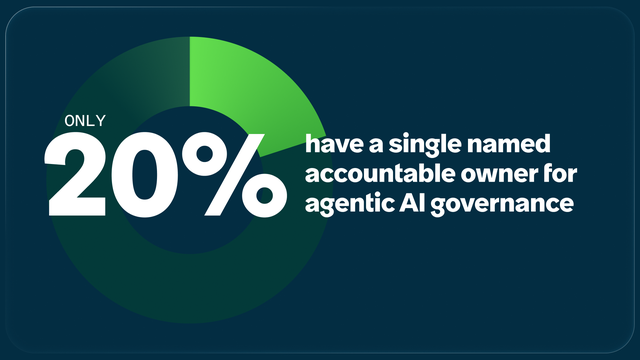
Data call out 20% have a single names accountable owner for agentic AI governance
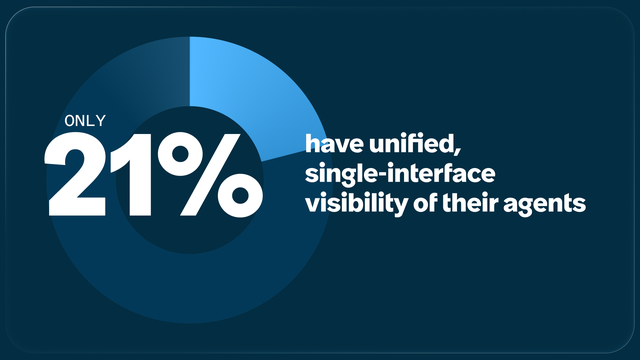
Data call out only 21% have unified, single-interface visibility of their agents
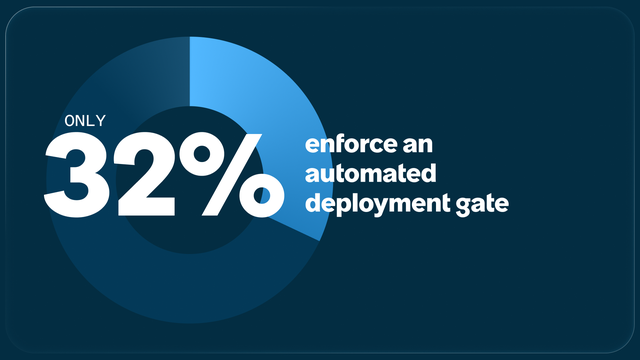
Data call out only 32% enforce an automated deployment gate
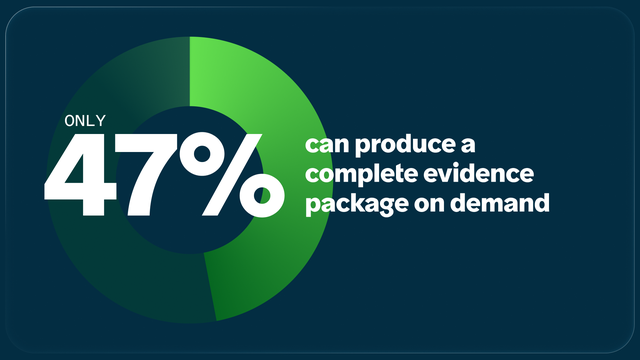
Data call out only 47% can produce a complete evidence package on demand
The ungoverned workforce, chaos included Security by design What you track, you prove Secure then scale
SECTION 1: THE UNGOVERNED WORKFORCE, CHAOS INCLUDED The attack surface

is expanding rapidly


While 57% of organizations claim they have a full, accurate record of every AI agent in production, many of those agents are actually ungoverned, unchecked, and untraceable, according to our research.

AI sparkle with a cursor arrow and a small green sparkle on a green background
Agents are deployed; governance is uneven 29% of security leaders discovered AI agents in production this past year that they didn’t know existed. Video CTA
Green padlock with an ai sparkle above a password field
A gate that isn’t required isn’t a gate Only 32% have a mandatory automated gate that blocks deployment until an AI agent passes a defined security check. Video CTA
Blue 3D line chart trending upward
On-demand AI agent activity tracking is lacking 48% have frameworks that cover AI agent ownership, intended use case, and permissions and access rights. Video CTA
Access is mapped

on paper,

not in practice

Context for AI agents is everything an agent can reach: the data it touches, the systems it connects to, and the permissions it’s accumulated. As AI agents are added and their permissions expand, keeping the mapping current is where most tools fall short.
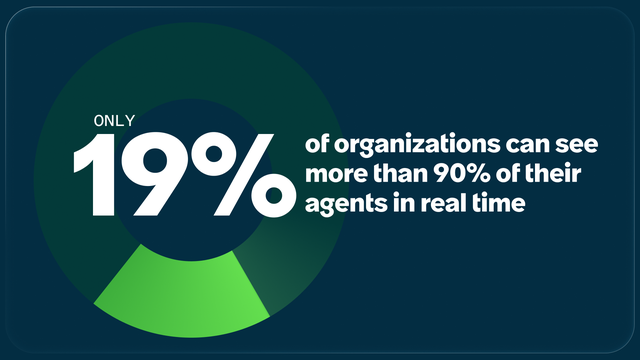
Data call out only 19% of organizations can see more than 90% of their agents in real time
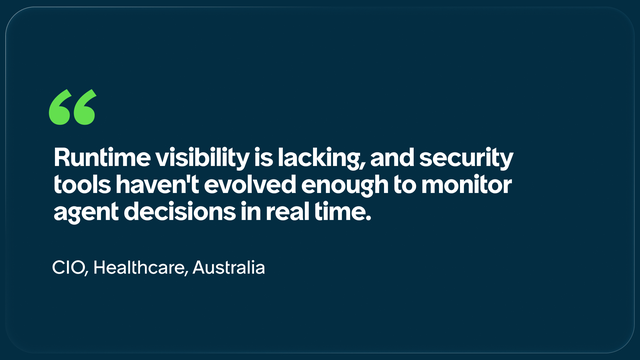
Quotation mark  Runtime visibility is lacking and security tools haven't evolved enough to monitor agent decisions in real time. CIO, Healthcare Australia
Agentic AI extends to physical

and operational tech

The exposure in physical and operational technology (OT) environments is greater than it is in IT: 82% of organizations run AI agents in or touching OT and physical environments, where visibility into agent activity is often weak. More than three-quarters (76%) of organizations have had an OT or physical security incident involving an AI agent in the past 12 months.
SECTION 2: SECURITY BY DESIGN Early governance

beats late detection


Security considerations might help shape how an AI agent is built, or they might not apply until after launch. A security team involved before the build can set the permissions, logging, and boundaries. A team brought in after inherits all three.

Our research found that only 44% of organizations bring in security before AI agent development begins. Once agents are live, only about half (51%) of the organizations we surveyed have automated real-time detection of anomalous AI agent behavior.
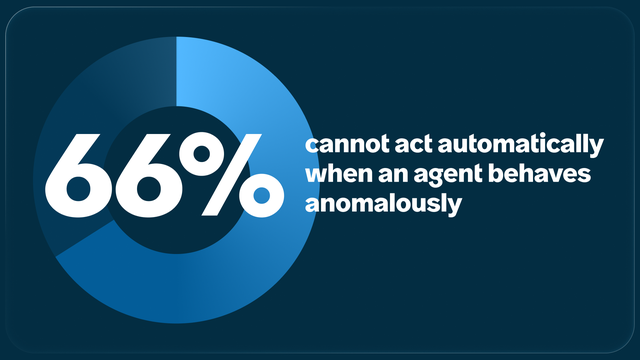
Data call out 66% cannot act automatically when an agent behaves anomalously
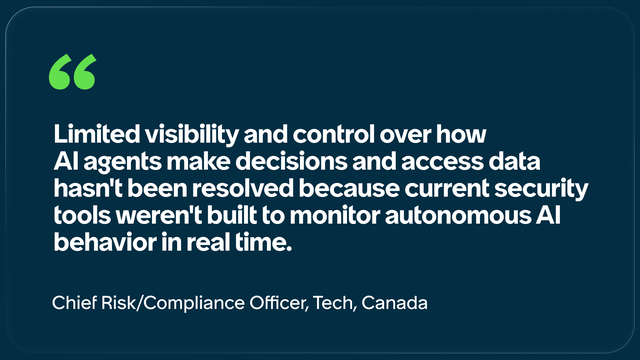
Quotation mark Limited visibility and control over how AI agents make decisions and access data hasn't been resolved because current security tools weren't built to monitor autonomous AI behavior in real time.  Chief Risk/Compliance, Officer, Tech, Canada
SECTION 3: WHAT YOU TRACK, YOU PROVE Can’t produce the trail;

can't prove posture


Whether an organization can prove its security posture affects how it runs security. Nearly half (47%) of the organizations we surveyed manage agentic security risk on a unified platform and see greater results than those that don’t take a platform approach.

The rest manage security across integrated tools, point solutions, and manual work, so the evidence package has to be assembled every time someone asks for it. When the system that runs security is also the system of record, the audit trail builds itself.
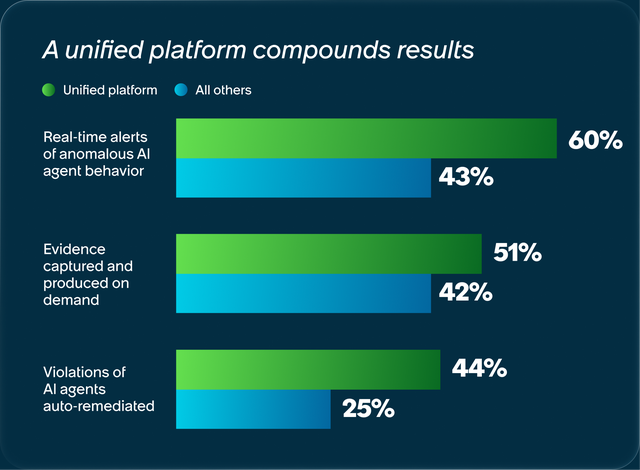
A unified platform compounds results bar chart


Organizations that can name every AI agent they run, assign each one an owner, and produce a record of each one’s actions built that structure on purpose. None of it accumulates on its own.

Below are the five choices that matter most.
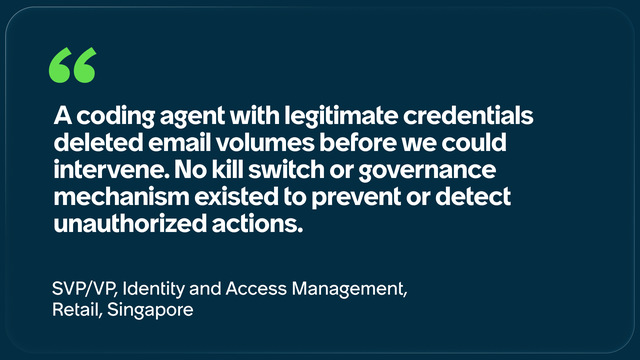
Quotation mark A coding agent with legitimate credentials deleted email volumes before we could intervene. No kill switch or governance mechanism existed to prevent or detect unauthorized actions.  SVP/VP Identity and Access Management, Retail, Singapore
SECTION 4: Secure then scale 5 moves for a defensible security posture


Organizations with a defensible posture didn’t get there by accident. Our research shows they made structural choices that separate them from everyone else.

Governance is built into how their organizations operate:

  • AI agents are inventoried automatically.
  • Accountability is formally assigned to a named individual.
  • Evidence is captured continuously.
  • A defensible security posture can be demonstrated on demand.

Following their example can help set up your organization with defensible agentic security.

Male and female walking down the stairs looking at a tablet
Move 1 Build a continuous inventory, and map agent access Make registration a technical control in the deployment path rather than a manual step. Hold the record and the access map in one system that updates itself so that what an AI agent has access to stays current. Video CTA Move 2 Embed security before design Write security requirements into the project brief before there’s an architecture to review. Clearly define what AI agents can access, what they can do autonomously, and how their activity will be recorded.  Video CTA Move 3 Unify visibility into agents, identities, and posture Bring AI agent activity, identity exposure, and posture into a single view. And automate detection so that anomalous behavior surfaces in real time.  Video CTA Move 4 Capture continuous evidence Write documentation and audit trail requirements into the AI agent governance framework. Capture approvals, permissions, and AI agent actions in one record as they happen.  Video CTA Move 5 Assign one accountable owner across the enterprise Name one individual who will be accountable for agentic AI governance and document their scope, including the framework, review gates, response plan, and the posture the organization can demonstrate on demand.  Video CTA
5 moves, 1 outcome: Control that holds as you scale

Organizations that build security into AI agents by design with unified visibility, clear ownership, and continuous evidence will set the standard. That’s how leaders will move fast and stay in control in the agentic era.


 

Download Report
Next up
Dive into more conversations AI App Development CRM Enterprise IT Ethics & Governance Human Resources Industries ServiceNow on ServiceNow Platform Foundations Products & Solutions All Topics
Stay in the know Join Us
stay in know image
Alt