

A study of customer expectations in the AI era


We surveyed 27,000 customers, 3,500 service representatives, and 3,900 executives globally to understand the state of CX today. What we uncovered was a major disconnect between what people want and what executives are using AI to deliver.
Half of the customers surveyed say lack of empathy is their biggest frustration, while only 23% of executives think it's a priority. We call this the empathy gap.
To close it, companies need a new approach, one that delivers a human touch at the speed of AI. They’ll need to embrace new technologies and ways of working, all connected by an intelligent AI platform. Luckily, our research identified ways to strike a balance and reap the benefits.
AI that acts, people who feel
Help the people who help your customers
The exec disconnect
Let’s be clear: Customers have no problem interacting with AI under the right circumstances. Three-quarters prefer self-service for the simple stuff (resetting passwords, tracking orders), but 87% still want to pick up the phone when things get complicated.
When it comes to rapid response, AI has raised the bar. But by sacrificing precision and connection for speed, businesses risk delivering substandard support, faster.
Today’s customers don’t want to choose between personal connection and AI intervention. That’s why the future of CX won’t be built on yesterday’s CRM. It’s up to today’s CX leaders to design a new approach that feels as human as it is smart.

It’s hard out there for a rep.
They spend less than half their day helping customers, in part because they have to toggle between three to five systems to do their job. They are undertrained (59% said orgs need to provide better training) and overwhelmed, with high call and case volume being the top challenge to providing personalized interactions.
When reps partner productively with AI, here's what happens: 53% say it allows them to focus on customer service by decreasing time spent on routine tasks. Nearly half resolve issues faster. That's not automation replacing empathy—that's technology amplifying it.

Here's an uncomfortable truth: While executives are busy checking AI boxes, they're unwittingly missing what customers are actually asking for. Less than 40% of leaders have made substantial progress on the things customers value most: responsiveness, security and, yes, emotional connection.
The result is that while AI investment is rising, it’s often misaligned with what people actually value. Case in point: 40% of customers are frustrated with the need to repeat issues to multiple people or reenter information. Meanwhile, 43% of reps face inconsistent customer data views.
When systems don’t connect, neither do people. Execs need to use a single-platform approach that unifies people, data, and processes using AI-powered workflows across departments.

The CX sweet spot lives in the space where customers can self-serve with speed or connect with an empathetic human. This takes anticipating customer needs. It takes systems that connect, not constrain. And it takes a commitment to embracing technology that makes your service feel more human—not less.
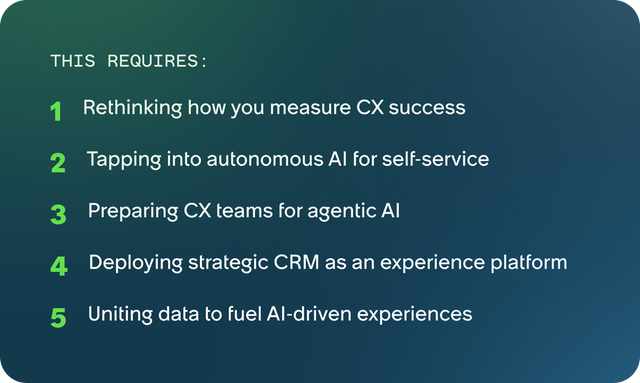
When you get the infrastructure right, the emotional connection follows and the gap between customer expectation and experience disappears.