





Business leaders have stopped asking if they’re ready for agentic AI. Nearly every chief information security officer I speak to is already running AI agents across their front, middle, and back offices. But while AI spending in Australia is up 115% year over year, according to the ServiceNow Enterprise AI Maturity Index 2026, the same can’t be said for security.
New ServiceNow research, Deployed but ungoverned: The state of agentic security in Australia, reveals one in four Australian organizations has AI agents in production that were never registered or known about. These rogue agents are freeriding, making decisions and taking actions no one ever intended.
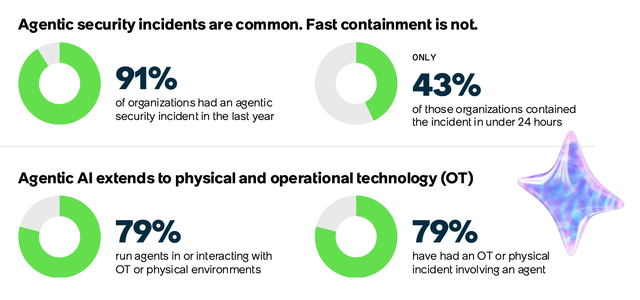
What’s more, 91% of organizations in Australia had an agentic security incident in the last year, but only 43% were able to contain it within 24 hours. That’s 7% worse than the global average. And our research shows AI agent sprawl already extends far beyond IT, with 79% of local organizations running AI agents in physical and operational technology systems.
Left unchecked, rogue AI is a threat to Australia’s economy and critical infrastructure, from hospitals to airports to the electricity grid. Even AI agents built with the simplest intent can engage in unpredictable behaviors, such as stealing and sharing data or rewriting code that underpins systems.
A recent data breach at an Australian government agency has elevated cyber resilience as a national priority. The Department of Home Affairs has issued a directive to all public sector agencies to strengthen their security posture. Every government service must know what technology it’s running and what’s at risk, and prove that it’s reducing that risk.
These may be difficult questions to answer for the 40% of Australian leaders who have no visibility into how AI is being deployed across their organization, according to the Enterprise AI Maturity Index.
Our agentic security survey asked leaders to rate their security posture. The results revealed an alarming difference between belief and reality:
- 58% said their current posture for securing agentic AI is established, yet most lack basic governance checks.
- Only 27% have a mandatory automated gate that blocks AI agent deployment until an agent passes security checks.
- 63% can’t act automatically when an AI agent behaves anomalously.
Security conversations are happening too late. Since the arrival of generative AI, organizations have been told by industry experts to adopt AI fast or fall behind. Amid that scramble to keep pace, businesses have bolted on governance as an afterthought.
Our research found that 57% of organizations fail to bring in security before AI agent development begins. Once agents are live, less than half of businesses have automated real-time detection of anomalous AI agent behavior.
Organizations with a defensible posture have made four defining moves:
- AI agents are registered and inventoried automatically.
- Security is built in before design.
- Accountability is formally assigned to a named individual.
- Evidence is captured continuously.
If you don’t know what, or where, AI agents are operating inside your organization, you can’t govern what they’re doing. And if you can’t govern what they’re doing, you can’t help prevent security incidents.
Organizations that can name every AI agent they run, assign each one an owner, and produce a record of actions have taken those steps purposefully. That’s the formula to move fast and stay in control in the agentic era.
Get more insights in the state of agentic security global report.