



- Legacy IT systems plague many supply chains and their ability to respond during an event or crisis.
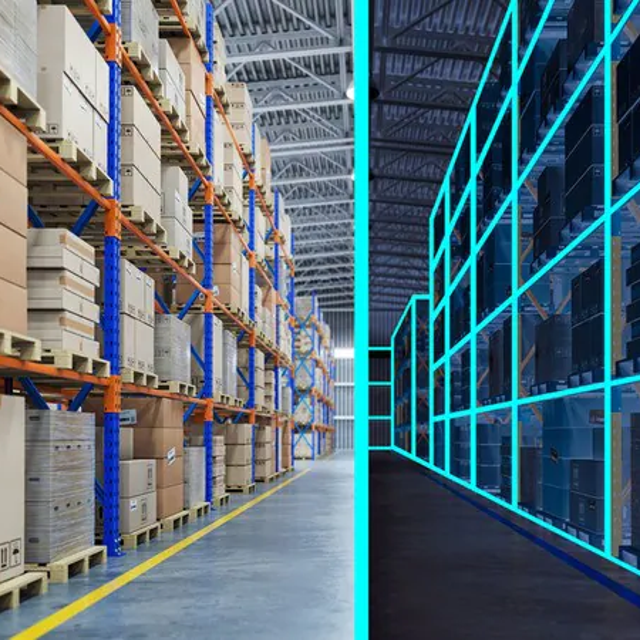
- Digital twins can simulate real-time movement of goods, material flows, inventory positions, and warehouse operations.
- AI tools can use digital-twin data to automate shipment and logistics recommendations and decisions.
It’s tempting to blame the world’s supply chain woes on the pandemic. Factory closures and labor shortages shut down delivery hubs and tied up merchant shipping. Unexpected gaps between supply and demand—for everything from laptops and lawn furniture to blue paint—exposed flaws in “just-in-time” models in dozens of industries.
There’s a deeper reason for lingering supply chain problems: the ongoing reliance on legacy IT systems and manual processes to move goods from farm or factory to their final destination. Some of the planet’s most complex supply chains, in fact, still rely on spreadsheets, email, and whiteboards.
Nearly 40% of organizations handle most of their procurement systems manually, and only 6% had fully automated supply chain processes, an April 2021 survey by SAP and Oxford Economics showed.
Running supply chains on email, spreadsheets, web portals, or ERP tools “leads to horrendous productivity and huge opportunities for error, and it’s very difficult for management to track,” says Chris Taylor, chief transformation officer at ServiceNow.
Technology alone won’t magically resolve current supply chain disruptions and slowdowns, but one emerging tool, the AI-powered digital twin, could help supply chain managers mitigate future problems before they turn into crises.
The digital twin concept is rooted in industrial simulation software, used since the 1970s for the precision design of parts in manufacturing, aerospace, semiconductors, and other sectors.
Internet of things (IoT) technology, data analytics, and machine learning enable digital twins to simulate connected processes and physical assets in several industries.
Manufacturers use them to replicate machines on the factory floor, increasing uptime by predicting when equipment needs maintenance. Medical researchers are using digital twins of human organs to design safer, more effective treatments. In Las Vegas, planners are using a virtual version of the city in hopes of improving air quality and energy usage.
Among enterprise organizations that have implemented IoT projects, 62% plan to use digital twins, according to a Gartner survey.
Supply chains represent a powerful use case for digital twins, which often apply machine learning across numerous data streams to simulate the real-time movement of goods, material flows, inventory positions, and warehouse operations.
DHL, the international shipper, created a digital twin of a food-processing warehouse in Southeast Asia. Using sensors and cameras to capture data, the digital twin represents pallets inside the warehouse as virtual objects inside a 3D computer model. Using real-time operational data generated by the twin, warehouse supervisors can ensure that perishable goods are correctly shelved within 30 minutes of arrival and that goods slated for delivery are ready to be shipped within 95 minutes of request.
Digital twins allow thousands of decisions to be automated and applied at scale in real time, says Dan Isaacs, chief technology officer at Digital Twin Consortium, a global organization created to drive enterprise adoption of digital twins across multiple industries.
One member company, says Isaacs, created a twin of its enterprise resource planning (ERP) system, which manages more than 120,000 stock-keeping units across more than 2,500 facilities, warehouses, and end users.
Every 10 minutes, the twin re-examines its inventory, determines the location of each item, and identifies which customers have requested it. The twin makes 250,000 recommendations a month about where and how to ship each one, flagging special circumstances that require human managers to step in and make the final call.
“More than 90% of those decisions are automated,” says Isaacs. “You can’t do that with an Excel spreadsheet.”
Digital twins also allow managers to run millions of simulations, using AI to predict outcomes based on different variables, says Özden Tozanlı, a postdoctoral associate at MIT’s Center for Transportation & Logistics. Her research focuses on how digital-twin technology can be integrated into supply chains as part of digital-transformation strategy.
For example, managers can use a twin to simulate disruptions at different distribution centers, which can tell them how to shift shipments to other centers to prevent their supply chains from breaking.
The digital twin’s perhaps most powerful long-term feature is running what-if scenarios that give businesses predictive insight about the future. What if a major hurricane shuts down auto factories in Thailand? Digital twins could calculate the risks, estimate the impact on a supply chain, and suggest steps to minimize disruption in the actual event.
“Digital twins give you the ability to run multiple what-if scenarios and pick the optimal one,” says Tozanlı. They can be used tactically or strategically, she adds, “to see the impact of making a change in your supply network design five or 10 years down the road.”
Find out how ServiceNow helps put AI to work for supply chains.