




Ask business leaders what percentage of their customers are dissatisfied because of a lack of empathy, and most will say less than 20%. Ask customers, and the answer is closer to 50%.
That blind spot is costing organizations in a currency that doesn’t show up cleanly in a dashboard: customer trust.
The CX Shift, ServiceNow’s latest customer experience (CX) report, found that 48% of customers cite a lack of empathy as one of their top frustrations, whereas only 19% of business leaders recognize it as a challenge.
Leaders aren’t ignoring CX. They’re seriously investing in it. But they’re measuring the wrong things. In the gap between what leaders believe they’re delivering and what customers are experiencing, trust quietly drains away.
That’s the right frame for thinking about CX. It’s not a set of transactions to optimize, but a relationship built or eroded through every interaction. Right now, the erosion is happening faster than most organizations realize.
Trust rarely breaks in one moment. It drains through small frictions: a service rep who couldn’t find a customer’s account history, an answer that contradicted what a customer was told last week, a callback that never came. Churn is rarely the result of one catastrophic failure. It’s the accumulation of small moments where the experience fell short and nobody noticed.
We’ve all been that customer. The CX Shift puts it plainly: “The lack of ownership and repeated transfers made me feel like a burden rather than a valued customer,” one consumer in India reported.
That single line captures what no efficiency metric measures. And it points directly at what needs to change.
The trust gap isn’t just between customers and organizations. It runs through the front line too. Service reps can build customer trust only if they can trust the data and information in front of them. Currently, many can’t.
Our research found that service reps are spending only 47% of their time solving customer problems. What are they doing the rest of the time?
Take an industry-agnostic example: A customer wants to know the status of their refund. To provide it, a service rep has to find out what the refund policy is, whether the returned item was received by the warehouse, and whether finance processed the payment.
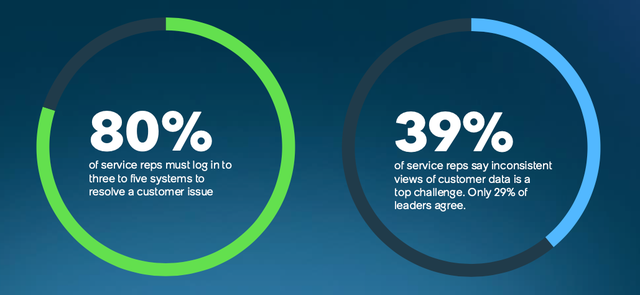
The rep has to navigate three questions, three different systems, and three separate processes that exist in isolation from one another. Then they have to make sense of what they find and turn it into an answer. That’s a painful, time-consuming response for a customer who just wants to know where their money is.
When 45% of customers say being transferred to multiple people or departments is a top frustration, that isn’t a people problem. It’s a systems problem. Jumping between disconnected tools does more than just slow resolution. It steals the moments where trust is built.
The 48% of customers who say they’re not getting the empathy they expect aren’t failing to receive it because service reps don’t care. They’re failing to receive it because service reps don’t have the space to deliver it.
When trust breaks down, the impact travels. The CX Shift shows the range of what customers do after a poor service experience:
- 37% tell family and friends
- 34% post negative reviews or file formal complaints
A customer who churns quietly represents the best-case scenario. However, a dissatisfied customer is far more likely to share their bad experience than to simply go to a competitor.
This can cause reputational damage, which is a greater cost and more difficult to quantify. And 56% of customers say trustworthiness is among the qualities they value most in a brand.
Trust lost is not just a churn metric. It’s a brand metric. And unlike a performance score, it doesn’t recover in the next quarter.
Business leaders already know they have a churn problem. “Great customer experiences do not come from individual effort,” says Adrian Johnston, president of Asia Pacific sales at ServiceNow. “They come from connecting platforms, data, and workflows so the organizations can act as one, with consistency across channels and continuity across every interaction.”
The challenge is that once significant CX investments have been made, the pressure for immediate profits shapes every decision. The ambition is differentiation. The reality defaults to quick wins. That disparity is where the trust opportunity goes unclaimed.
The metrics historically used in CX have been weighted toward efficiency: mean time to resolution, cases closed, and speed. While these matter, our research found that only 19% of organizations have made meaningful progress building emotional connections with customers.
The intention is there. What’s still being built is the infrastructure to act on it: the connected data, unified workflows, and single view of the customer that makes every interaction feel informed rather than impersonal. When that foundation is in place, service reps stop navigating and start solving. And when they can solve, they can build trust.
The organizations that close this gap won’t just improve their CX scores. They’ll build something far harder for competitors to replicate: the confidence of customers who feel genuinely understood.
Read The CX Shift India report for more insights on closing the customer trust gap.