






As a sales rep, you finish a call at 4:58 p.m. It went well, and you feel like the opportunity has momentum. Your next call starts at 5 p.m. With no time to prepare, you enter it cold, with no context on the account and no memory of what the client is waiting to hear. The customer senses it, and the conversation falls flat. By the time that call ends, you feel like you’ve taken a step backward and the deal hasn't moved.
You want to close your laptop, but first you have to update the customer relationship management (CRM) system. You log the two calls, update the opportunity stage, and try to recall details from earlier in the day that are fuzzy after eight hours. By 7 p.m., you’ve filled in all the CRM fields and will likely never look at them again.
You've spent an hour doing work that checks the compliance box but doesn’t help you understand your customers better or progress your deals. It’s the same kind of work you were stuck doing yesterday, when you could have been preparing for that 5 p.m. call.
This isn't what CRM was supposed to be.
The promise was that CRM systems would make selling easier, but they were designed to track activity, not enable action. Every required field and every activity log exists for the Monday forecast call, not the rep in the room.
The responsibility of manually filling in every field turns sellers into part-time data-entry workers, taking them away from focusing on customers. Most sellers spend only 25% of their time selling, according to Bain & Company. The rest is consumed by processing repeat orders, performing admin tasks, and working in the tools.
For most sales teams, one of the main tools depleting time is the CRM system. It’s created a vicious cycle: Sellers self-report incomplete data, leadership operates blind, leaders ask for more data when a quota is inaccurate or missed, and sellers are stuck with more fields, more reminders, and more homework.
Even as systems of record, legacy CRM systems often fell short. The goal was to create one source of truth, but that can happen only when all fields are filled in accurately and updated regularly. Three-quarters (76%) of CRM users acknowledge that less than half of their organization’s CRM data is accurate and complete, according to Validity’s The State of CRM Data Management in 2025.
Poor-quality data leads to inaccurate forecasting. That should come as no surprise when the forecast is built on what a tired rep remembered to type into fields they didn’t care about. The more complex the deal, the more likely it is that the CRM system isn’t an accurate reflection of what’s happening.
Faulty forecasts are just a symptom of the problem. In the same Validity study, 37% of CRM users said their organization lost revenue as a result of poor data quality. The cost of the broken CRM system affects both your front line and your top line.
When AI arrived, the industry decided that what sellers needed was smarter advice. Copilots reminded reps to log calls, suggested next steps, and drafted follow-ups. But advice didn’t fix the broken system and outdated processes.
A rep who never updated fields manually didn’t start just because AI asked nicely. A quote that took two days to generate didn’t get faster simply because an AI chatbot drafted it. An at-risk renewal didn’t get saved as a result of AI making a suggestion in a tool the rep didn’t use. Poor-quality data didn’t support better outcomes no matter how quickly AI analyzed it.
The fundamental design flaws of copilot AI in CRM are that it still waits for a human to do the work and it’s often bolted onto a broken system.
According to a Gartner® survey, "The divide between sales organizations realizing value from AI and those struggling to capture returns is already emerging: 25% of sales organizations report a 50% or higher return on their AI investments, while 20% report a 50% or higher negative return.”1
The organizations seeing strong returns from AI are the ones that realized they needed to redesign their systems around AI.
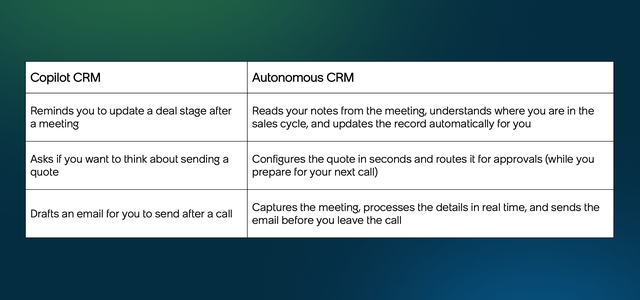
Imagine a CRM system that doesn’t ask you to do anything. Your call ends, and the system logs it, updates the opportunity, and drafts the follow-up while the quote configures itself and moves into approval. By the time you close your laptop, the deal is already moving.
That's autonomous CRM. A copilot suggests; an autonomous system executes. The table provides a few examples.
For the first time, CRM does the admin work so you can focus on prospecting, building pipeline, and closing deals.
ServiceNow built Autonomous CRM around three capabilities that work together:
- Aware: The system pulls live signals from across the business, including service, support, finance, and delivery, so it understands the full story of each customer.
- Autonomous: AI agents do the work of logging calls, updating records, configuring quotes, routing approvals, and flagging risk so that sellers can focus on relationships.
- Adaptable: It's headless, composable, and extendable; it works through any interface (e.g., Claude, ChatGPT, Teams, Outlook, or any custom channel); and it’s ready for partner and channel selling.
Together, these three capabilities transition CRM systems from surveilling sellers to serving them.
When a CRM system works for sellers instead of against them, you can expect quick improvements with lasting impact:
- Compounded efficiency: A rep who gets time to focus on customers is able to move faster on the deals already on their desk and take on more accounts without losing depth. They show up to calls prepared. The Gartner research backs this up: “Sales organizations that achieve moderate to large AI time savings and then reinvest that time into high-impact sales activities are 2.2 times more likely to exceed customer growth goals."1
- Honest forecasts: When the data reflects what's truly happening instead of what a rep entered after a nine-hour day, the forecast can be trusted. Deals progress the way the CRM system says they do, and leaders can share their numbers with confidence instead of hedging them.
- Flourishing talent: The moves that make your best reps successful— such as how they engage, when they follow up, and what they say—stop existing only in their heads. The CRM system captures those moves and runs them consistently across every rep and every deal, every time. Your average performer starts operating like your best one, and your best performers keep raising the bar.
Organizations are already running autonomous CRM systems in production and reaping the benefits:

The pattern is consistent across all of them: When the CRM system does the work, deals move, reps sell, and quotas close.
It's exactly what sales leaders say they need, according to a recently commissioned ServiceNow study on sales leader expectations of CRM in the AI era.
"I'm expecting AI, those tools, to really improve the quality of the data," said one vice president of sales. Another leader shared, "Our sales team would like to have better visibility, reporting on allocation, which products are available, what they can sell, and what they can promise to their customers."
See more of what sales leaders expect from CRM in the AI era.
1 Gartner Press Release, Gartner Survey Finds AI Saves Sellers Nearly 5 Hours Per Week, Yet 72% of Sales Organizations Fail to Reinvest Time in High-Value Activities, May 19, 2026
GARTNER is a trademark of Gartner, Inc. and/or its affiliates.