





Most people stop noticing their work badge within a week. But that small plastic card does a lot of work every time it touches a reader.
Picture the badge reader at the front entrance of your company’s headquarters. An employee taps their badge against it, and the system knows who they are, who they report to, and which floors they’re cleared to enter.
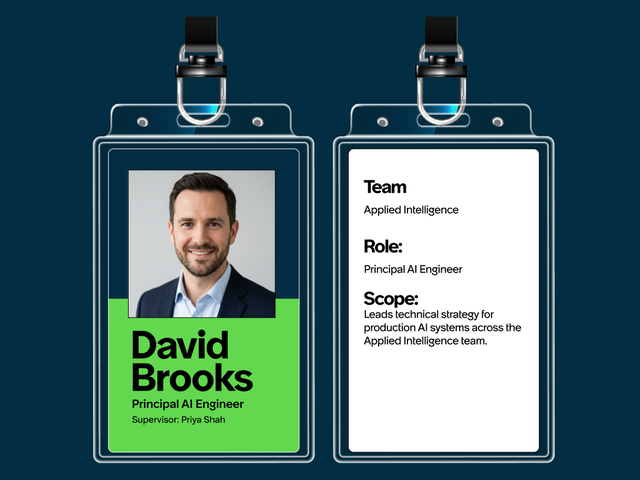
Now picture an AI agent entering the same company. It never comes near the front entrance. It slips in through a side door someone left propped open, such as a service account, an API key, or a vendor integration. It carries no employee badge, and no reader checks it. Nobody has recorded who it is, who’s responsible for it, or what it’s there to do.
That’s a problem. Ninety percent of organizations had an agentic security incident in the past year, according to ServiceNow’s state of agentic security survey of 3,766 security leaders in 20 countries. Only 36% contained the incident within 24 hours.
Security incidents happen because organizations don’t know what AI agents they have, and they’re difficult to contain because businesses don’t know what their agents are doing. Imagine an employee badge for every AI agent. What would it say, and what harms might it prevent?
Fifty-seven percent of organizations say they hold a full record of every AI agent in production, according to our research. Only 34% register new agents automatically. And 29% of security leaders found AI agents running that nobody had registered.
The fix is to make registration a byproduct of deployment. The moment an AI agent goes live, the system should create its record automatically: a unique ID, where it came from, what it’s for, who owns it, and what it’s allowed to touch. AI agents deployed by vendors get the same treatment, and that information goes straight onto the badge.
Only 20% of organizations have named a single person accountable for agentic security governance, according to our research. A compliance executive in the UK's automotive sector said no formal documentation splits risk ownership across teams.
The study recommends that each organization name a single leader with enterprisewide AI agent accountability. Beyond that, each function is responsible for its own AI agents, and each agent gets one named owner.
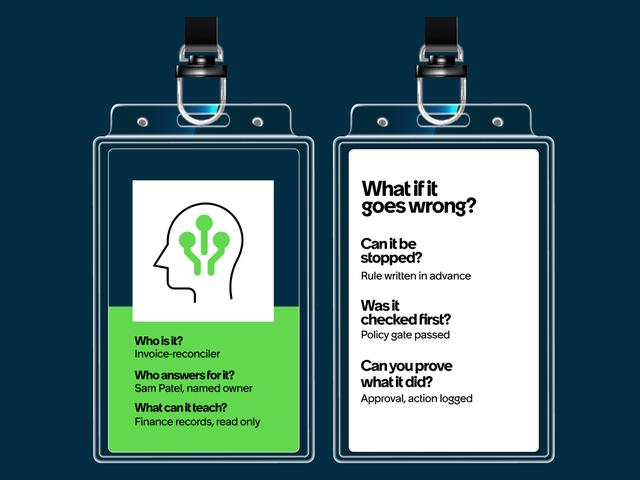
Seventy-six percent of leaders we surveyed say they keep a complete, current map of every AI agent's access. Only 19% can watch more than nine in 10 of their agents as they work.
Rahul Prakash, who leads identity security at ServiceNow, argues that an AI agent’s reach should be recorded on demand. Each role should be traced through nested groups and inherited policies so that when access is revoked, it can be confirmed in the system.
Sixty-six percent of organizations can’t act automatically when an AI agent behaves anomalously. An identity executive in Singapore’s retail sector described a coding agent with legitimate credentials that deleted emails before anyone could intervene. No kill switch existed.
The organizations that are ahead of threats like that keep people updated and loop them in earlier. A person writes a rule for the AI agent in advance: This is what an anomaly looks like, and this is what happens when one appears. The system then applies that rule automatically.
Only 32% of businesses have a mandatory automated check that blocks deployment until an AI agent clears it, our research found. And only 44% bring in security before beginning to develop an AI agent. Paul Kunas, a managing director at Accenture who contributed to our study, calls late security a retrofit: slower, costlier, and often less effective.
His fix is to put security in the front-door process and “make the secure path the easiest path.” In other words, include the requirements in the project brief, embed the policy as code, and hold off on deployment until the AI agent passes security checks.
Only 47% of businesses say they can produce a record of what an AI agent did. A compliance executive at a U.S. retailer said the company can't keep full reasoning traces past 30 days.
Instead of retroactively chasing down evidence, aim to capture evidence as work happens. Log the approval, the scope, and the action immediately.
Fifty-six percent of leaders rate their agentic security as established, according to our research. But just one in eight has what the study calls a defensible posture. Those organizations moved their controls into the systems that do the work, so the check runs as the work runs.
Looking back at the badge reader scenario, an employee taps in once and gets through the day. An AI agent might pass through thousands of digital “doors” in a single day. Give every AI agent an employee badge, and check it each time the agent reaches for something new: every database it queries, every tool it calls, every action it takes.
Find out how ServiceNow can help secure your AI agents so you know who and what can access your data.