
Conversations On AI App Development CRM Enterprise IT Ethics & Governance Futures HR Industries ServiceNow on ServiceNow Platform Foundations Products & Solutions All topics For Leaders In IT & Dev Customer Experience Finance, Operations & Strategy Employee Experience Security & Risk News & Events People & Culture My List Explore All
Macrh 4, 2025 12 min Transforming Banking Unlocking transformation at scale can help banks build better customer experiences and improve risk and resiliency. Industries Research Download Report
Transforming Banking
Top 4 Takeaways 1 Meet the pacesetters
How leading banks create value
2 Intelligence at scale

From silos to AI-powered workflows
3 Put AI for the people

Great experiences build trust
4 Risk and regulation
The future of landscape
Introduction

As a former bank CIO, I’ve seen the success that comes when digital investments are an integral part of delivering overall outcomes. I’ve also experienced the challenges that arise when the various functions of a banking organization are siloed and misaligned. What’s clear to me is that business and technology can’t be separated. Instead, technology must be a critical piece of every bank’s operating and go-to-market strategy.

That’s why leveraging an AI platform for business transformation is a true game-changer. It connects people, data, and processes to realize value quickly. It helps build trust and positive human experiences, powers regulatory compliance and risk management, and reduces costs.
At the same time, technology is not a magic bullet. Banks need a human-centered approach that blends high tech and high touch for employees, customers, vendors, and regulators.

Our new report on banking transformation shows the path forward. In collaboration with our research partner Thought Lab, we surveyed 1,125 banking IT leaders in 12 countries around the world. Our research identified a small cohort of digital Pacesetters that are using AI and other emerging technologies to deliver positive, human experiences that create value and enhance customer trust. Read on to see how Pacesetters are creating the future of banking.

Simon Cox
Simon Cox Chief Transformation Officer, ServiceNow
01 Pacesetters speed time to value

About 21% of banks in our study are Pacesetters, and they are well ahead of others in driving digitally enabled business transformation at scale across the enterprise.

To be a Pacesetter, you can’t just throw money at the problem or focus on one area of operations at the expense of others. Instead, Pacesetters drive progress across the organization in line with strategic goals and objectives.

Banking Pacesetters are reaping big rewards. Compared to others, they report:
  • Reduced costs (59% vs. 48%)
  • Better products and services (49% vs. 35%)
  • Improved decision-making (47% vs. 36%)
  • Increased revenue (46% vs. 39%)
  • Stronger competitive advantages (42% vs. 34%)
  • Greater productivity (39% vs. 29%)
Pacesetters are realizing 1.5X faster time to value on transformation initiatives compared to others (50% vs. 33% of others)
Report highlights Survey demographics 1,125 global banking executives 12 countries “Banks are striving for the same things: top-line growth, cost reduction, and regulatory compliance. Piling on more technologies isn’t the answer. One AI platform is." Vidya Balakrishnan VP/GM Financial Services - Industry Vertical Products only 30% of banks say their current transformation programs have enabled them to keep pace with customers’ changing digital expectations only 32% of banks have improved risk and compliance management through their current transformation programs Pacesetters do 
things differently 96% are scaling business processes to drive cross-functional collaboration (vs. 56% of others) 85% are automating workflows for employee productivity (vs. 37% of others) 83% are making large AI investments to optimize tech infrastructure (vs. 59% of others) Pacesetters do 
things differently 97% are digitizing governance, risk, and compliance (vs. 51% of others) 70% are mid-to-advanced implementation of an 
end-to-end platform (vs. 24% of others)
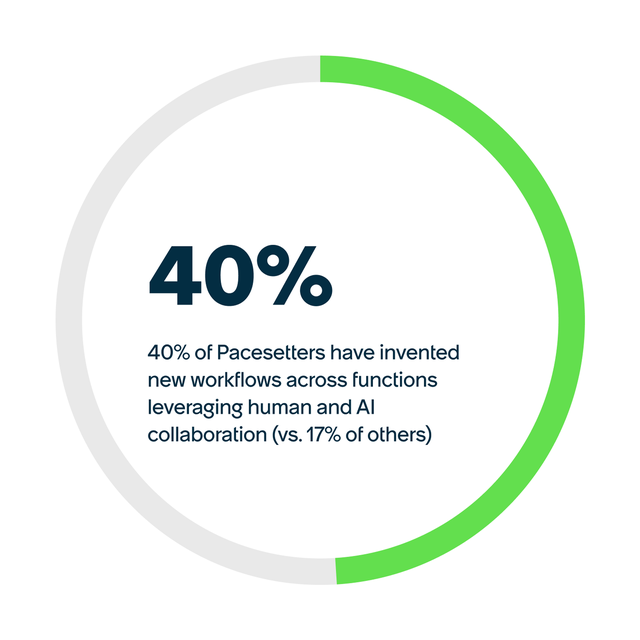
Data callout 40% of pacesetter have invented new workflows across functions leveraging human and AI collaboration (vs. 17% of others)

Pacesetters bet big on AI
Percentage making large investments to optimize tech infrastructure
02 AI and scale Pacesetters scale processes Ninety-six percent of Pacesetters report mid-to-advanced progress in harnessing cloud, SaaS, and digital solutions to scale process and collaboration (vs. 56% of others). Pacesetters embrace traditional and generative AI

Pacesetters deploy AI solutions across the bank to address front- and back-office challenges, including:

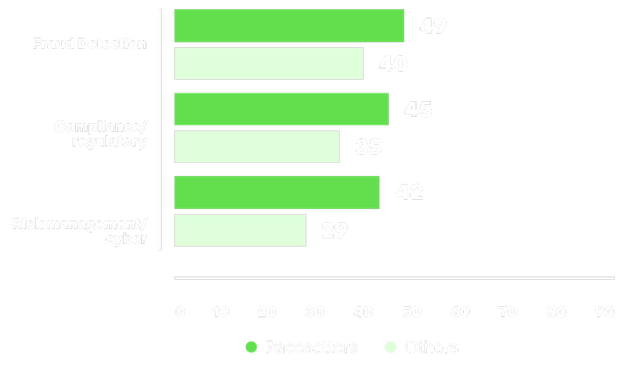
  • Fraud detection (49% vs. 40% of others)
  • Customer onboarding (49% vs. 38% of others)
  • GenAI (46% vs. 32% of others)
  • Compliance/Regulatory / Regulatory (45% vs. 35% of others)
Pacesetters focus on people and processes. They are more likely to:
  • Foster collaboration between business and IT teams (51% vs. 45% of others)
  • Monitor IT performance against business plans (48% vs. 34% of others)
  • Work with technology, consulting, and academic partners (48% vs. 34% of others)
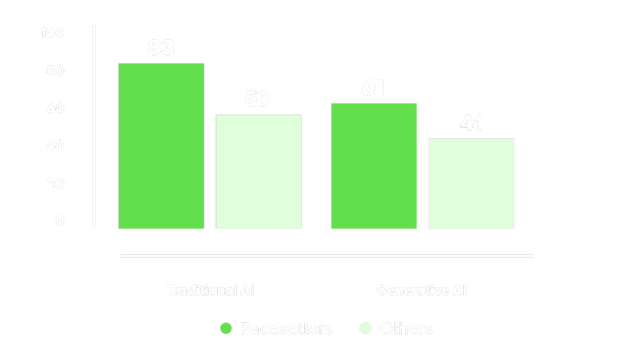
Bar chart showing Pacesetters outpace others in AI infrastructure investment. For Traditional AI: 83% of Pacesetters vs. 59% of others. For Generative AI: 61% vs. 41%.
03 Customer experience

Pacesetters put customers first

They are investing heavily in tech that improves experiences and builds trust. Pacesetters are more likely to:

  • Improve customer data privacy and security (54% vs. 44% of others)
  • Simplify customer onboarding (50% vs. 41% of others)
  • Personalize marketing and customer interaction (44% vs. 33% of others)
47% of Pacesetters have achieved increased customer engagement by investing in technology to improve experiences (vs. 34% of others)
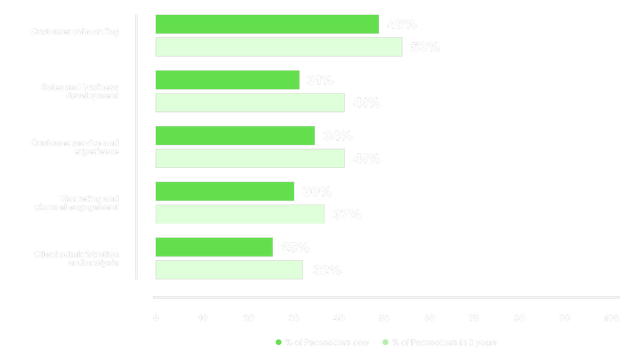
AI is the secret sauce Over the next three years, Pacesetters will increasingly use AI to power customer experiences.
Paired horizontal bar chart showing Pacesetter AI adoption now versus projected in three years across five business areas. Customer onboarding leads (49% now, 53% in 3 years), followed by Customer service and experience (34%, 41%), Sales and business development (31%, 41%), Marketing and channel engagement (30%, 37%), and Client administration and analysis (25%, 32%)
We use traditional AI to simplify new customer account openings. In the future, generative AI may help customize onboarding experiences based on financial history and needs, creating a more welcoming banking environment. Office of CEO executive universal bank, Netherlands
95% Pacesetters have made mid-to-advanced progress digitizing risk and compliance systems (vs. 49% of others)
04 Risk and regulation New risks, new playbook Over the next three years, banks will need to comply with an evolving web of regulations as policymakers take steps to mitigate digital risks that threaten consumers and markets. Banks expect AI regulations will take the biggest share of their compliance efforts over the next three years. Pacesetters’ tech priorities include:
  • Data management systems for sharing risk data
  • Predictive analytics
  • Cybersecurity technologies for risk detection
Pacesetters focus on digitizing compliance solutions. These will be the top priorities over the next three years:
  • Implement robust AI governance
  • Digitize, automate, and integrate compliance controls
  • Monitor privacy and data loss to maintain compliance
[We are] using GenAI to streamline regulatory compliance processes and enhance risk management practices. CTO Commercial bank, U.S.
Quote from a U.S. commercial bank CTO about using GenAI for regulatory compliance and risk management, paired with a bar chart showing Pacesetters outperform others in three areas: Fraud Detection (49 vs. 40), Compliance/regulatory (45 vs. 35), and Risk management/cyber (42 vs. 29)
TAKEAWAYS Pacesetters show the way 1 They use the latest security tools to predict, detect, and respond to cyber threats. 2 They drive business transformation at scale via pervasive use of cloud, SaaS, and API solutions. 3 They deliver frictionless customer experiences that simplify customer onboarding, personalize interactions, and deliver omnichannel engagement. 4 They use AI to detect fraud, onboard customers, generate new content, conduct real-time analyses, comply with regulations, and much more. 5 They provide the digital tools and experiences employees need to excel, including mobile apps, digital performance management systems, and automated employee and HR workflows. 6 They manage governance and compliance aggressively via data security controls and third-party risk management. They also digitize KYC/AML checks and build such checks into client onboarding.
Alt
Transforming Banking Unlocking transformation at scale can help banks build better customer experiences and improve risk and resiliency. Get the full report
Next up
Dive into more conversations AI App Development CRM Customer Stories Ethics & Governance Human Resources Industries IT Now On Now Platform Foundations Products & Solutions All Topics
Stay in the know Join Us
stay in know image
Alt