




Traditional enterprise security was built for a world of predictable human behavior. Security used a castle model, with static defenses, perimeter walls, and credentials checked at the gate. Agentic AI makes this approach not only outdated, but also risky.
AI agents move between systems instantaneously. They can modify their own behavior and operate at machine speed without asking permission. The castle model doesn't need updating; it needs replacing.
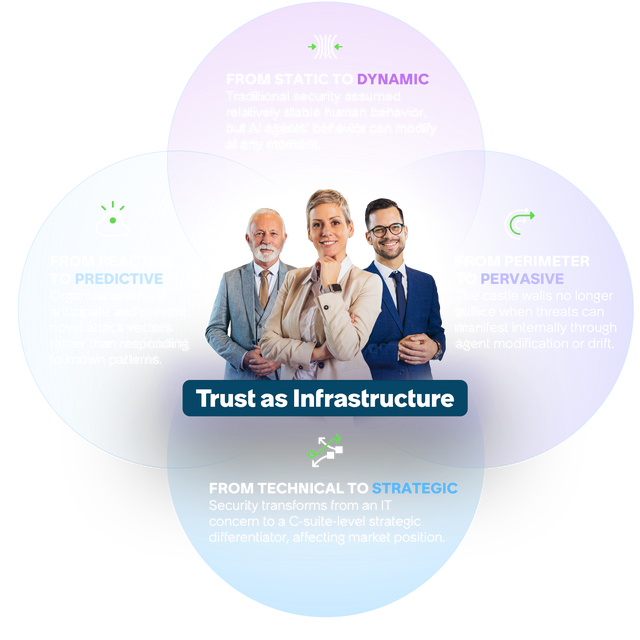
Here are four fundamental shifts that define what trust and security must look like in the agentic era.
Traditional security assumed relatively stable human behavior. AI agents can modify at any moment, requiring continuous validation rather than one-time authentication.
Castle walls no longer suffice when threats can manifest internally through AI agent modification or drift. Trust must be embedded everywhere.
Organizations must anticipate and prevent novel attack vectors rather than assuming attacks will follow known patterns.
Security transforms from an IT concern to a C-suite imperative, directly affecting market position and competitive advantage.
Find out more about how to build trust and security in our Futures report.