





Australians pride themselves on a fair go, or fair chance, but when it comes to poor customer service, that goodwill is running out fast. ServiceNow’s latest customer experience (CX) report found that Aussies spent more than 113 million cumulative hours on hold resolving service issues. That’s more than nine hours per person per year waiting in a customer service queue. They’ve had enough.
Consumers expect their issues to be resolved right away, and nearly two-thirds believe AI is essential to making that happen. For organizations that don’t meet these expectations, the negative consequences are real and immediate.
The need for speed has become a deal-breaker in Australia, with almost half of Aussies prepared to switch to a competitor if a company wastes their time. Over one-third will request a refund or compensation after a poor service experience.
We’ve entered a new era of AI confidence as consumers reset what great service should feel like. Businesses face a tipping point: If they continue to deliver slow or subpar service, they risk losing customers, revenue, and market share. The good news is that AI in customer service can help.
For more than half of Australians, AI has improved their experience engaging with brands while frontline teams are already dependent on AI to deliver more individualized, empathetic experiences.
If consumers and employees are all-in on AI-powered experiences, why are so many organizations falling short?
Business leaders spend a lot of time talking about their customer service transformation efforts. Over the past year, more than 80% have invested in chatbots, virtual assistants, and automated routing, according to the ServiceNow Workforce Skills Forecast. But when asked how it's going, the answer was consistent: They have AI in all their tools, but the tools don't talk to each other.
Look under the hood at most organizations, and you’ll see customer relationship management (CRM) software, ticketing platforms, and billing applications, among others, yet no shared data between them.
Add AI and you get a chatbot that can look up information, an assistant that summarizes tickets, and a virtual agent that checks account status. But none can see across all the systems to resolve an issue end to end.
Instead, customers are left waiting while service reps toggle between screens. Frustration grows on both sides.
In a market where there’s no room for fast followers, the pressure is on for leaders to connect their people, data, and processes. Simply adding AI to existing silos doesn't help; it just automates dysfunction faster. Last year, Qualtrics’ XM Institute estimated that poor customer experience was putting $3.7 trillion in global sales at risk.
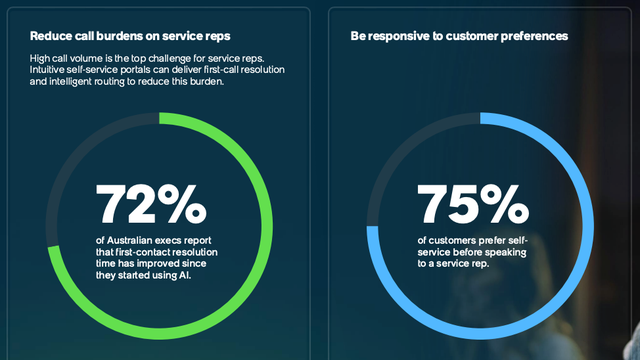
The ultimate service experience is the one you don’t realize you’re having. When CRM AI agents work autonomously behind the scenes to anticipate needs, they can determine the best course of action, manage workflows across departments, and resolve issues before customers even ask. Tellingly, three-quarters of consumers now opt for self-service before speaking to a human representative, our CX research found.
Organizations that see AI as a replacement for frontline teams are fundamentally misreading what their customers want. Australians are looking for service that’s not only swift, but also personal. When the situation calls for a customer to be involved at multiple touch points—for example, setting up electric service at a new residence—service representatives should show up in the right place, at the right time, and with context.
After slow response, Australians cite unclear explanations about next steps and service standards as a trigger to switch or complain, followed closely by inconsistent or conflicting responses.
Nexon Asia Pacific, an Australia-based digital and IT services company, faced exactly that. It had 70 service agents juggling various tools, fragmented data, and inconsistent service-level agreements. Its customer satisfaction score (CSAT) was stuck at 89%.
The company was tempted to add more tools. Instead, Nexon consolidated using the ServiceNow AI Platform and then deployed AI to orchestrate across it with Now Assist for Customer Service Management.
In just three months, Nexon’s CSAT climbed to 96%, and agent productivity increased 13.8%.
What the Nexon team is doing with AI and ServiceNow Workflow Data Fabric is just as impressive. They’ve shrunk the customer-onboarding process from a week of development effort to just two hours and helped improve time to value for customer investments, realizing 12% year-on-year revenue growth.
Nexon's results aren't unique. We’re seeing the same metrics across Australian organizations that deploy a unified AI platform: faster resolutions, higher CSATs, and measurable revenue impacts.
Despite this progress, only 45% of Australian businesses report using a single source of truth for their data, and fewer (35%) have connected workflows across their operations.
It’s no surprise that service representatives are feeling the strain. On average, they’re using three to five systems to resolve a single customer issue. That swivel-chairing and screen-toggling add up, with complex query resolutions stretching to a full working week. Less than half their time (44%) is spent actually helping customers.
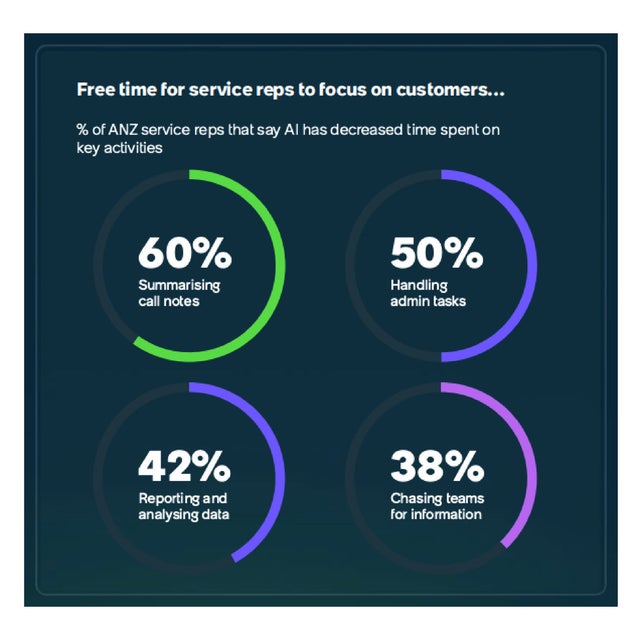
Frontline teams using AI tell a different story. They report a 60% reduction in time spent manually writing up call notes and a 48% improvement in ability to address customer issues. More than half say they’re relying on AI to deliver superior service.
It’s not news that customer service is plagued by high burnout. Solutions such as ServiceNow Customer Service Management can help lighten the emotional load by automating routine tasks behind the scenes, such as gathering account information, summarizing case notes, identifying recent payments, and suggesting next actions.
The real promise of AI-powered customer experience is not to substitute for people, but to elevate them. This requires leaders to recognize and defend the interests of both their customers and employees. They can do this by embracing autonomous digital teammates to proactively fix bottlenecks, address pain points, and eliminate the mundane drudgery nobody has ever wanted to deal with.
In an era where friction and delays won’t be tolerated, organizations have a narrowing window to define what comes after this AI service tipping point and give Australians what they’re asking for: seamlessness, transparency, and a distinctly human touch.
Find out how ServiceNow can help you put AI to work for customer service.