
Conversations On AI App Development CRM Enterprise IT Ethics & Governance Futures HR Industries ServiceNow on ServiceNow Platform Foundations Products & Solutions All topics For Leaders In IT & Dev Customer Experience Finance, Operations & Strategy Employee Experience Security & Risk News & Events People & Culture My List Explore All
February 24, 2025 12 min AI-Powered Cities
of the Future
AI holds potential to make cities safer, healthier, and more sustainable
A report by ServiceNow, Deloitte, and NVIDIA in collaboration with ThoughtLab

AI Research Download report
AI powered cities of the future
Top habits of AI leaders 1 They get their data straight
88% of AI leaders integrate data across departments/silos
2 They use intelligent IT platforms
88% of AI leaders are midway or advanced in leveraging a modern IT platform
3 They prioritize human-led innovation
92% of AI leaders have digital innovation teams to drive their AI initiatives
4 The focus on good governance
73% of AI leaders establish clear AI governance frameworks
A new age of urban reinvention

What do you picture when you think about a city of the future? Flying cars? Wireless…everything? Well, you’re not that far off. AI is proving to be a force multiplier of progress, helping cities become safer, smarter, and more efficient. And that’s important because a report by the United Nations found that by 2050, about 68% of the world’s population will live in urban environments—2.5 billion more people than today.

For this study, ServiceNow, NVIDIA, and Deloitte collaborated with research firm ThoughtLab to examine the AI plans, investments, and practices of cities around the world. We identified AI leaders on every continent and discovered some truly groundbreaking use cases, from disease outbreak prediction in Chicago to water harvesting in Jaipur, India.


"With the right digital infrastructure, cities can unlock AI’s potential to become safer, healthier, and more sustainable than ever before." Paige Young Chief Corporate Affairs Officer, ServiceNow
Research highlights Survey demographics 259 cities surveyed 78 countries 49 cities identified as AI leaders “AI has the power to catapult cities into the future. By leveraging data-driven insights, AI can revolutionize urban planning to make cities more resilient and sustainable.” Michael Flynn Global leader for Infrastructure, Transport and Regional Government, Deloitte Ireland 92% of AI leaders are developing integrated data management systems 83% of cities will make wide or selective use of traditional AI by 2027 AI-ready cities What are they doing differently?
AI ready cities Americas
Americas
AI ready cities Asia Pacific
Asia Pacific
AI ready cities Europe and Middle East
Europe & Middle East
01 AI’s Urban Takeover

AI presents a unique opportunity to improve the lives of residents, employees, and local businesses while strengthening urban readiness and resilience.

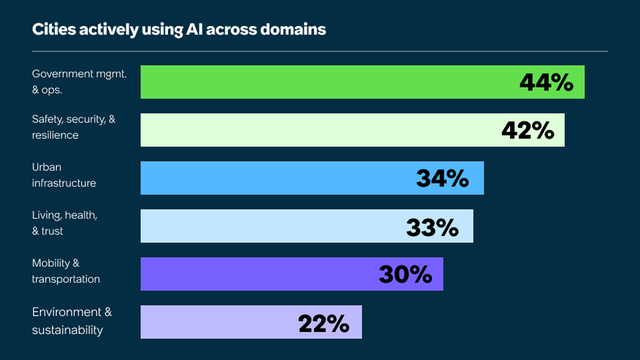
We found that 43% of large/mega cities surveyed are already deploying traditional AI. And while only 12% of small cities surveyed do so today, that number will jump to 41% in three years. Meanwhile, generative AI (GenAI) is becoming a game changer, with almost nine out of 10 cities planning, piloting, or using GenAI. Expect an almost 3x increase in the number of cities widely or selectively using GenAI over the next three years—from 18% to 59%. AI is already making an impact across the urban landscape, from digitizing government operations to optimizing energy usage.
AI will allow cities to do what they already do better, faster, and more efficiently. But crucially, it will enable cities to do things they could never do before. Jumbi Edulbehram Global Business Development, Smart Cities and Spaces, NVIDIA
Cities actively using AI across domains
City spotlight Tokyo Japan
City Spotlight Tokyo, Japan Situated solidly in the Pacific Ring of Fire, Japan has experienced more than its fair share of earthquakes, tsunamis, and other natural disasters. To mitigate this geologic vulnerability, the city of Tokyo has implemented a comprehensive disaster preparedness system that combines sensors with predictive modeling, simulation tools, and community-based disaster management initiatives. Bolstering this effort is a network of high-altitude cameras that automatically detect early signs of impending disasters and issue rapid alerts, speeding up response times and potentially saving lives. Download the research paper for more urban AI use cases
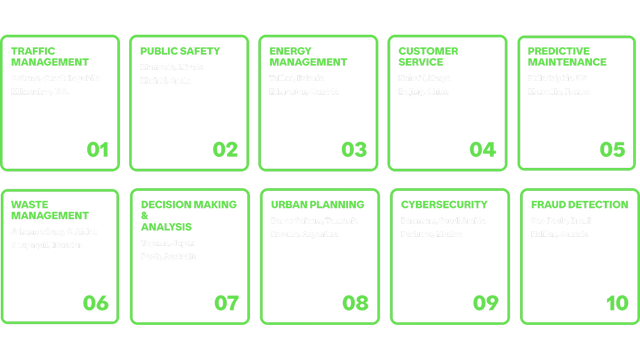
The top 10 most effective AI use cases ranked by city
Top 10 most effective AI use cases
02 Future-Ready Frontrunners

Climate change, public health crises, crime, lack of affordable housing-cities are grappling with a host of complex problems. Al has the potential to move the needle on these seemingly intractable issues.

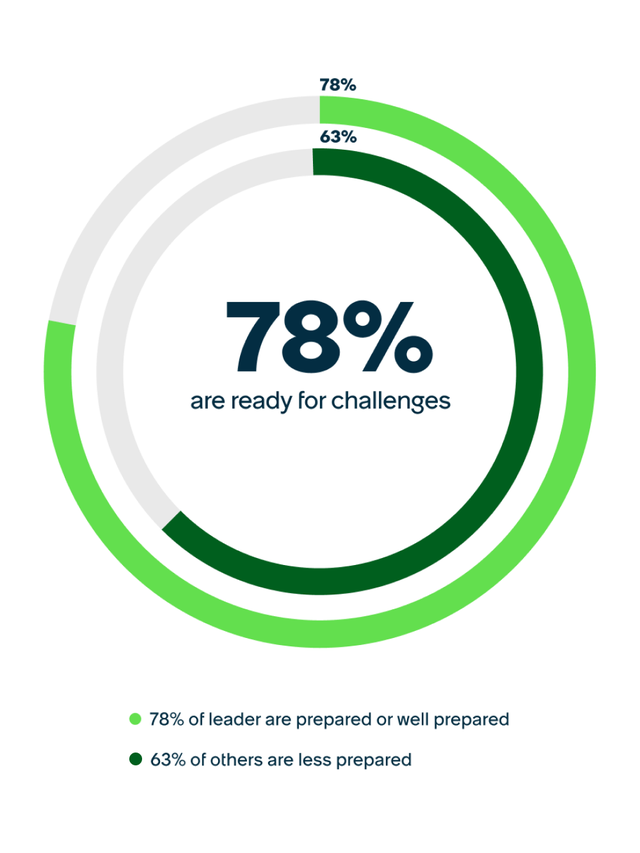
We found that 78% of Al-leaders surveyed are well or very well prepared to deal with challenges, compared to 63% of cities that are less prepared. And nearly three times as many Al leaders are very well prepared compared to others.
Modernized IT platforms have made it possible for the city to provide self-service capabilities to residents, enable employees to work remotely, and adjust to shifting expectations. City official Jeddah, Saudi Arabia
Future ready frontrunners
City Spotlight Raleigh North Carolina
Raleigh, North Carolina Future-Ready Frontrunners The heat is on during summer in Raleigh, North Carolina, when temperatures reach into the mid-90s Fahrenheit. To help their planners improve urban livability, leaders created a citywide digital twin that models the microclimate impacts of new urban developments. The twin is then integrated with an AI-driven microclimate modeling tool that forecasts weather conditions. The result is smarter, more sustainable development that minimizes impact on urban heat levels. Download the research paper for more AI use cases
03 Governance at the forefront

While AI creates huge opportunities for cities, it also presents risk for residents. The potential for discrimination, job displacement, data breaches, and loss of privacy should not be taken lightly. Meanwhile, as cities transfer more control to machines through GenAI and Agentic AI, the risk of misinformation and bad decisions could escalate.

Without the proper safeguards, these errors could be catastrophic in cities, where energy grids, infrastructure, and other systems are interconnected. That’s why today’s AI leaders are taking a multipronged approach to AI governance.

Just like the physical infrastructure cities are built on, AI is only as powerful as the platform it's built on. Casey Coleman VP of Global Public Sector, ServiceNow
Top actions leaders take
to build robust AI governance
73% Establish a clear AI governance framework 65% Implement guidelines for handling of personal data 61% They prioritize human-led innovation
92% of AI leaders have digital innovation teams to drive their AI initiatives

City Spotlight Amsterdam Netherlands
City Spotlight Amsterdam, Netherlands Aiming to be open and transparent about their use of algorithms and AI, Amsterdam has created an AI registry that gives insight into the nitty gritty details of the city's AI applications, including which datasets were used and how the algorithms were assessed for potential bias. There are currently 42 services available in Amsterdam’s AI registry, making it a pioneer of public sector transparency.  Download the research paper  for more AI use cases.
WHAT‘S NEXT? Agentic AI While GenAI is driving innovation in cities today, the next wave is Agentic AI, which enables fleets of AI agents to act and interact in smart and autonomous ways. As cities become smarter, autonomous AI agents will become the driving force behind projects such as managing traffic flow, optimizing energy use, and improving public safety. 
Predictive maintenance and planning allow us to reduce the need for costly emergency repairs and extend the lifespan of urban infrastructure assets. City official Murcia, Spain
04 Follow the leaders We found that 88% of AI leaders surveyed are midway or advanced in deploying a modernized IT platform, compared to 43% of others. In addition, those who have been the most successful in their AI efforts follow these seven best practices.
What sets AI leaders apart? 1 Make a top-down commitment
88% of AI leaders integrate data across departments/silos
2 Build a modern data and IT foundation
88% of AI leaders are midway or advanced in leveraging a modern IT platform
3 They prioritize human-led innovation
92% of AI leaders have digital innovation teams to drive their AI initiatives
4 The focus on good governance
73% of AI leaders establish clear AI governance frameworks
5 They get their data straight
88% of AI leaders integrate data across departments/silos
6 They get their data straight
88% of AI leaders integrate data across departments/silos
7 They get their data straight
88% of AI leaders integrate data across departments/silos
Artificial intelligence,
real transformation
AI Powered Cities of the Future Get the full report
Next up
Dive into more conversations AI App Development CRM Customer Stories Ethics & Governance Human Resources Industries IT Now On Now Platform Foundations Products & Solutions All Topics
Stay in the know Join Us
stay in know image
Alt