






Over the past year, the leadership conversation around AI shifted. The focus moved from investment to tangible outcomes. Budgets got approved. Pilots ran. Tools were implemented.
Now many business leaders are asking what it all adds up to. Answering that question is harder than it should be because many organizations are missing return-on-investment (ROI) opportunities.
Their people are getting faster at tasks, running AI agents, and reporting activity to the board. The problem is that those may not be the most valuable metrics to indicate AI success. Most organizations may not realize that until the gap that separates them from AI leaders becomes too difficult to close.
For the third consecutive year, ServiceNow surveyed 4,500 executives for its annual Enterprise AI Maturity Index. For the first time, we included 2,000 employees across 19 countries and 12 industries in our survey. We measured AI progress across seven pillars:
- Vision and leadership
- Management and culture
- Data modernization
- Governance
- Talent and skills
- AI-enabled workflows
- Value creation
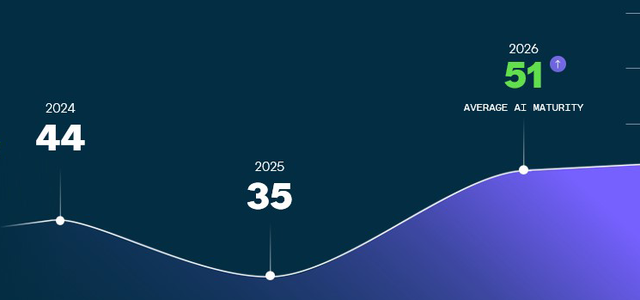
In 2024, AI maturity meant adoption: implementing AI, running pilots, and showing the board momentum. In 2025, the average AI maturity score dropped as technology outpaced infrastructure and organizations found out the hard way that speed without foundation creates problems faster than it solves them.
In 2026, an AI maturity rebound reflects something different: Organizations are entering an execution phase with clearer direction and more accountability.
However, the rebound masks a structural problem. Organizations scored highest in vision and leadership, at 57 out of 100. They scored lowest in AI-enabled workflows, at 40. The 17-point gap between those two pillars signifies the disparity between a strategy that looks right and an organization built to execute it.
The reason most organizations are stuck comes down to a structural choice: deploying AI into existing infrastructure rather than building infrastructure designed for AI to run on.
The two approaches look similar at first glance. Over time, however, the results diverge sharply. Organizations on the first path get faster. Organizations on the second path innovate and differentiate.
The research backs this up. More than half (59%) of organizations have moved beyond piloting agentic AI, yet only 9% have made progress building the autonomous, multistep workflows that agentic AI is supposed to enable.
Cross-functional AI integration dropped from 30% in 2025 to 16% in 2026. This isn’t a sign of organizations failing at AI, but of succeeding at a version of AI that won't scale across the enterprise.
Every year, a group of those furthest along in AI maturity pulls ahead. We call them Pacesetters. This year, they represent 21% of organizations. What defines them is a set of decisions made before deployment, not after.
As a result, Pacesetters are achieving an average return of 160% on their AI investments and are projected to reach an ROI of 194% in two years. Let’s take a closer look at what separates them from the other organizations in our study.
Strategy for Pacesetters is something the whole organization owns, not something leadership hands down.
Nearly three-quarters (71%) of Pacesetters communicate AI vision across the organization, compared to 29% of others. In addition, 57% of Pacesetters have set a strategic vision for AI that goes beyond efficiency gains, compared to just 21% of others. That alignment keeps execution coherent as complexity scales.
Data integration isn’t always easy, but doing it effectively determines whether AI operates with the full context of your enterprise or just a fragment of it.
Nearly two-thirds (64%) of Pacesetters use digital technologies to integrate and optimize data before deploying AI at scale. That’s true for only 14% of other organizations.
More than one-third (36%) of Pacesetters use agentic AI to create autonomous, multistep workflows, compared to only 2% of others.
That gap reveals a disconnection between automation and orchestration. Automation makes individual tasks faster. Orchestration changes how work moves across an organization, connecting systems, decisions, and people in ways that fragmented infrastructure never could.
Most organizations sort out the technology first and bring people along later. Pacesetters reversed that sequence.
Fifty-seven percent of Pacesetters provide tailored, ongoing AI training and upskilling programs. Only 4% of others have equivalent initiatives in place. Pacesetters are 2.6 times better at employee engagement and retention as a result. They understand an AI strategy without a workforce strategy is a plan with no one to run it, and the skills required to work alongside AI agents aren't ones people develop on their own.
Autonomous doesn't mean unattended. The organizations moving fastest with AI are those that decided early on exactly where human judgment begins.
Sixty-nine percent of Pacesetters embed trust and transparency into AI processes from the outset, compared to 16% of others. Pacesetters understand that building governance before deployment gives them confidence to move fast, because every autonomous decision is already grounded in the rules of the organization.
Every workflow Pacesetters execute adds enterprise context that makes the next deployment smarter and faster. For organizations still running AI on fragmented infrastructure, the same effort adds complexity without compounding returns. The gap widens with every cycle.
Instead of asking “How are we using AI?” organizations should be asking “Is our infrastructure built to execute AI?”
Get more insights in the complete Enterprise AI Maturity Index 2026 report.