




Call it due diligence: Most of us like to double-check or even triple-check important work before it leaves our desks. We review, revise, and sense-check.
Yet Australian organizations seem comfortable with AI outputs that haven’t been checked at all, according to the ServiceNow Enterprise AI Maturity Index 2026. The majority of businesses are trying to scale AI without verifying or validating what it produces.
Our research found that only one in four Australian enterprises has AI testing or auditing processes in place. And just 17% have implemented systems to manage and track their AI governance and compliance.
With so much critical data left unchecked, the opportunity for errors is wide open. Our research confirms that, showing that Australia is the country most concerned about AI accuracy and in need of AI guardrails.
This lack of oversight reflects the breakneck speed at which organizations are investing to transform. Leaders have a shorter runway to deliver results.
The research found Australia’s AI spending surged 115% year on year, 5% above the global average. The nation has leaped ahead in the race to harness AI for a tech-driven productivity boost, lifting its AI maturity score from 36 out of 100 in 2025 to 51 in 2026.
There’s no room for fast followers in the AI era, but that urgency is now exposing an alarming oversight when it comes to governance. Organizations are buying into AI quicker than they can embed it into day-to-day operations.
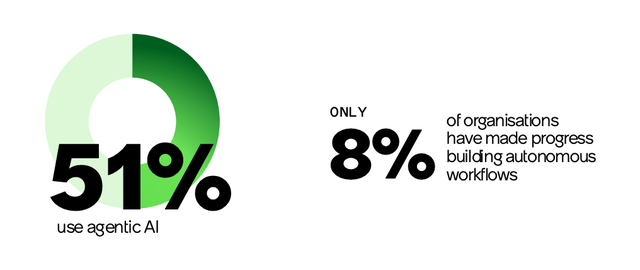
Leaders have spent two years experimenting with AI tools at the expense of enterprisewide workflows. Although 51% of Australian organizations are using agentic AI, according to our research, only 8% have built autonomous workflows. Most are using AI to help individuals, not to transform how work gets done—essentially investing in capabilities that aren’t being fully implemented.
In that context, 40% of Aussie leaders say they don’t have visibility into how AI is being deployed or what it has access to. How do you govern what you can’t see?
The challenge I see most often is that governance conversations are happening after AI is already deployed and problems have started. Decision-makers put governance on the “we’ll think about this when we’re ready to scale” list when they’re under pressure to get pilots to production.
In reality, those scaling AI fastest build governance into the foundation. Without it, deployments inevitably stall—flagged by the risk officer, the legal team, or the board. Our research findings are stark:
- 72% of leaders cite inadequate data accuracy, access, and management
- 62% cite lack of transparency and potential for misinformation from AI
- 54% cite data privacy and security concerns
Governance isn’t just about risk management; it’s conditional to trust and business-wide adoption. Human experiences can be elevated when trusted AI is embedded in workflows across the enterprise.
The Salvation Army Australia, one of the country's largest not-for-profits, is focused on human connections. The charity helps thousands of vulnerable Australians each year, touching every demographic.
Five years of engagement surveys showed that the organization’s 12,000 employees were struggling to navigate two dozen applications.
“Our people were overwhelmed by fragmented systems, duplicated processes, and the cognitive burden of navigating more than 20 applications just to do their jobs,” says Milad Kruze, chief information officer at The Salvation Army Australia. “That load was taking them away from what matters most: empathy, compassion, and connecting with the people we serve.”
The organization sought a simpler, trusted front door to its technology environment.
Kruze and his team launched Goldie, an AI-powered employee experience tool built on ServiceNow EmployeeWorks and implemented by 89 Solutions. Accessible through Microsoft Teams, Goldie lets employees ask questions in plain language and receive instant answers, regardless of where information is stored.
Crucially, rather than bolting AI on top of fragmented systems, The Salvation Army Australia designed governance and guardrails into Goldie from day 1. It’s a “safe to play” environment in which employees can access only approved internal systems and operate within existing permissions.
This approach means staff can experiment and use Goldie with confidence, knowing data is secure and outputs are based on what employees can already access in the organization’s systems.
Beyond efficiency, Goldie helps frontline workers stay present with the people they serve.
Since rollout, Goldie has resolved nearly 90% of queries without escalation through 22,000 conversations. This has helped save more than 2,700 hours for frontline workers alone and given valuable time back to addressing community issues, including homelessness, family violence, and addiction.
“By giving our teams a single, conversational front door to get things done, we’ve removed that administrative friction and returned time, confidence, and purpose back to the front line,” Kruze says.
The Salvation Army Australia has achieved enterprise-grade AI at scale in less than a year, ahead of organizations with 10 times the resources. What does that teach us? The organization built the proper foundation first: connected data, integrated systems, and governance. That decision is now showing up in returns that are difficult for competitors to realize.
The next stage of Australia's AI maturity will be defined by how effectively organizations turn their investments into productivity, trust, and resilience. It's time to move beyond pilots and point solutions to connect AI across workflows.
The Pacesetters—those furthest along in AI maturity in our research—have proven that when you establish the fundamentals of interconnected data, integrated systems, and clear governance early, you can create a platform for confidence and scale. Ultimately, this approach is what makes AI work more human, not less. That's why leaders need to embed governance from the start.
Find out how ServiceNow can help you control and govern AI.