



Maturity
Index 2024


Companies, governments, and nonprofits have a generational opportunity to put AI to work for their people.
AI Technologies such as machine learning, natural language processing, computer vision and decision-making algorithms—as well as the large language models that power generative AI applications—increasingly touch every part of our lives. Their potential business benefits are coming into focus: greater productivity, faster innovation, and improved experiences for customers and employees alike. Yet most organizations are still beginning their AI-powered business transformation.
To better understand how organizations are deploying AI, ServiceNow and Oxford Economics teamed up to create the Enterprise AI Maturity Index. We surveyed nearly 4,500 senior leaders and IT decision-makers worldwide and used a proprietary indexing model to measure the AI maturity of their organizations.
We found that while most organizations are early in their AI journeys, a select few are pulling away from the pack. Our research reveals that these AI Pacesetters share certain attitudes and practices that help distinguish them from their peers. These emerging best practices can help any organization put AI to work effectively.
Read on to explore key findings, or click below to download the full report.

Chief Customer Officer
How are organizations using AI to transform their operations? To answer that question, ServiceNow and Oxford Economics surveyed nearly 4,500 global executives about their organizations’ progress with AI. We plugged their answers into a maturity model, developed in collaboration with ServiceNow's Office of Innovation, that measures performance in five key dimensions—strategy & leadership, investment, workflows, talent, and governance—to create an AI maturity score between 0 and 100.
The results confirm that the race to put AI to work has just begun. The average Enterprise AI Maturity Index score in 2024 was just 44. Only about one-sixth of respondents scored higher than 50, and no organization received a score higher than 71. At this early stage, AI maturity is quite low across the board.



To identify best practices in enterprise AI, we examined the behaviors and attitudes of the top-scoring organizations in our survey. We wanted to know where AI Pacesetters were outperforming and how they achieved those results.
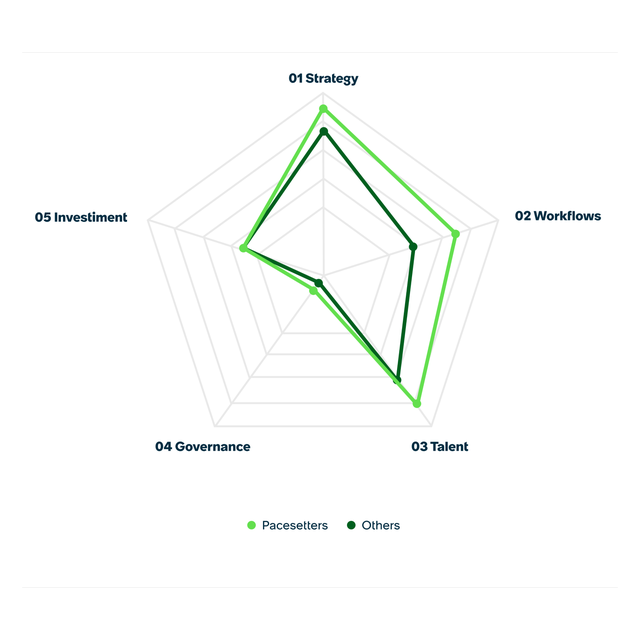
Based on their answers to survey questions, we classified companies that scored highest across the five dimensions of the Enterprise AI Maturity Index as “Pacesetters.” Only one-sixth of all the organizations in the survey ranked as Pacesetters. These companies were much more likely than others to benefit from visionary leadership, leverage AI to reshape how work gets done at scale, develop talent to fuel AI progress, enable transformation through sound data and AI governance, and align investment strategy and performance metrics to their AI vision.
Read on to see what it takes to be an AI pacesetter.

guided by visionary
leaders
AI Pacesetters benefit from the guidance of strong leaders—in fact, our research shows no factor predicts AI maturity as well as a clear strategy driven by senior leadership. They understand that AI-powered business transformation isn’t a job that one executive or function can handle alone.
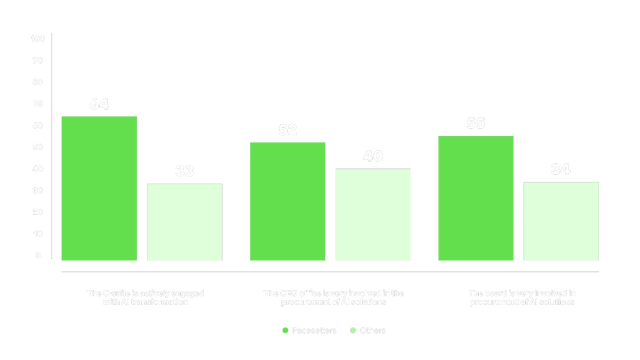
Pacesetters are more likely than others to say that the IT (83% vs. 67% others) and security/cybersecurity functions (79% vs. 56%) are very involved in setting AI strategy. And they are far more likely to say board members (55% vs. 34% others), the CEO office (52% vs. 40%), operations (43% vs. 30%), and legal teams (42% vs. 28%) are very involved as well.
AI Pacesetters know where they want to go
AI-powered business transformation can be a difficult journey if you lack a clear picture of the road ahead. AI Pacesetters are more than twice as likely as their peers to strongly agree that they are operating with a clear, shared AI vision across the organization.
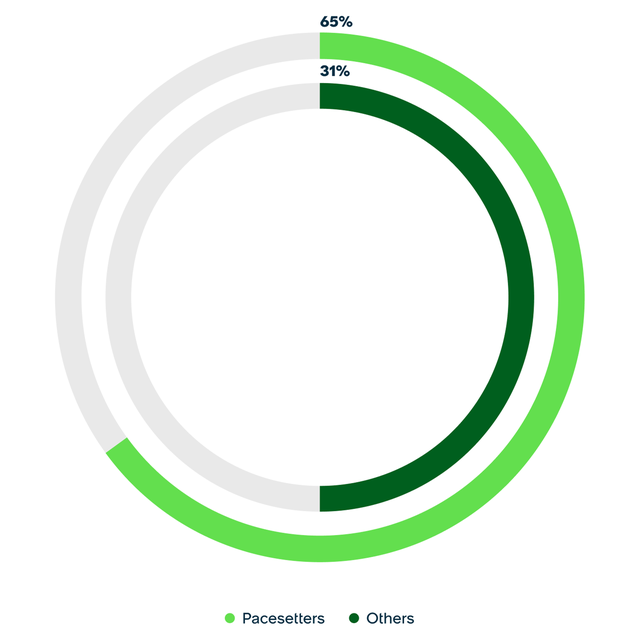
The strong C-suite leadership and common vision reported by Pacesetters go a long way toward creating consensus within their organizations. That helps explain why Pacesetters are significantly more confident (65% vs. 31% others) that their department or function is aligned with others across the organization when it comes to AI strategy.
Perhaps the most notable area where Pacesetters stand apart from others is in how they measure the progress of their AI initiatives. Nearly two-thirds of Pacesetters (62%) strongly agree that they have a defined set of metrics in place to measure the impact of and return on AI transformation efforts, while a meager 28% of others share this conviction.
Without tracking the performance of AI initiatives with clear and measurable KPIs, executives may be missing out on critical insights that could improve how transformation is carried out.
Brian Solis, ServiceNow’s Head of Global Innovation, and Mike Bechtel, Deloitte Consulting LLP’s Chief Futurist, discuss how leaders drive AI transformation.
Chris Bedi and Yuzuru Fukuda-san share insights on leveraging AI for digital transformation and the future of work at Fujitsu.

leverage AI at scale
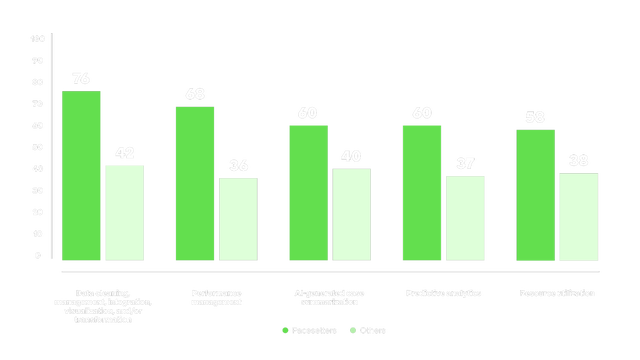
It may be the early days of the enterprise AI revolution, but Pacesetters are already leveraging the technology to optimize their own operations. They’re much more likely than others to work smarter by deploying AI for data cleaning, management, integration, and visualization (76% vs. 42%); performance management (68% vs. 36%); case summarization (60% vs. 40%); and predictive analytics (60% vs. 37%).
Pacesetters are also using AI to improve customer experience. Top priorities for Pacesetters over the next three years include harnessing generative AI to create customer support summaries and power customer agent assistants.
Functional silos and old ways of working can present significant hurdles to business transformation. Pacesetters are achieving much greater success than their peers in breaking through these barriers—and they’re using AI to do it.
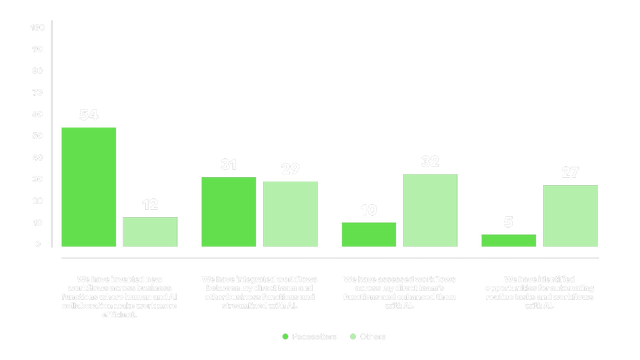
While most companies we surveyed are using AI and automation to optimize existing workflows within functions, Pacesetters take a different approach. They’re more than four times more likely than others (54% vs. 12%) to have invented new ways of working designed from the ground up with human-AI collaboration in mind. This approach is helping them unlock efficiency gains that less mature organizations struggle to match.
Pacesetters know these AI-powered workflows are only as good as their data. Some 60% of them say they’re making significant progress toward breaking down data and operational silos, outnumbering the 41% of others who report similar results.
Pacesetters know AI is only as intelligent as the platform it runs on
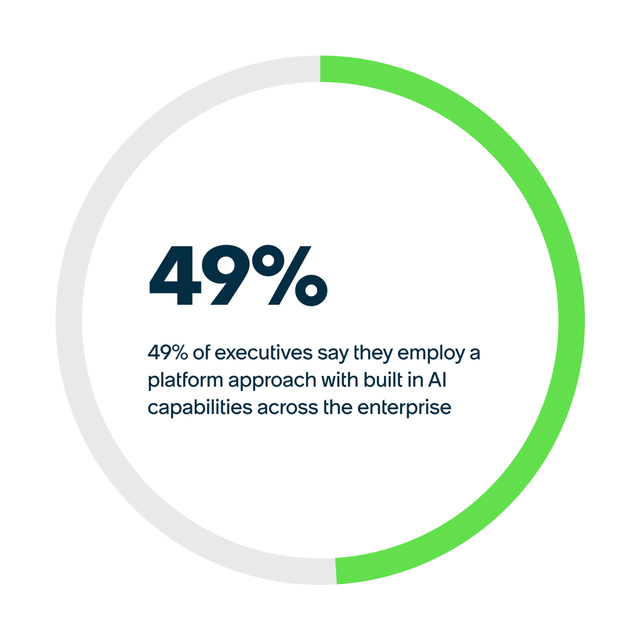
AI can’t achieve its potential as a catalyst for end-to-end business transformation if it’s sprinkled randomly across teams and functions. Pacesetters understand this, which is why they’re significantly more likely to adopt a platform approach with built-in AI capabilities that span the enterprise (61% vs. 46% others).
Overall, 52% percent of respondents say their AI applications span multiple business areas. Embracing the power of a platform approach is a key step toward becoming an AI pacesetter.
Gregory Chocoloff, Director for IT, HR, and Employee Services at Danone, explains how AI is changing how work gets done.
AI can help organizations work smarter. Vijay Kotu, ServiceNow’s chief analytics officer, explains how.

talent to the next level
AI Pacesetters know where they want to go
Leaders can set AI strategy, but execution requires a workforce with the skills to make it work. Pacesetters are ahead when it comes to preparing their people for AI transformation. In fact, they’re twice as likely as others (61% vs. 30%) to say their employees already have the right mix of skills and experience to execute their strategy.
That confidence makes it easier to foster a culture of innovation and allow workers to innovate on their own. About two-thirds of Pacesetters say they allow teams to identify problems and recommend AI solutions autonomously (68%), as well as make decisions about AI solutions that solve their functions’ business needs (66%).
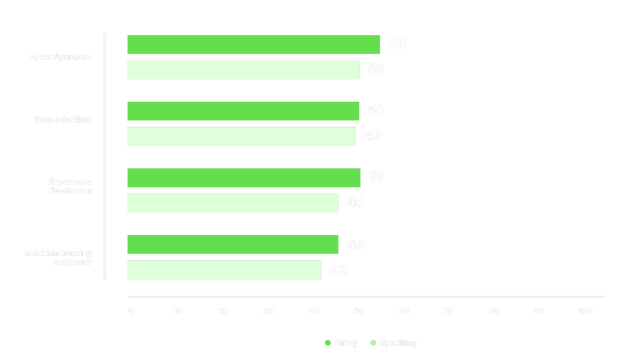
Most Pacesetters have confidence in their people’s abilities, but that doesn’t mean they aren’t looking for reinforcements. In fact, a majority of Pacesetters plan to accelerate hiring across eight key AI-related job categories.
AI configurators, data scientists, and experience developers are at the top of the list. These roles are each cited as hiring priorities by more than 70% of Pacesetters. Demand for these workers will far outstrip supply in coming years. That's probably why a similar proportion plan to implement upskilling programs to develop the necessary expertise internally as well.
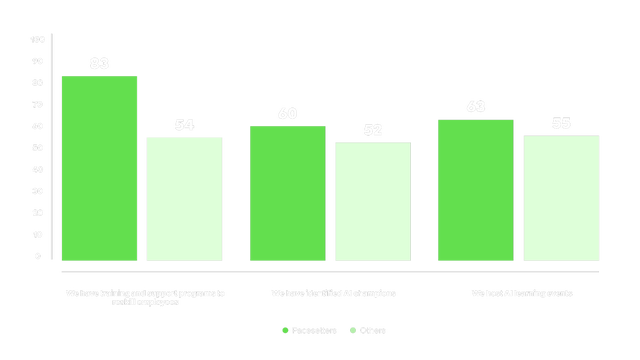
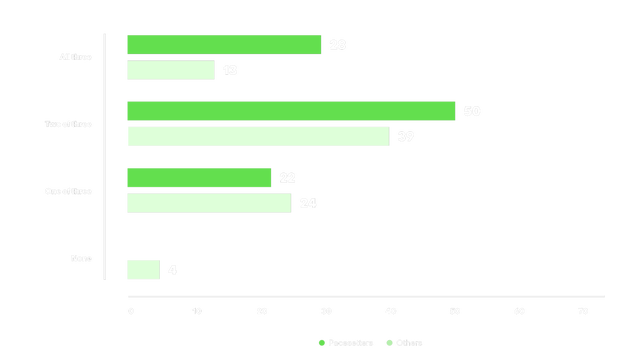
When it comes to upskilling for the AI era, Pacesetters are going all out. They are more likely than others to have implemented training and support programs to uplevel their employees’ skills, to have identified AI champions to evangelize the technology from the bottom up, and to have hosted AI learning events that disseminate expertise and best practices across the organization.
Pacesetters aren’t taking these steps in isolation. In fact, they’re much more likely than others to implement two of these measures (50% vs. 39%) or even all three (28% vs. 13%). Meanwhile, 44% of organizations that aren’t Pacesetters are doing only one.

innovate
responsibly
Any organization looking to put AI to work for people must institute an effective governance strategy that maximizes AI benefits while minimizing potential harms. Not surprisingly, Pacesetters ensure the right leaders are at the table when AI strategy is set. Additionally, a greater share of Pacesetters reports that the IT (83% vs. 67% others) and security/cybersecurity functions (79% vs. 56%) are very involved in defining AI strategy.
Pacesetters also separate themselves from the pack by empowering AI experts. They’re more likely than others to set up innovation centers to test new AI tools and solutions (62% vs. 39%). They are also more likely to create AI Centers of Excellence to ensure that appropriate guardrails are in place (62% vs. 41%).
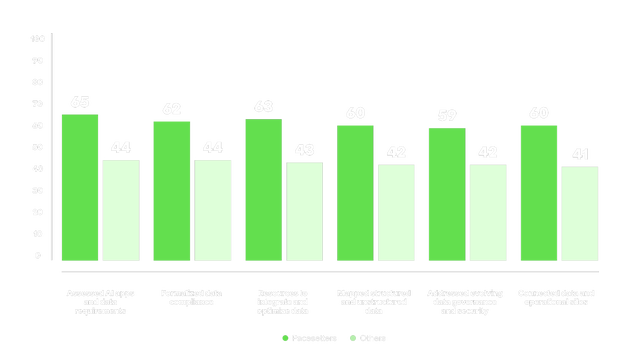
Without data, there’s no AI. So, it’s good news that about half of organizations report significant progress toward understanding, organizing, and securing their data.
Pacesetters are even more likely to say they have made headway on data governance efforts. More Pacesetters have made significant progress on acquiring technologies to integrate and optimize data (63% vs. 43% others). They are also more likely to have formalized data governance and privacy compliance (62% vs. 44%). Finally, they are ahead when it comes to meeting new AI governance needs and creating AI-specific policies to protect sensitive data and maintain regulatory compliance (59% vs. 42%).
Pacesetters build trust by paying attention to their people’s concerns
Many employees question the potential impact of AI on the business—and on their own futures. Given the vital importance of an engaged workforce invested in AI’s success, executives should respect employee concerns and work to address them.
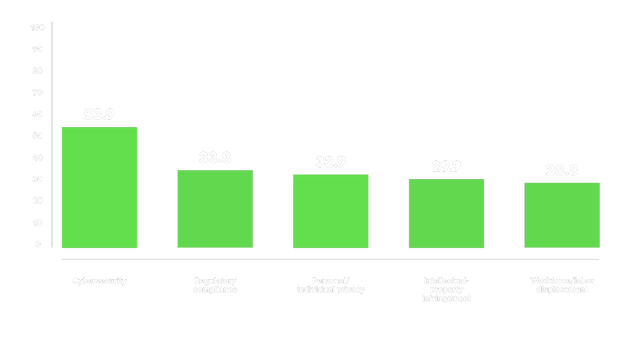
Pacesetters are more likely than others to acknowledge the AI governance concerns of their workforces. They say their people are raising concerns about potential AI harms, including data security lapses (66% vs. 53% others), compliance failures (61% vs. 47%), IP violations (58% vs. 42%), and job insecurity (57% vs. 46%).


lasting value
AI spending is surging, and Pacesetters are leading the way
Across regions and industries, most companies in our study plan to increase their investments in AI technologies. They see AI as a generational opportunity to transform their businesses and build competitive advantage.
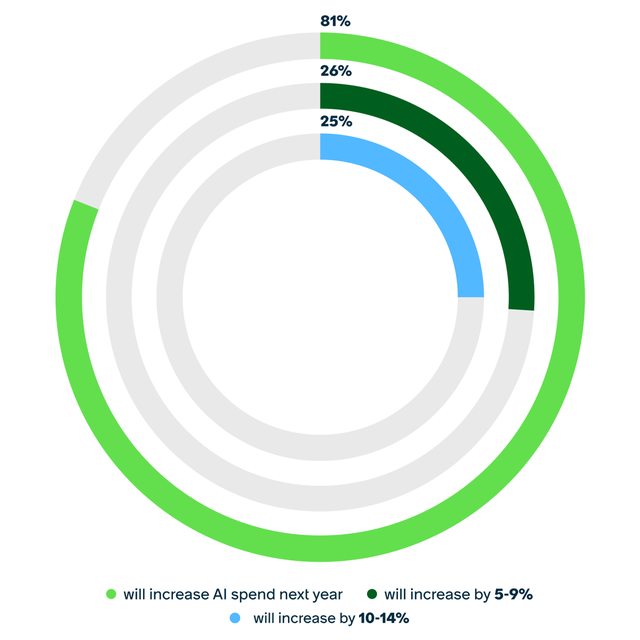
Among Pacesetters, this sentiment is nearly universal. While 81% of all organizations we surveyed say they plan to increase AI spending in the year ahead, 94% of Pacesetters report they will do so. Only two of the more than 800 Pacesetters we identified in our research say they will reduce AI spending over the next year.
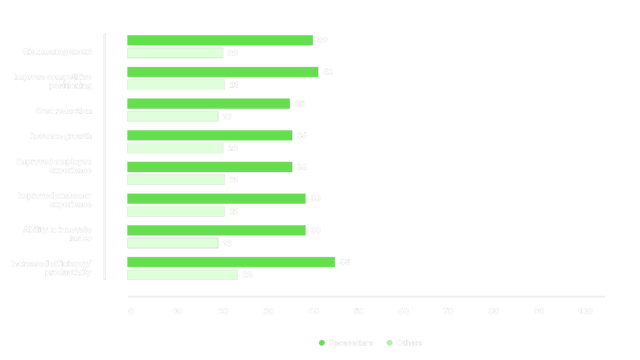
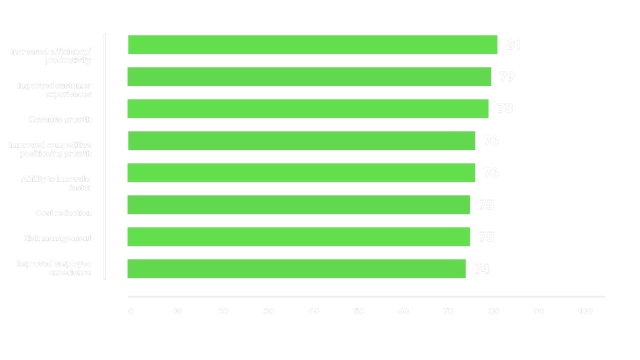
Organizations are deploying AI to help them achieve the business outcomes that matter most. Increased productivity, enhanced customer experience, higher revenue, improved competitive positioning, and faster innovation are each cited by more than three-quarters of organizations surveyed as crucial benefits they expect AI to deliver.
More Pacesetters are achieving positive returns on investment across these areas and similar ones compared with other organizations. (For example, 74% of Pacesetters say AI investments have paid off in the form of accelerated innovation, compared with 59% of others.) Still, although more Pacesetters have realized significant ROI than other organizations, only about one-third have seen returns of 15% or more in any business area. Plenty of opportunity remains to realize transformational results.
Excitement over AI’s potential is running high, perhaps matched only by executives’ optimism that the bets they’ve already placed on the technology are paying off. Indeed, about two-thirds of all leaders we surveyed say they believe their AI investments are yielding positive ROI. But only 35% say they have defined clear metrics to measure the impact of these investments.
AI Pacesetters don’t just hope that their AI investments will pay off. They are much more likely to have identified the right KPIs and metrics (62% vs. 28% for others). In turn, robust metrics give many of them confidence to go all in on AI. The proof: Pacesetters are twice as likely to say they’ll up investment by 15% or more next year (40% vs. 18% of others).
Eaton Chief Technology Officer Balaji Ganesan explains how AI helps get things done and create value for the enterprise.
Michael Park, ServiceNow’s Global Head of AI Go-to-market, on how AI helps accelerate business transformation

Organizations everywhere can learn from our AI Pacesetters
AI-powered business transformation is a marathon, not a sprint. Organizations at every level of maturity will face some big decisions as they push to optimize their organizations for the AI era.
What are the key strategic choices for AI-powered organizations, both now and in coming years? Read on to find out.
Organizations have been exploring uses for AI for years. But their efforts to deploy generative AI specifically are relatively new. When it comes to developing the large language models (LLMs) that power generative AI solutions, organizations are building models in-house (31%), buying prebuilt models (36%), and taking a hybrid approach (36%) in roughly equal measures. This reflects not only a lack of consensus about the best way forward, but also the reality that not every organization has the technical wherewithal to develop LLMs from scratch.
Pacesetters show much greater willingness and ability to dive in and build their own models. Compared to others, they are less likely to rely solely on prebuilt/off-the-shelf solutions compared to others (21% vs. 39% others). They are also more likely to adopt a hybrid approach that includes both purchased tools as well as AI models they've built themselves (47% vs. 31% others). Pacesetters are also more likely to say they are building their own AI-powered chatbots and other tools (49% vs. 27% others).

All the companies in our study, including the pacesetter cohort, rely to some extent on external vendors and partners. As AI matures, leadership must make sure these relationships adjust with the times.
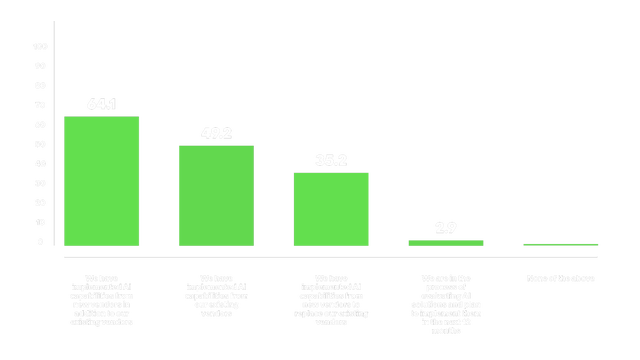
Rather than finding new partners, many respondents are strengthening ties with existing ones. As you’d expect in a fast-moving field like enterprise AI, new partners are entering the fold as well. Nearly two-thirds (64%) of respondents have purchased AI solutions from new vendors, while about half (49%) are implementing completely new AI capabilities offered by existing providers. Only about one-third (35%) are completely replacing their current vendors.
These results are fairly consistent across all the organizations we surveyed. Another consistent theme: Three-fifths of all respondents say they have a central AI committee or other governance body that approves new AI solutions and vendors.
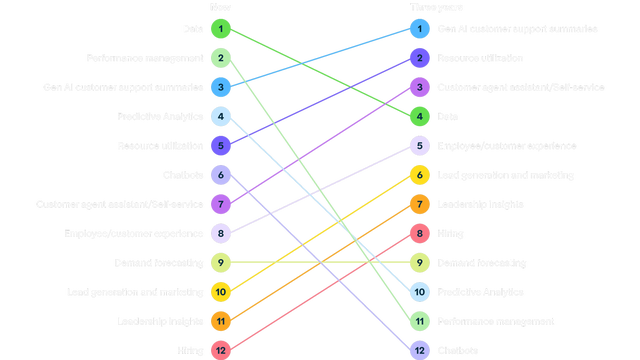
When asked how they’re deploying AI to improve internal operations today, more than three-quarters (76%) of Pacesetters say they are using AI for data cleaning, management, integration, visualization, or transformation—the No. 1 present-day use case for the cohort. We found less consensus about future use cases. But when asked how they envision using AI three years from now, only 58% of Pacesetters gave the top-rated answer: AI-generated customer support summaries.
The universe of possible AI use cases is expanding so rapidly that it’s hard to predict what tomorrow’s killer apps will be. Given this uncertainty, organizations will need to think carefully about how they put AI to work over time.

show the way
Even at this early stage, it’s clear that AI will transform how companies operate and go to market. As organizations of all types scramble for position, Pacesetters offer a promising blueprint for success. Under the watchful eye of involved leadership, our AI Pacesetters have built new, AI-powered workflows and put clear governance frameworks in place. As more business use cases emerge, skills programs will need to be updated and governance policies must evolve to address new AI risks.
Here are key lessons that all enterprises can learn from AI Pacesetters:
Creating pathways for end-to-end data flows will allow AI assistants to better support and expedite routine tasks. From payroll and procurement to employee requests, customer queries, and content creation, AI will reshape work throughout the enterprise.
Using an enterprise AI platform approach, teams and ecosystems can work together to scale efficiently. For example, connecting customer service, technical support, and customers can speed up interactions and free up employees for higher-value work.
As AI matures and use cases proliferate, the potential for costly errors also increases. Creating guardrails can prevent AI from gaining access to restricted data sources, granting access where access should be denied, or acting on AI insights without checks and balances that protect the business from potentially harmful consequences.
A clear strategy driven by visionary senior leadership predicts high AI maturity more than any other factor. Senior executives must be the driver behind implementation, and the responsibility for integrating AI in ways that advance strategic goals will fall on their shoulders. Individual employees can contribute to innovation, but only top executives can drive transformation. Now is a great time to get started.