



Maturity Index
2025
In partnership with Oxford Economics

maturity score
dropped 9 points

ServiceNow
In 2025, AI continues to dominate the global conversation, spanning keynote stages, earnings calls, and LinkedIn feeds. But beneath the buzz lies a sobering reality: most enterprises are struggling to keep up with the pace of AI innovation.
And with good reason. In the past nine months alone, breakthroughs in multimodal models and agentic AI have pushed the technology forward at unprecedented speed. But despite the relentless AI chatter, organizations often struggle to translate hype into business value.
In this second edition of our Enterprise AI Maturity Index, we found the average maturity score has dropped by nine points year over year. The causes? A growing AI skills gap and persistent concerns over data privacy and security, compounded by a lack of cohesive adoption strategies.
leaders are falling behind and show how a
select group of Pacesetter organizations are
using AI differently to gain a decisive edge.


considering adopting agentic AI
in the next 12 months.
ServiceNow paired again with Oxford Economics to survey just under 4,500 executives from 16
countries and 11 industries to measure organizational performance across five pillars of AI maturity: AI
strategy and leadership, workflow integration, talent and workforce, AI governance, and AI investment.
Based on responses, we assigned each organization an overall AI maturity score between 0 and 100.
The average score in our second annual Enterprise AI Maturity survey dropped 20%, or nine points, from
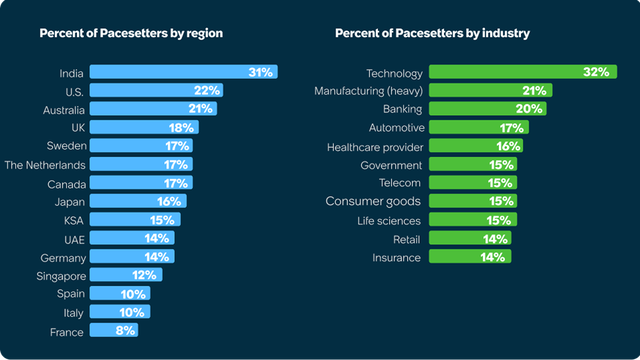
44 to 35. Our Pacesetters (who constitute 18.2% of the total respondents) saw their average score drop
from 54 to 44. Fewer than 1% of respondents scored higher than 50 on our 100-point scale. The highest
score fell 13 points year over year, from 71 to 58.



with the responsibility of doing the right thing.
ServiceNow
ServiceNow
and chasing in
lead with an average score of 44—nine points higher than the overall average.
Among other advantages of AI maturity, 83% of Pacesetters report increased
gross margins compared with 64% of others.
to this AI moment





Deloitte
Pacesetters are more than twice as likely to combine strong, visionary leadership with rigorous metrics designed to measure progress toward AI goals.
They are also more likely to launch AI-focused innovation centers and use AI to surface leadership insights.
Develop an AI vision: Pick AI metrics that reflect your business priorities and show how AI is impacting the bottom line.
Build an innovation center: Such centers allow orgs to quickly and securely experiment with AI tools.
Adopt cross-functional AI: Invest in AI that breaks down silos, boosts productivity, and drives revenue.
Two-thirds of Pacesetters run their AI solutions on one platform with a single architecture and data model. This unified approach makes it easier to adopt the latest AI tools and allows every team to draw from a central data repository.
Build a holistic AI strategy: Invent new ways of working across functions that facilitate human-AI collaboration.
Integrate workflows across functions: Look for opportunities to connect teams and processes across the organization.
Pacesetters have the right mix of AI-ready talent. They also focus on upskilling their existing workforce by offering formal training, hosting AI learning events, and celebrating internal AI champions.
Future-proof your talent: Hire or appoint change agents to manage how AI impacts your culture, vision, and goals.
Upskill employees: Invest in reskilling your workforce to ensure it’s AI ready.
Make AI exciting: Identify and champion those who are leading the charge on AI. Host events to encourage an AI-forward culture.
Almost two-thirds of Pacesetters have made significant progress drafting AI-focused data governance, privacy, and compliance policies. As a result, they can encourage AI experimentation while minimizing risks.
Address governance now: Before AI deployment, have proper controls and governance in place. Once deployed, track, monitor, and quickly respond to AI risks.
Understand the requirements: Make sure you understand where the data associated with AI applications is going and what must be done to keep it secure.
Pacesetters are already seeing greater ROI from agentic AI investments. As a result, they report better experiences, greater efficiency, and increased revenue.
Learn about agentic AI: Immerse yourself in the latest AI developments and capabilities. Don’t stay on the sidelines.
Identify quick wins: Look for easy, cost-effective ways to capture value from AI to show colleagues the benefits and gain support for transformation.
ServiceNow
Becoming an AI-mature organization isn’t just about tech stacks, policies, or KPIs; it’s about mindset. The enterprises pulling ahead aren’t just deploying smarter tools; they’re building cultures of trust, experimentation, and empowered decision-making. They’re investing in people as intentionally as they invest in platforms.
Pacesetters are proving that real AI transformation starts with human conviction, not just machine intelligence. As the pace of innovation accelerates, the leaders who rise to the top won’t be the ones chasing every trend. Instead, they will stay grounded in what makes transformation stick: strategic clarity, bold action, and a relentless focus on people. Because in the age of AI, the most powerful advantage isn’t artificial; it’s human.


AI to work for people