
Conversations On AI App Development CRM Enterprise IT Ethics & Governance Futures HR Industries ServiceNow on ServiceNow Platform Foundations Products & Solutions All topics For Leaders In IT & Dev Customer Experience Finance, Operations & Strategy Employee Experience Security & Risk News & Events People & Culture My List Explore All
October 14, 2024 12 min An Innovation Roadmap For IT Leaders
Artificial intelligence has created a tidal wave of change, accelerating the pace of innovation, increasing the cost of failure, and boosting potential ROI. To learn what Pacesetters are doing differently, ServiceNow teamed up with ThoughtLab to survey 500 IT leaders across seven countries and six industries. Enterprise IT Research Download report
A small group of office workers sitting together at a table with their laptops.
In this report 1 Turning cost into revenue
Pacesetting IT leaders are taking IT from cost center to revenue generator
2 Forming strategic partnerships
Top-performing IT leaders are partnering closely with CXOs
3 Becoming cultural change agents
IT leaders are leading from the front
4 Hiring and upskilling
Compared to peers, Pacesetters are more involved in hiring for the future

Introduction

As ServiceNow’s chief digital information officer, I’m no stranger to big, bold change. With every shift—whether it brings challenges, opportunities, or both—there is immense potential for growth and innovation.

The AI explosion is one of the biggest changes we have seen since the dawn of enterprise computing back in the mid-20th century. It follows the era of digital transformation, when technology leaders needed to expand their mandate so it touched every corner of the company.

AI has complicated the jobs of IT leadership, magnifying existing roadblocks while opening up new avenues for creativity. Today’s technology leaders must be agile and visionary to keep up with current business demands as well as the ever-changing AI technology landscape.

Some are leaning into the chaos by becoming “chief everything officers,” partnering with leaders across the C-suite to help shape how their enterprise works. Others are struggling to prioritize and delegate, as their to-do lists get longer and their workdays feel shorter. Even those who know they need to rethink their approach aren’t sure how to meet the moment.

To understand how technology leaders are reacting to the AI-powered computing revolution, ServiceNow teamed up with ThoughtLab to survey 500 IT leaders across seven countries and six industries. We identified a cohort of Pacesetter IT leaders who are redefining the IT function and driving strategic change across the enterprise. Our findings highlight what Pacesetters are doing well and what stragglers could be doing differently.
Technology leaders must be agile & visionary to keep up with current business demands
Research highlights Survey demographics 500 IT leaders 7 countries 6 industries 87% Operational, such as IT project delivery success or system uptime 75% Cybersecurity, such as number of breaches and incident response time 65% Business-related, such as Impact on overall revenue, costs 57% IT employee management, such as engagement, satisfaction, retention
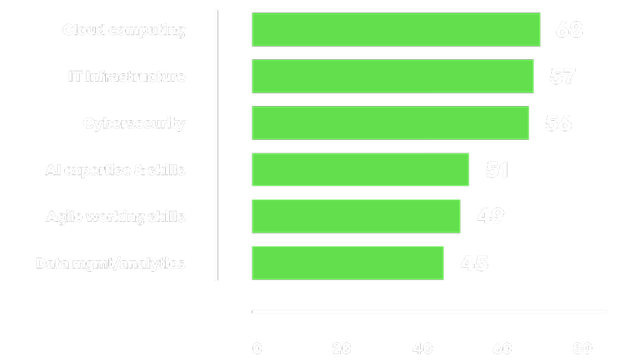
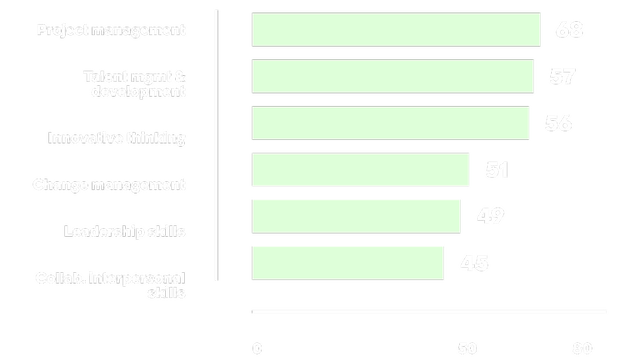
Essential skills for IT leaders over next two years
Technical skills
Technical skills are led by cloud computing (68), IT infrastructure (57), and cybersecurity (56).
Business skills
Business skills are led by project management (68), talent management & development (57), and innovative thinking (56). Both charts share the same top three scores, with AI expertise, agile working, and data analytics rounding out technical skills.

All roads converge on IT

Aston Martin F1 CIO Clare Lansley on the growing impact of the CIO on every aspect of business operations.

The CIO’s expanding role

ServiceNow Chief Customer Officer Chris Bedi and Fujitsu Chief Digital Transformation Officer/CIO Yuzuru Fukuda discuss the delicate balancing act of the modern-day CIO.

01 Turning cost into revenue

Historically, IT departments operated primarily as cost centers. IT has been expanding its purview beyond IT for decades, but AI has accelerated this change. And smart IT leaders are leaning in.

Rather than focusing on siloed investments in technologies with a limited scope, Pacesetters are making ambitious investments in AI-centric tools that boost innovation, drive customer satisfaction, and increase productivity.

Their peers, by contrast, continue to treat IT as an overhead expense. The result: siloed teams whose work rarely impacts more than one or two areas of the business.

To streamline work and free up resources, IT leaders at larger organizations are building hybrid IT departments that function as both cost centers and revenue drivers. This hybrid strategy enables IT investments that drive performance across the whole business.
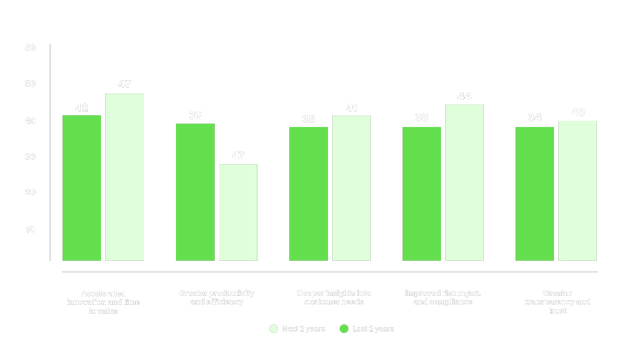
44% of Pacesetters IT leaders are aligning IT with overall business strategy (vs. 23% of others) 58% of IT leaders are future-proofing their business operating model by making IT decisions more value-based
IT's impact on performance
Alt
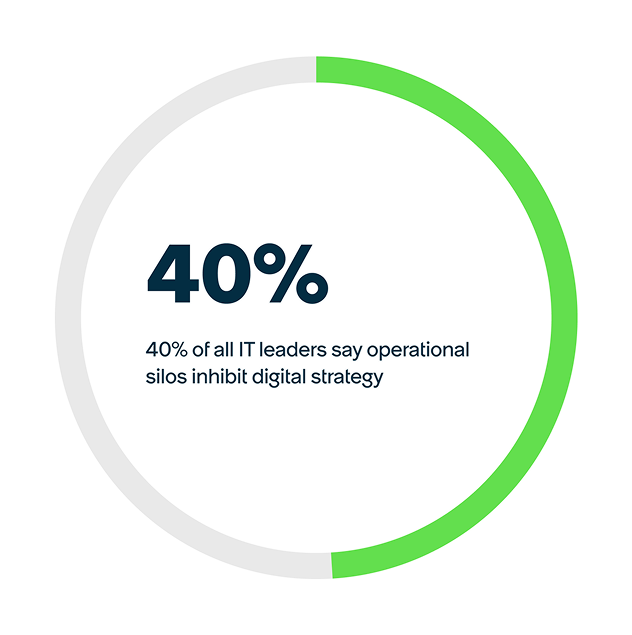
A donut chart showing that 40% of all IT leaders say operational silos inhibit digital strategy.
Pacesetters collaborate
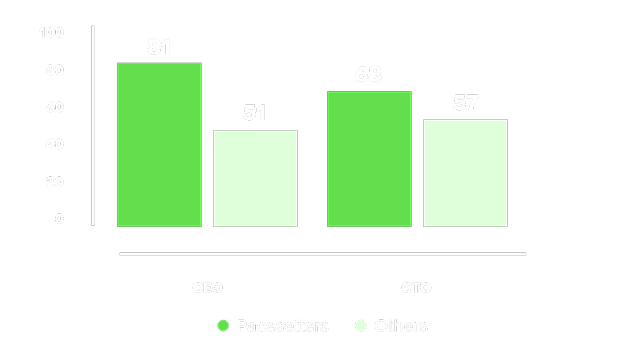
Pacesetters collaborate bar chart A grouped bar chart showing Pacesetters collaborate more with CEOs (81% vs. 51%) and CTOs (68% vs. 57%) compared to other IT leaders.
Compared to others, Pacesetter IT leaders collaborate more with the CEO and CTO
02 Forming strategic partnerships

At many companies, both technical and nontechnical teams are now using AI to get work done. That’s putting a lot of pressure on IT leaders to perform, because they now have to serve the entire company. Some are buckling under the pressure, sticking to their operational silos and focusing solely on IT.

But Pacesetters are forming strategic partnerships across the org to knock down operational silos. As part of this goal, top-performing IT leaders are decentralizing IT to distribute decision-making and resources across units, departments, and locations.

Decentralization is a superpower for three reasons. First, IT leaders are now evaluated on their ability to make decisions that impact the whole business, which they can’t do inside a silo. Second, AI is a value multiplier, but only when used strategically. Third, decentralizing IT puts leaders in a good position to serve as strategic partners for the CXOs and as tactical partners for AI implementation and governance.
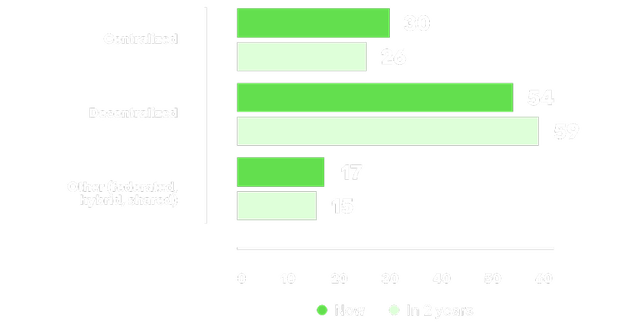
IT organizational approach, all firms
IT organizational approach bar chart A horizontal bar chart showing current vs. projected IT organizational structures across all firms. Decentralized models lead now (54%) and are expected to grow (59%), while centralized models are declining and federated/hybrid structures remain small.
03 Becoming cultural change agents

Smart IT leaders aren’t passively allowing AI to change their company culture. Instead, they’re becoming cultural change agents.

Compared to other IT leaders in our study, Pacesetters have a strong grasp of soft skills like collaboration and problem-solving, which enable them to get work done in partnership with changemakers across the org.

Pacesetters recognize that they are uniquely positioned to weave innovation into the cultural fabric of the business. They’re taking a hands-on approach to communicating with their employees: advising them, reassuring them, and inspiring them to get creative.

Interpersonal, leadership and communication skills

Pacesetters have strong interpersonal skills (66% vs. 34% others) and leadership and communication skills (60% vs. 37% others)
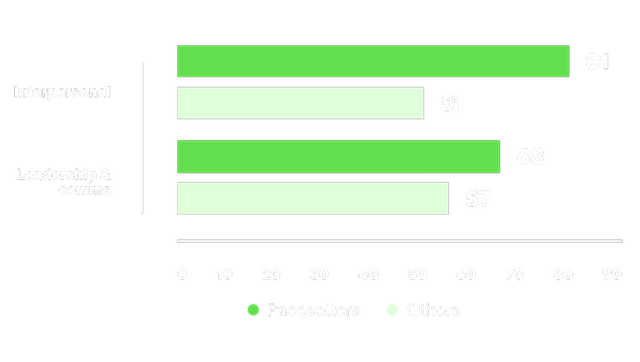
A horizontal bar chart comparing Pacesetters vs. other IT leaders on interpersonal and leadership & communication skills. Pacesetters score significantly higher — interpersonal (81 vs. 51) and leadership & communications (68 vs. 57) — highlighting the soft skill advantage of top-performing IT leaders.
Culture of innovation 67% of Pacesetters are working to foster a culture of innovation vs. 58% of others
44% Compared to others, Pacesetters collaborate more with the CHRO (44% vs. 30%)
04 Getting hands-on with hiring and upskilling

AI is transforming the job market. About 70% of all IT leaders believe most employees will require greater technical and data literacy to succeed in the AI era.

IT leaders who leave hiring to the hiring managers aren’t saving as much time as they think. In fact, if they don’t advise the CHRO on how to hire and where to upskill, their organization may not have the talent required to get ahead.

Pacesetters are taking an active role in hiring and upskilling and are more likely to collaborate with CHROs than the rest.

Working closely with HR, Pacesetters are increasingly developing training programs for employees who use AI on the job. For example, many Pacesetters are collaborating with HR to train customer service reps on AI tools that speed up service delivery.
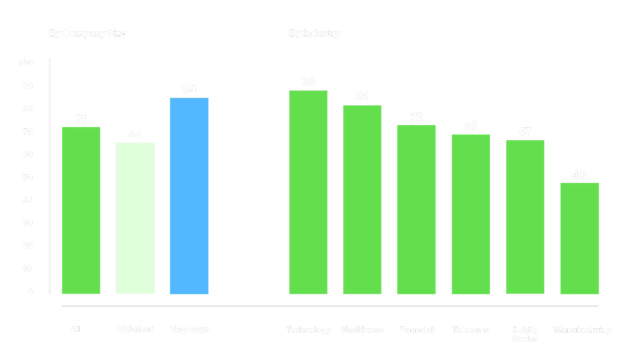
IT leaders agree most employees will require higher technical and data literacy skills

Two bar charts breaking down data by company size and industry. By size, very large companies score highest (84) vs. mid-sized (66) and all (71). By industry, technology leads (88), followed by healthcare (81), financial (72), telecoms (69), public sector (67), and manufacturing lowest at 48.
4 takeaways from the report In this moment of truth for IT, Pacesetters are seizing the day 1 Organizations need IT to step up. IT leaders are no longer being evaluated simply on their ability to smoothly run an IT department; they’re being graded on their impact on business metrics such as revenue and shareholder value. The Pacesetter teams in our study are already serving as strategic partners for CXOs. 2 IT becomes a performance driver. Companies are transforming IT into a hybrid cost center/revenue generator to realize businesswide goals such as revenue growth and increased efficiency. The largest companies have the most ambitious plans, and two-thirds say they’ll be operating as hybrids in the next two years. 3 IT leaders need new skills. To weather the storm, they’ll need stronger business acumen and sharper interpersonal abilities. Pacesetters are already leading from the front as cultural change agents. 4 Pacesetters are doubling down on soft skills. Staying on the cutting edge of new tech is still vitally important for success as an IT leader. To maximize AI’s potential, however, Pacesetters are doubling down on human skills such as collaboration, problem-solving, and communication.
Alt
Innovation roadmap for
IT leaders
Discover how IT leaders are taking charge across the enterprise Get the full report
Next up
Dive into more conversations AI App Development CRM Customer Stories Ethics & Governance Human Resources Industries IT Now On Now Platform Foundations Products & Solutions All Topics
Stay in the know Join Us
stay in know image
Alt