





An AI agent approved an access request 19 days ago. Now someone wants to know why.
At most organizations, that query goes nowhere. The entry in the access system's audit log shows the outcome, a time stamp, and maybe a service account ID. Everything that truly matters is gone or was never captured in the first place: what the agent saw, how it reasoned through its decisions, and whether it stayed inside its permissions.
This is the quiet liability underneath the agentic AI boom. Fifty-nine percent of organizations are now running agentic AI to do autonomous work, according to the ServiceNow Enterprise AI Maturity Index 2026. But AI agent governance hasn't kept pace.
AI agents are making more decisions on their own, and a growing share of those decisions can't be explained once the moment has passed. Gartner predicts that “over 40% of agentic AI projects will be canceled by the end of 2027.”
Many of the reasons trace back to the disconnect between AI use and accountability, where the risk and the murkiness around AI governance pile up faster than anyone budgeted for.
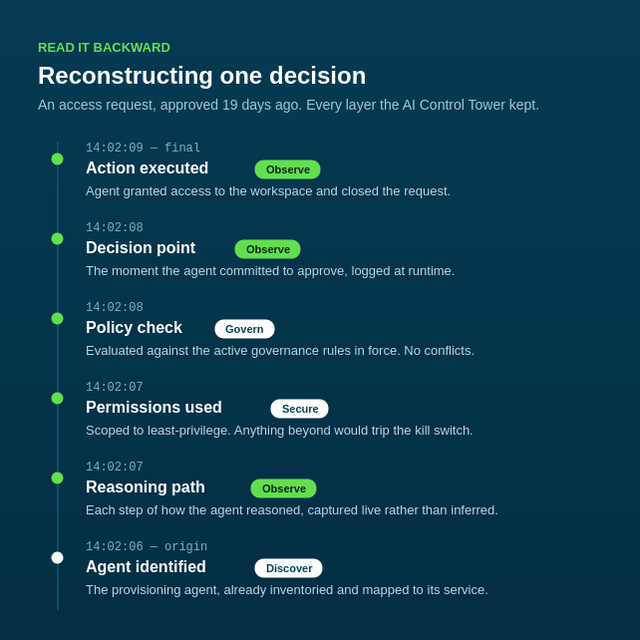
Closing the gap takes something more specific than another dashboard. You have to be able to take a single decision that an AI agent made and walk it backward, step by step, until the whole thing is visible.
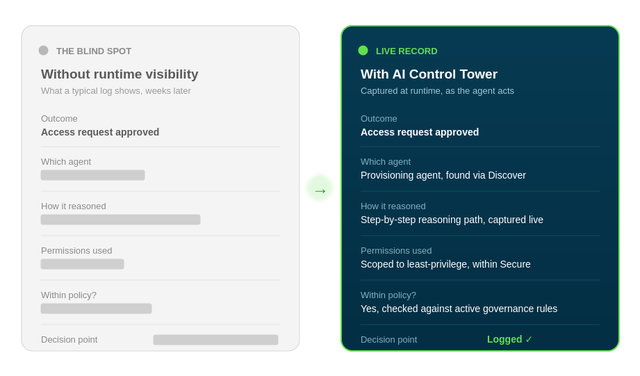
That’s the design logic behind ServiceNow AI Control Tower. The solution operates across five dimensions that together answer the question every governance team eventually has to answer: What did this AI agent do, and why?
- Discovery: You can't govern what you can't see, and most enterprises can't see their own AI. AI Control Tower automatically inventories every agent, model, and Model Context Protocol (MCP) server across the organization, whether it was built in-house or bought from a vendor. A sprawl of shadow AI deployments becomes a single map of what exists and what each piece is doing.
- Security: Once you know an AI agent exists, the question becomes what it's allowed to touch. AI Control Tower tracks identity, access, and exposure for every AI asset, enforcing least privilege so that agents operate only inside their granted permissions. It watches security posture continuously and blocks prompt injection attempts in real time, closing the divide between an agent having access and an agent abusing it.
- Governance: This is where AI strategy meets accountability. AI Control Tower sets the policies AI agents are checked against; manages their full lifecycle, from intake to retirement; and enforces controls without routing everything through spreadsheets and approval bottlenecks.
- Observation: AI Control Tower monitors and evaluates how AI agents perform at runtime, capturing metrics and log traces as the work happens rather than after the fact.
- Measurement: AI Control Tower quantifies business impact through metrics that track adoption, realized value, and return on investment from day 1.
It's tempting to treat traceability as a compliance chore, the thing you build because a regulator will eventually ask. That framing undersells the power of intelligible AI.
Traceability separates organizations that can scale agentic AI confidently from those white-knuckling their way through deployment. The organizations pulling ahead in the agentic era can answer for what their AI agents did. Those with sprawling fleets of agents simply can’t do that.
Someone will eventually ask why an AI agent made a call 19 days ago. Whether you answer clearly or remain quiet will say more about your AI program than the number of agents you've deployed.
Find out more about how ServiceNow can help you control and govern your AI agents.