




Yet as Brackin, a Pennsylvania native and 11-year veteran of Liberty Tire, dug more deeply into the ESG reporting process, she realized that, even for a green-focused company, the effort can be laborious and reveal as much about the company’s shortcomings as its achievements, both environmentally and operationally.
“ESG is a lot harder than people realize,” Brackin says.
With investors and regulators eager to see companies help combat climate change, ESG reports are increasingly necessary. Liberty’s report, which came out in April 2022, was encouraged by the energy investment firm ECP, which acquired Liberty Tire in mid-2021 and has been urging its portfolio of privately held firms to follow the lead of larger organizations. According to the Governance & Accountability Institute, more than 90 percent of S&P 500 companies now publish ESG reports in some form.
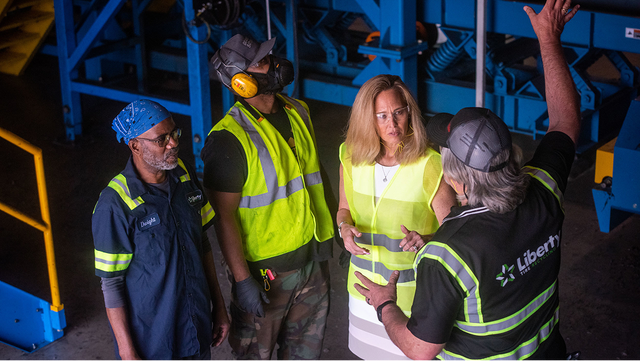
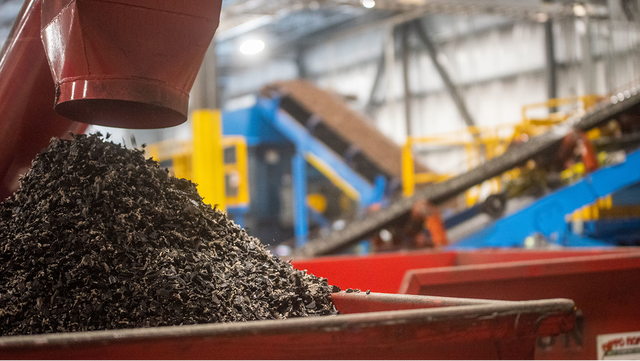
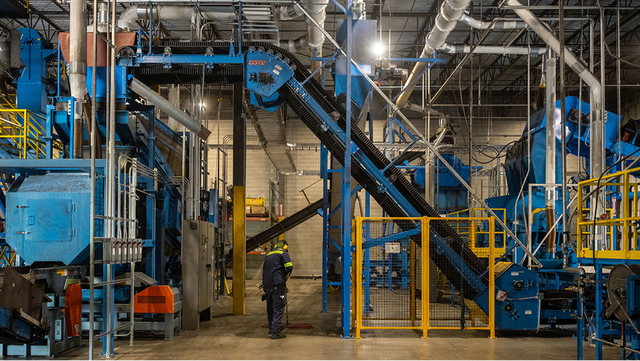
Yet even for large organizations, ESG reporting can be a learning experience, challenging companies to conduct an honest and authentic assessment of its practices. At Liberty Tire, the 16-month process changed how the company saw itself. “When we shifted to looking through an ESG lens, we started to notice that maybe we’re a little more of a brown organization with a green story,” says Brackin. Those 190 million reclaimed tires notwithstanding and a “handprint” of displacing emissions five times larger than its carbon footprint, the company was not as sustainable as it wanted to be. Going through ESG reporting was transformative for several areas of the business, uncovering opportunities for greater operational efficiency and revealing pockets of scattered data in need of better systems for managing them.
“We had to ask ourselves what we wanted to be when we grow up,” says Leigh Eastman, Liberty Tire’s senior vice president of logistics. The work of creating the report helped answer that question.
Founded in 2000 by a group of investors, Liberty Tire grew through the acquisition of several regional tire recycling facilities. As it expanded and created a more systematic approach to tire recycling, the company helped divert millions of tires from landfills, where they can trap methane gas, and removed tires from dozens of abandoned dump sites that were at risk of causing a fire or harboring mosquitos. When tires are not properly monitored and managed, a tire pile can accumulate heat and potentially catch fire, releasing thick plumes of smoke that can take weeks to extinguish. But there were always more tires to collect than what could be sold to make new products or tire-derived fuel, the destination for about 45 percent of the nation’s tires. Brackin joined the company in 2012 to help find new customers and develop new markets. Initially a regional sales manager, she later became vice president of market development.
In early 2021, Liberty Tire CEO Thomas Womble had conversations with potential new equity partners that highlighted the value of embracing ESG throughout the business. Brackin’s experience made her an ideal fit for the sustainability role. She had a deep understanding of many areas of business and was comfortable representing the company externally. “ESG is not a department that sits by itself on an org chart,” she explains. “It’s a thread that runs through everything we do as a business.”
Her first move was education—starting with her own. “I had no prior experience with ESG, other than what I’d read or heard. There’s so much in the world of sustainability to wrap your arms around.” To deepen her understanding, she enrolled in an ESG certificate course at Duke University’s Fuqua School of Business and a program in corporate sustainability management at the Yale School of Management Executive Education.
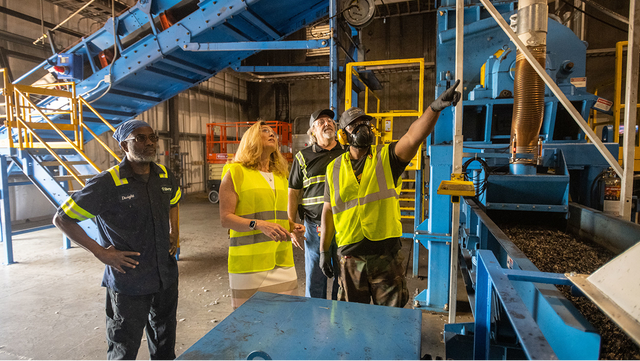
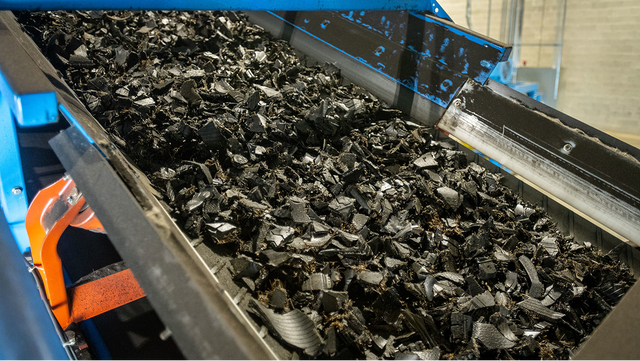
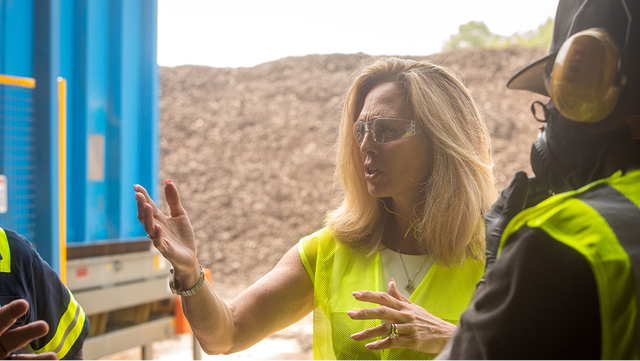
Most of her team, too, came in cold. After selecting nine task force members from the legal, finance, procurement, human resources, marketing, sales, transportation, government relations, and operations departments, she brought in the ESG firm Bridge House Advisors to run workshops to educate the team on why ESG matters, how to do benchmarking, and the value of managing your carbon footprint. The firm also helped Brackin complete a materiality assessment to identify the priority topics for the company and to create a strategic framework to embed them. It was built around four pillars: advancing sustainable products, accelerating environmental stewardship, engaging people and communities, and operating responsibly.
With a framework in place, task force members began fanning out across the organization to explain the initiative to their direct reports and peers, who would ultimately need to do the work of chasing down data. It wasn’t an easy sell. “People wondered why they needed to spend time on this? Why was this so important?’” says Brackin. “For an operations team that is already busy with their day-to-day management of operating plants, collecting and receiving tires, or managing truck fleets, this sounds like taking on yet another thing from corporate. You have to show people how they can play an important role and the overall impact they can have on the business.”
Brackin credits unwavering support from Liberty’s CEO and other members of the C-suite with helping win hearts and minds. “They would say, ‘This is critical to the way we operate our business and it creates significant long-term value for Liberty and our stakeholders. This isn’t a short-term initiative. It’s a new way of doing business that is important to us and to our planet, so therefore it should also be important to you.’ Those messages helped a lot.”
There’s no question that well-executed ESG programs can create significant value, says Elisha Harrington, a field innovation officer at ServiceNow. Data is the key to fulfilling that promise. “The journey toward a sustainable future for any organization starts with information,” Harrington says. “It’s really fundamental to start by developing a baseline—where are you today?—and then asking where you need to be in the next decade. Being able to measure progress toward those goals is really important.”
To compute Liberty’s carbon footprint, Brackin focused on two obvious greenhouse gas emission culprits: the fuel burned by the company's fleet of 400 trucks and the electricity powering its energy-intensive tire-shredding plants. Almost immediately, it was clear the job of compiling this data was going to be harder than expected.
Since fuel efficiency was not tracked by any centralized system, Eastman and her logistics team spent months manually collecting information from three different fueling outlets and four leasing partners, two of whom were franchise-owned. For that particular company, some dozen different locations had to be contacted individually. Making matters worse, Liberty’s trucking operations use no fewer than 20 different technology systems, including two from the same company that are not able to communicate with each other. “We’ve had to do things the old-fashioned way,” says Eastman. “It’s just so much more complicated than I thought it would be.”
Information on electricity usage was also not readily available in a centralized location. The company was tracking energy spending through procure-to-pay software, but this financial system didn’t record non-financial metrics like kilowatt hours or other details of energy efficiency—information that would be needed for the report. To get this data, 12 months of utility bills had to be merged with other information from hundreds of different utility companies. Among the findings were wild variations in energy efficiency. Unbeknownst to the company, a tire-shredding facility in one location, for instance, was using 50% more energy to produce the same amount of product as a facility in another region.
Similarly in human resources, teams had to comb through employee files manually to compile data on employees who were minorities, veterans, or formerly incarcerated. One positive finding: a highly diverse workforce. The company hadn’t realized that 62 percent of its employees were ethnic minorities, predominantly Latino. “Having to report ESG data was an eye-opener,” says Barry Mathis, Liberty’s chief human resources officer. “It made us prioritize having a system that would make all this easier.”
Brackin considers this new emphasis on upgraded data systems to be a silver lining. In some cases, there was low-hanging fruit. Existing HR software, for instance, had a module for compiling employee demographic data that nobody had been aware of. In other cases, new solutions were adopted, such as an energy management system that Unbeknownst to the company, a tire-shredding facility in one location was using 50% more energy.
automates the tracking of electricity usage. Hooking directly into the networks of utility companies, this software provides analytics on pounds of product produced per kilowatt hour and gives Brackin and other executives easy visibility into energy efficiency at every location. It also allows the company to set criteria for flagging inefficient electricity usage. Both solutions have helped in the creation of Liberty’s second ESG report, due in July.
“When you start looking at things differently, you realize there are a lot of improvements in terms of operational efficiency that you can identify,” says Brackin. “If you’re doing it right, these will be cost savings measures and result in value creation, while also reducing emissions. That’s when it all starts to make sense.”
In Liberty’s transportation department, Eastman says she is working on rolling out, hopefully next year, fleet management software that will automatically compute fuel efficiency calculations for each truck and provide route optimization for drivers. No need for calls to franchised leasing operations or extensive number crunching. By helping drivers cut down on idle time and boost the number of tires they collect per mile, she estimates the new system could reduce the company’s annual fuel usage by 15–25% and lower overall greenhouse gas emissions. Eastman is also working on whittling down those 20 different technologies to a handful.

Asked to reflect on what she’s learned from her two-year ESG journey, Brackin emphasized humility. Instead of positioning Liberty as an eco-champion, an approach that has subjected some companies to greenwashing accusations, she opted for a candid evaluation. “One lesson for me is, don’t be afraid of what you’ve done or not done as a company,” she says. “We know we’ve got areas we can improve upon, but here’s where we’re at right now.” With this in mind, Brackin has tabled several ambitions until at least 2024, including a calculation of greenhouse gas emissions coming from suppliers. “We need to get better at gathering data, and many of our suppliers are not as far along as we are. It simply takes time,” Brackin says.
Once these emissions, called Scope 3, are factored in, they are likely to be a far bigger number than those coming directly from Liberty’s own operations and energy usage. Until that data is collected and evaluated, Brackin has put a Net Zero commitment on hold. Instead, Liberty’s immediate goal is zero waste. Roughly one quarter of what’s collected still winds up in landfills. “Continued market development and collaboration with our industry partners is the key to us getting to zero waste. We are very focused on this and are confident the industry is also moving in the same direction,” Brackin promises.
Often framed as a way for companies to contribute positively to society and the environment, ESG has also hit a lot closer to home for Liberty Tire. Says Brackin, “It’s helped make us a better company.”