
Home Conversations On AI App Development CRM Enterprise IT Ethics & Governance Futures HR Industries ServiceNow on ServiceNow Platform Foundations Products & Solutions All topics For Leaders In IT & Dev Customer Experience Finance, Operations & Strategy Employee Experience Security & Risk News & Events People & Culture My List Explore All
October 22, 2024 15 min Impact AI:
2024 Workforce Skills Forecast

Emerging technologies will disrupt entire industries while creating new opportunities for people with the right skills. Research by ServiceNow and Pearson predicts how labor markets will evolve as AI gets to work. HR Research Download full report
workforce skill forecast
Top 3 takeaways The demand for labor will exceed supply over the next five years despite rising automation. One million additional workers will be needed in the U.S. alone. The demand for tech workers will increase. By 2028, the U.S. will need to fill an additional 1.76 million IT jobs. As AI takes over more routine tasks, there will be rising demand for intrinsically human skills like critical thinking and creativity.
Top takeaways
AI has been reshaping the workforce for years. Ask Garry Kasparov. When the AI chess program Deep Blue knocked the chess grandmaster off his throne in 1997, the world noticed.

27 years later, we're still playing chess—and using AI to improve our skills. New data shows that just as AI enhances people's chess games, it will improve the way we work and create opportunities for people with the right skills.

In partnership with our research partner Pearson, we used AI-driven algorithms to predict how generative AI (GenAI) and related technologies will transform how people work.

Chess pieces with AI sparkle
What we learned
two females shaking hands with birds in the background
What we learned AI will take your job... and make it better
We'll need more people, not fewer

Across most countries we researched, the data shows that even with the automation of some tasks and AI-driven capacity gain (hours saved) in others, the workforce will still need to expand if we are to sustain projected economic growth.


When we dig deeper into how AI will affect IT roles, the data shows that we will need additional tech workers. In the U.S., the impact of automation and augmentation on overall job numbers (-0.43M) is minimal in comparison to expected growth in tech jobs (+2.19M). Many of these jobs will exist to implement and support emerging technologies, so IT workers will need AI skills to tackle these roles.

Industries will feel AI's effects differently
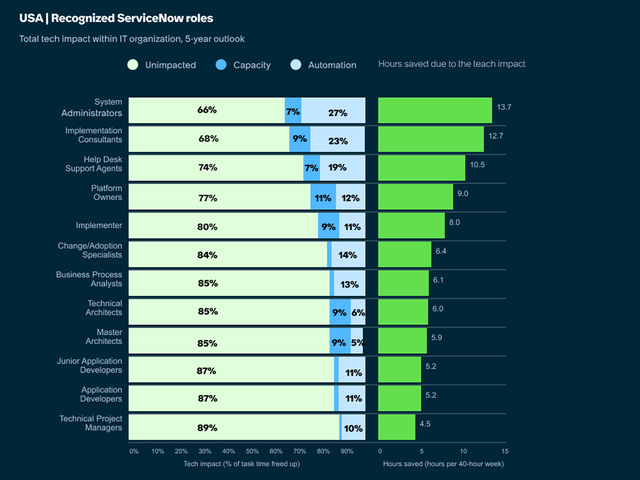
Not all industries will be impacted equally. For example, our research predicts that AI will replace many IT jobs in retail in the near future. For every net job loss, however, we see additional jobs being created in other industries—more than enough to balance out the loss of jobs more vulnerable to automation. The key will be to create programs that help people make the career leap from one industry to another. Beyond predicting how AI will impact the workforce, we also set out to estimate how much time AI and GenAI will save workers by role. For example, we predict that systems admins within the ServiceNow ecosphere will save 13.7 hours per week, on average, due to automation and capacity gain. That’s an extra day and a half freed up to focus on reskilling or on tasks that only humans can do.
Female carrying backpack walking and leaning back looking phone
The time to
Reskill is now
Last year’s edition of this study concluded that the more we use machines to do the kind of work they’re good at, the less humans have to work like machines. By reallocating tasks best done by AI and other technologies, people can focus on human strengths such as critical thinking, interpersonal communication, and creativity.
To achieve this optimistic vision—and to support healthy economic growth—businesses and governments must create training opportunities to proactively prepare the workforce. This can only be done by understanding which skills are on the wane and which are on the rise in the IT industry and beyond.
Initiatives like RiseUp with ServiceNow and solutions such as ServiceNow’s Talent Development are needed to support evolving talent and skilling needs. By identifying and supporting people whose jobs are at a higher risk of being disrupted by automation and augmentation, organizations can close today’s persistent skills gaps and support a new generation of highly trained, high-value employees.
How we learned it
How we learned it Our research
methodology

in a nutshell
ServiceNow partnered with workforce data experts Pearson to develop AI-driven algorithms that combed massive troves of publicly available labor market data. By using that data to figure out how people spend time doing their jobs, we could identify:
  • Which tasks could be completed entirely by AI
  • Which tasks could be assisted by AI
  • Which roles and skills would grow in demand
  • How leaders can reskill their workforce to future-proof their business
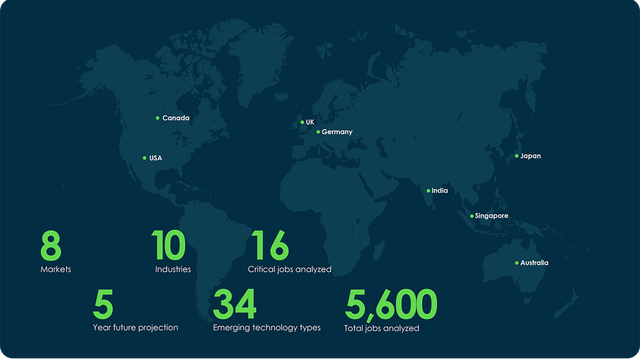
Our research looked at 1,400 occupations and broke them down into 5,600 separate job functions.
AI Impact: 2024 Workforce Skills Forecast

Our research looked at 1,400 occupations and broke them down into 5,600 separate job functions made of 80,000 different tasks. And we did it for Australia, Canada, Germany, India, Japan, Singapore, the U.Kl, and the United States, making this one of the world’s most comprehensive studies of how AI will impact the global workforce.
Workforce impact
Workforce impact More AI,
more jobs

Over five years, the workforce will grow even after considering AI’s impact.

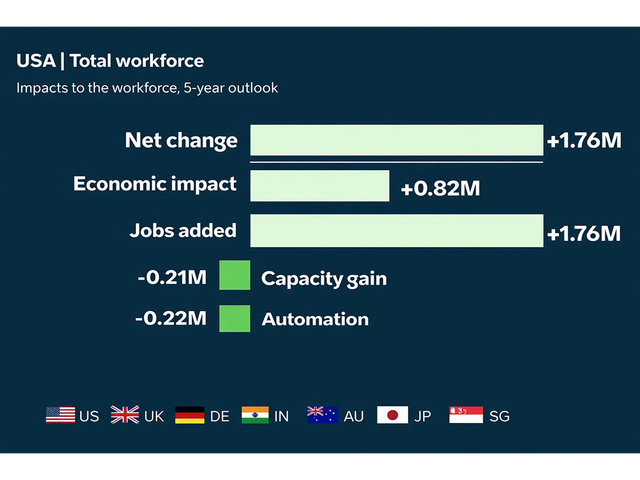
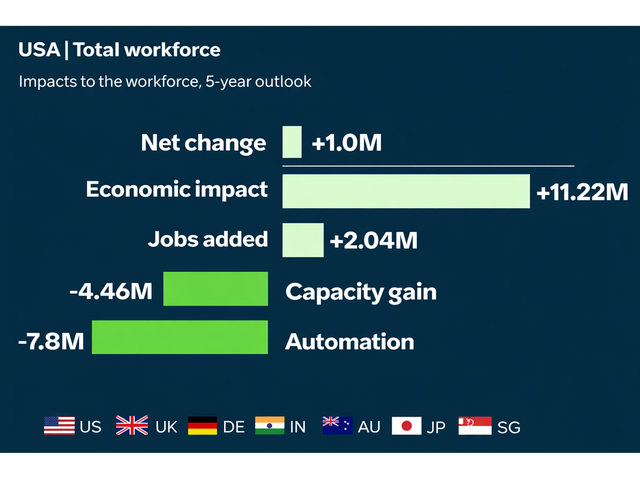
The IMF estimates that the U.S. economy will grow at an annual rate of 2.1% over the next five years. Without taking the productivity-boosting effects of AI into account, the U.S. economy would need to add 11.22 million people to the workforce over five years to support this growth rate. Our research predicts that AI will be able to do the work equivalent to 12.26 million full-time employees. To realize this potential, however, an additional 2.04 million tech jobs will be needed to implement and maintain emerging technologies.

Male happily walking in stride
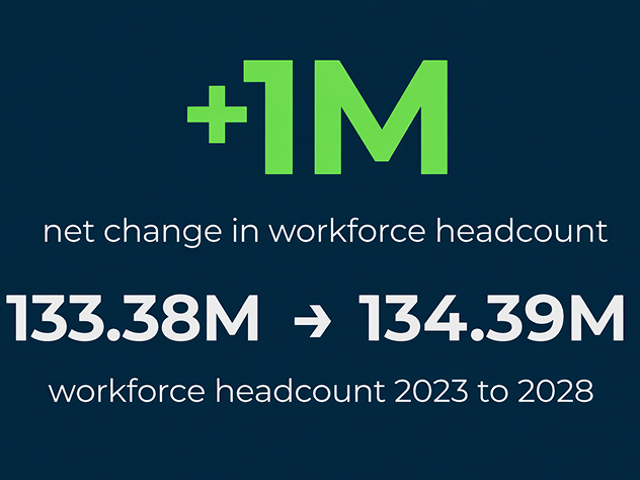
When all factors are considered, an additional 1 million people will need to be added to the workforce by 2028 in the U.S. alone. The short story is that AI, like many technologies before it, will disrupt the workforce—but will lead to a net-positive job gain.
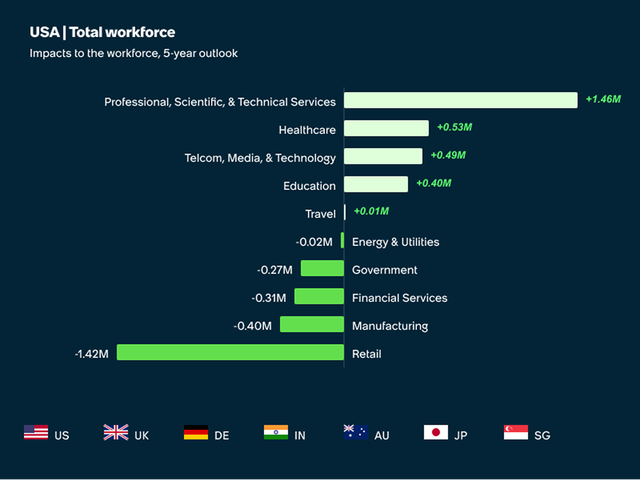
USA total workforce, impacts to the workforce, 5-year outlook
Definitions

Economic impact

Headcount needed to achieve expected economic growth

Jobs added

additional jobs required to implement and maintain emerging technologies

Capacity gain

Hours freed up by using technology to work fore efficiently

Automation

Hours freed up when technology alone completes a task

Skills impact
Skills impact New world,
new skills
Organizations everywhere face a persistent tech talent gap. In a recent Deloitte survey of tech industry leaders, 90% said recruiting and retaining talent is a moderate or major challenge.
Two males spinning and doing flips in the air
The flip side of this equation is that, with the right reskilling, there is a huge opportunity for non-tech workers to move into tech roles.
This is especially true when you consider that AI and related technologies like low-code software development are automating certain traditional tech skills while putting an emphasis on intrinsically human attributes such as collaboration and problem-solving.
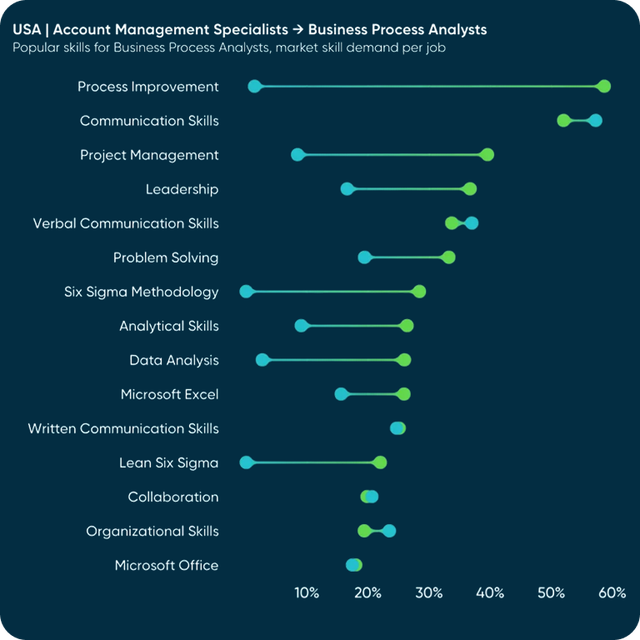
To get insight into which non-tech roles would be ideal matches for in-demand tech jobs, we mapped the skill set of existing positions we know will be affected by automation to the skill set necessary to perform growing job personas in the ServiceNow ecosphere. For example, we know that the demand for business process analysts is growing—and that account management specialists have many of the same skills.
In this case, we see that account management specialists and business process analysts have very similar communication, organizational, collaboration, and Microsoft Office skills. With some reskilling in process improvement, project management, and Six Sigma methodology, the transition into business process analyst would be smooth.
Percentage bar graph of USA account management specialist to business analysts popular skills for business process analysts, market skill demand per job
10 pathways to future-proof positions
Non-tech role Project analyst Media collections specialist Property consultant Compliance engineer Brand designer Quantity surveyor Strategy consultant Financial quantitative analyst Risk assurance consultant Investor relations specialist
ServiceNow tech role Technical project manager Help desk support agent Business process analyst Flow automation engineer UX designer Technical project manager Implementation consultant Machine learning engineer Business process analyst Implementation consultant
Tech jobs impact
Tech job impact Up your
AI game
IT roles will be in high demand across all industries over the next five years. The impact of automation and capacity gain on tech workers’ roles is a drop in the bucket compared to the projected growth of tech jobs across all sectors, in all countries. Why? Someone needs to implement and support AI and other emerging technologies. The trick will be having the people with the right skills to do so.
Male on a skateboard jumping in the air above AI sparkle
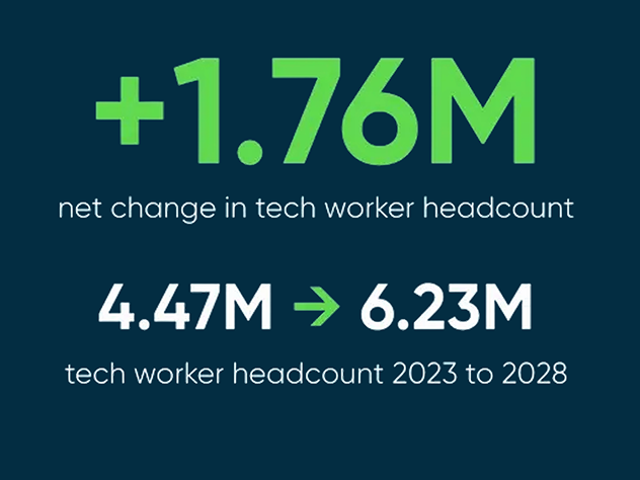
USA Total workforce, impacts to the workforce, 5-year outlook.
+1.7 million net change in tech worker headcount. 4.47 million to 6.23 million in 2023 to 2028.
Definitions

Jobs added

Additional jobs required to implement and maintain emerging technologies

Economic impact

Additional headcount needed to achieve expected economic growth

Industry impact
Industry impact Some will grow,
some will slow
Lab technician holding a test tube and pipette dropper
While AI will impact tech and non-tech workers across all industries, not all will be affected equally. 
In the U.S., retail will lose 1.42 million jobs over five years while professional, scientific, and technical (PS&T) services jobs will grow by 1.46 million. Programs to reskill/upskill retail workers can help meet the growing demand for PS&T services tomorrow.
Bar graph of USA total workforce, 5 year outlook
Efficiency impact
Efficiency impact How AI and GenAI
free up time
We looked at a handful of ServiceNow-specific IT roles to find out how they would be impacted by AI in general, and GenAI in particular. We found that certain roles will see a significant number of hours saved (aka increased productivity) as a result of automation and capacity gain.
Employees and business leaders can use this information to evaluate which roles within their workforce will have more time freed up to spend on more high-value, creative tasks—or to upskill so that they can move into a new, more future-proof position.
Male dancing with AI sparkle in background
USA recognized ServiceNow role, total tech impact within IT organizations, 5 year outlook
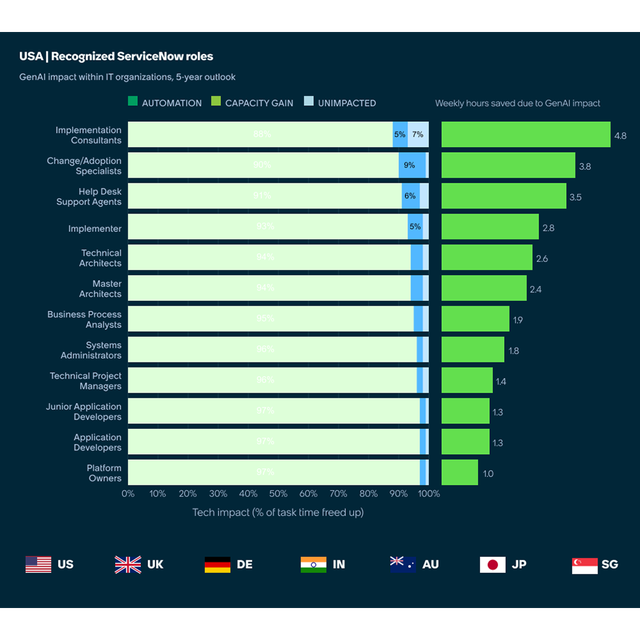
We also looked at the productivity impact of GenAI, which will be mainly driven by adoption of chatbots running on large language models (LLM).
USA recognized ServiceNow roles, GenAI impact within IT organizations, 5 year outloo
IT jobs by industry
IT jobs by industry Where Opportunity
knocks
We predict reduced demand for tech workers in certain industries, such as financial services. These industries will shed tech roles not required to implement and maintain AI and other emerging technologies. Other industries, such as healthcare, will increase in overall employee headcount, making it necessary to increase IT roles needed to implement and maintain emerging technologies.
Overall, the projected economic growth of thriving industries provides enough job opportunity to counteract decreases in headcount due to emerging technologies.
Female standing on top of a hill with excitement
USA recognized ServiceNow roles, tech jobs growing and going by net change in headcount, 5 year outlook
IT jobs in demand
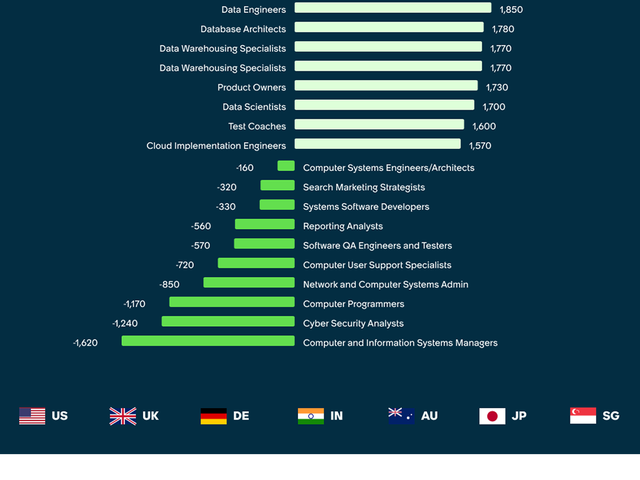
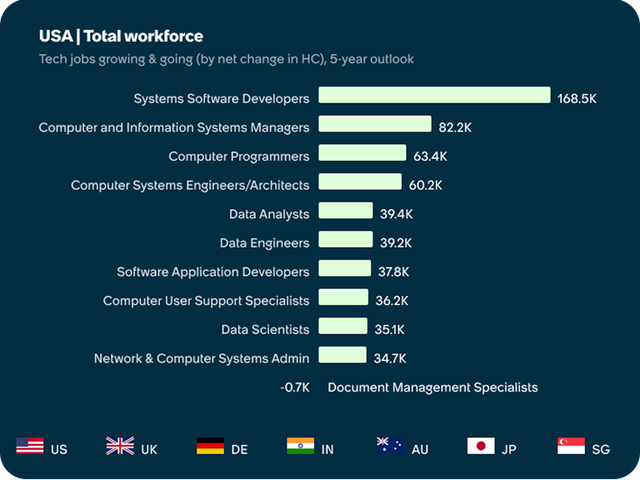
IT jobs in demand Techies needed Almost across the board, we predict rising demand for most tech roles. In the U.S., we found that with one exception (document management specialists), the need for skilled tech workers will increase over the next five years.
Female with headphones walking up stairs carrying laptop and phone
USA total workforce, tech jobs growing and going by net change in headcount, 5 year outlook

The data shows that a new wave of AI-savvy employees will be needed to support continued digital transformation and economic growth. This means that for those willing to acquire these new tech-related skills, opportunity will abound.

Initiatives such as RiseUp with ServiceNow can help people interested in changing careers get the skills they need to thrive in the new world of work. Couple that with products such as ServiceNow’s Talent Development which identifies transferable skills so that business leaders can create new professional pathways within an existing workforce, and you have clear path forward to creating the IT workforce of the future.

AI Sparkle
Impact AI:
2024 Workforce Skills Forecast
Emerging technologies will disrupt entire industries while creating new opportunities for people with the right skills. Research by ServiceNow and Pearson predicts how labor markets will evolve as AI gets to work.
Get the full report
Next up
Dive into more conversations AI App Development CRM Customer Stories Ethics & Governance Human Resources Industries IT Now On Now Platform Foundations Products & Solutions All Topics
Stay in the know Join Us
stay in know image
Alt