



Across the world, manufacturing is undergoing a profound transformation. A broad set of macro challenges, ranging from disrupted supply chains, environmental challenges and labor shortages to rising costs and geopolitical risks, are forcing manufacturers to rethink nearly every aspect of how they operate and go to market.
To bolster competitiveness and address challenges across the value chain, many manufacturers have made digital investments to improve procurement and supply chain operations, accelerate digital factory transformation (including OT security), empower connected workers, and to optimize customer support operations. While these investments set the foundation for growth, our research shows that manufacturers face challenges maximizing ROI.
ServiceNow and Dynata recently surveyed 1,901 manufacturing leaders worldwide. We found that for most manufacturers, technology investments are not fully translating into priority business outcomes.
Likewise, only 39% of manufacturers rate themselves mature in their ability to harness manufacturing technology through an integrated approach to digital transformation. One in four characterize their digital maturity as low (with a siloed use of digital technology or only starting some aspects of a digital strategy). Manufacturers who are unable to improve their ability to leverage their technology investments will likely continue to suffer the impacts of macro uncertainty.
The good news? Manufacturers have a major opportunity to accelerate performance by driving enhancements across the value chain. This isn’t just about deploying new tech. Crucially, manufacturers need to connect data and insights across multiple systems and teams, while they automate tasks across people, processes, and technologies.
The benefits are clear: managed risk, improved productivity, higher quality, and frictionless customer and partner experiences. Those who embrace manufacturing technology are far better positioned. Simply put, they are future-ready.
Cybercriminals are targeting manufacturers where it hurts: in OT. While IT leaders have increasingly focused on cybersecurity threats in recent years, OT has often lagged behind. This has created opportunities for hackers, who funnel into main IT systems through OT holes. The potential consequences are calamitous. Breaches can halt operations and cost millions per hour.
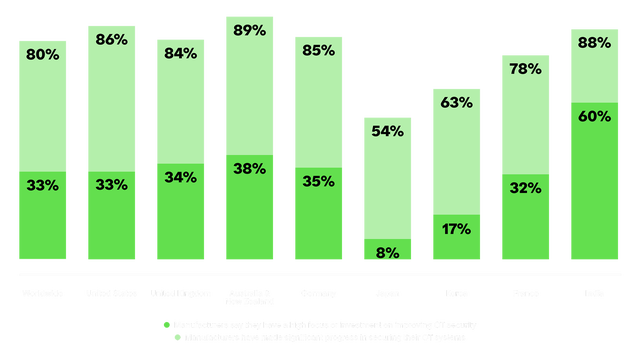
This is not news to manufacturers. Eighty percent of respondents in our survey place a high priority on improving OT security, and they have clear related business outcomes they want to achieve: preempt attacks more effectively, prevent factory downtime, and keep their employees safe. But more needs to be done to manage risks, as only one-third (33%) of respondents have made significant progress securing their OT systems.

Many manufacturers lack a holistic OT and IT security strategy and lack visibility into potential threats. When different stakeholders manage IT and OT security separately there is no single strategy for managing the attack surface as a whole. This creates visibility gaps that increase vulnerability.
Just over one-third (35%) of survey respondents say they’ve made significant progress in achieving a single, comprehensive view of all OT vulnerabilities. Only 36% say they have made significant progress in proactive vulnerability response. When manufacturers lack visibility, they can’t address vulnerabilities. When a breach does occur, they cannot quantify the impact. They may not even understand how the breach happened or how to resolve it.
Leaders who experience a higher level of OT visibility have something in common: they are more likely to embrace the convergence of OT and IT. Seventy-two percent of respondents who have significantly boosted their OT security manage OT and IT assets together and show increased capabilities across OT security.
To withstand disruption, manufacturers must fundamentally rethink their approach to OT security, introducing both the technologies and operational mindsets needed for OT to be part of an overall enterprise risk approach with IT. The first step for manufacturers is to understand what OT and IT assets they have. But visibility goes beyond asset lists, helping you determine what OT and IT devices are in play and how they interact. Once you know what’s there, you can begin untangling the web of visible and often invisible dependencies that create vulnerabilities.
To mitigate threats in real time, manufacturers must integrate data from multiple sources on a single platform.




Forward-thinking manufacturers are turning to shop floor digitization to enhance operational efficiency and future-proof their operations. But to reduce cost on the factory floor, manufacturers need to think beyond equipment automation and focus on how teams get work done.
Even on the most high-tech factory floors, workers often rely on manual, paper-based, non-standardized processes. These processes often slow down work, decrease productivity, increase human error and unplanned downtime, and create poor experiences for employees. All this hurts the bottom line. When production stops, the cost to medium and large manufacturers can reach $1,000,000 an hour.

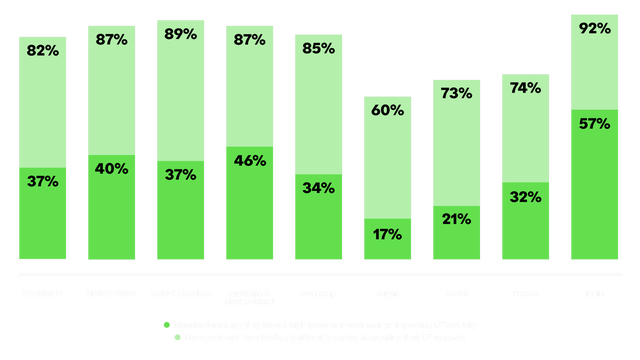
While manufacturing leaders recognize the importance of digitally enabling factory floor workers, they also know there is progress to make. Eighty-two percent of respondents place a high priority on factory floor digitization, yet only 37% indicate they have made significant progress in doing so.
This lack of digitization can hamper manufacturers’ ability to meet their top business outcomes too. Respondents ranked increased employee productivity, cost reduction, and risk management as their top three priorities.
What’s holding them back? Respondents point to a slow time to value for factory workers and a lack of a common factory knowledge repository as top factors that limit their ability to improve factory floor productivity. This has a ripple effect, as 89% of respondents say a lack of digitization for factory worker processes impacts overall equipment effectiveness (OEE).
Nearly half (49%) of organizations with advanced digital maturity have made significant progress in enabling their factory workers, compared to 31% of lower digital maturity organizations.
Manufacturers can boost OEE by digitizing standard operating procedures. The goal is to replace inefficient, manual processes with standardized, automated decision making. Digital tools that democratize institutional knowledge allow workers to achieve continuous improvement through collaboration and problem-solving. They can make decisions in real time, driving action and empowering higher levels of organizational performance. This yields safer, more fulfilling, and more productive work.
Manufacturers can also use IoT data to accelerate digital worker initiatives. And in the future, IoT data can be leveraged to further accelerate productivity.
“This is where sensors, connectivity, and automation come in,” says Julia Martensen, ServiceNow field innovation officer. “You get data from sensors and are able to feed it into different platforms and systems. When these platforms and systems are connected, it will allow you to use collected data and rules that were set up to then automate different actions. And that in turn helps you fix problems before they occur, which ultimately increases trust in your operational ecosystem. It’s a good value chain.”



Talent shortages are making it difficult for manufacturers to attract and retain workers. “The COVID-19 pandemic and this digitalization age have been catalysts to see why we need change,” says Lindsey Berckman, a Deloitte principal and smart manufacturing leader. Berckman recommends that manufacturers broaden the net by recruiting workers with a variety of skill sets, certificates, and advanced degrees, rather than requiring an engineering degree as a condition of employment
To boost competitiveness, manufacturers need to create a digitally fulfilling employee experience. Done right, factory floor digitization can reduce voluntary exits and improve the desirability of manufacturing jobs by:
- Appealing to the next generation of digital workers
- Reducing employee turnover with a work environment that contributes to worker happiness and well-being
- Improving worker and shop floor safety by digitally embedding safety policy controls into day-to-day work
Capturing work processes and outcomes digitally allows other workers to gain from their insights. Digital processes also speed up knowledge transfer and training, so new or upskilled employees can add value even faster. Ultimately, digitization can result in greater OEE as well as create a fulfilling work experience that boosts employee productivity, retention, and loyalty.

There are great opportunities for manufacturers to use advanced manufacturing technology. With digital twins, for example, you can mimic and simulate and test out workflows, such as how work might flow through your production line and how people move around.
You don’t have to wait for problems to happen. You can simulate the problem first, allowing you to test out your mitigation or contingency plans. You can train your people how to solve the problem in the digital space, and then not be as afraid if the problem actually happens in the real world. Or, you’ll have already mitigated risk to a point where the problem might not even occur.
Manufacturers may see the potential of something like extended-reality technology, but they might not yet see the return on investment. Plus the technology might not be advanced enough at this point in time. One example may be training a forklift driver for a new surrounding, or testing new factory floor layouts in virtual reality. The benefits, such as saving time and cost and mitigating risk are apparent, but what if you have someone who experiences motion sickness because the technology is not yet advanced enough? In this case, the return on investment and change management may be an issue.
Other advanced technologies, such as augmented reality, might be a better fit in that case. There are plenty of manufacturing-specific applications, but manufacturers will also benefit from other employee experience innovations. For instance, virtual reality glasses in a static environment can be used to improve soft skills and help a factory manager practice conversations around employee growth or feedback enriched with in-ear prompts.

Recent supply chain shocks have exposed the brittleness of just-in-time manufacturing. As a result, manufacturers have learned to adjust to supply chain disruptions.
“What happened to the supply chain during the COVID-19 pandemic brought risk to the top of the list in terms of priorities,” says Rosemary Coates, a global operations expert who founded the Reshoring Institute. "We saw factories opening and closing, a backlog of container freight around the world, backlogs at our ports. It was a real wakeup call for manufacturers: start considering not just your economic profile, but also consider risk.
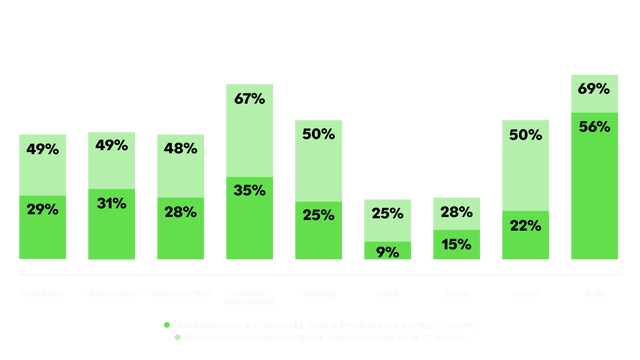
The manufacturing leaders in our survey recognize the need to build resilience into their supply chain strategies. Some 67% perceive a high or very high risk of supply chain disruption in the next 12-18 months.
Manufacturers are taking action: 49% of respondents state that to reduce risk they have increased investment to a great extent in supplier communication and collaboration. Their top goals include boosting on-time delivery rates from suppliers and improving supply chain agility for sourcing. Yet when asked, only 29% have made significant progress in reducing supply chain risk.




What separates laggards from leaders is a unified digital experience that brings internal teams together with suppliers to ensure predictable material supply and improved operational efficiency. This requires seamless supplier experiences at the front end while automating away complexity in the back office. With supplier onboarding, for example, manufacturers can provide self-service and omnichannel access to simplify and automate interactions.
Work flows more smoothly when manufacturers and suppliers collaborate on a single digital platform. Complex tasks can be automated in sequence. The legal team can interact on nondisclosure agreements and contractual needs. Finance can review and provide oversight. The governance, risk, and compliance team can assess supplier compliance and risk using real-time insights. Procurement can process contracts.
Unfortunately, our survey reveals that email and phones remain the primary method of communicating and collaborating with suppliers. Only 31% of respondents use a supplier portal, while 17% use a virtual agent and 14% provide self-service. Likewise, less than half of survey respondents are using automation and workflows to improve supply chain resilience.
At most manufacturers, the current IT environment is a jumble of legacy solutions, including enterprise resource planning (ERP) systems, supply chain applications, and various point solutions. Manufacturers recognize the need to streamline and integrate their IT. They cite a lack of data and analytics to inform business decisions and siloed systems and technologies as the top two barriers impacting their ability to effectively manage supply chain issues.
Digital maturity can enable manufacturers to extract greater value from manufacturing technology investments. Compared to digital leaders, respondents early in their digital transformation journey had less success using ERP to effectively resolve supplier issues (20%), while more advanced maturity respondents using manufacturing technology to bridge siloes saw 48% ERP effectiveness.
Investing in systems of record like ERP, customer relationship management (CRM), and case management (CMS) is only a first step to generating value from a digital strategy. By uniting disparate ERP and CRM instances with automation and extending their value by linking them with other systems and across different parts of the business, manufacturers can work digitally with real-time oversight across departments and systems to efficiently onboard, manage, and collaborate with suppliers.

It’s astounding how much the world is disrupted if manufacturing doesn’t work. With so many different players involved, the supply chain is a fragile environment. Port strikes, material shortages, road congestion, geopolitical conflicts all can bring production lines to a stop. As you go about your day, you realize how much in life is thanks to a well-functioning supply chain and manufacturing processes. And if it doesn’t go to plan, and those things aren’t there—the things you take for granted—that disrupts your flow of work and your flow of life.
There are pros and cons to any production strategy, be it onshoring, offshoring, or farshoring. That’s usually an interesting intersection to think about: what is my actual priority? Which goods do I want to have manufactured nearby to mitigate supply chain risks? There will probably be less disruption if something is being manufactured close to where I am. On the other hand, onshore production can be much more expensive. Do I pass those costs on to the consumer of my goods or do they cut into my profit?
There are so many different factors: time-to-consumer, transport challenges, and cost of labor and goods. To me, it’s all about visibility, communication, and flexibility. The companies that did well during the pandemic were the ones who pivoted quickly. They could see which suppliers were able to produce on time, and they had the ability to engage new suppliers dynamically.
You can only do that if your processes can accommodate that switch easily. If you have a very cumbersome vetting and onboarding process, you’re probably impacting your own supply chain. If those processes are nimble and frictionless, everything gets easier. As a next step, process automation can yield faster, more efficient supplier management.
Customer expectations are evolving, and it’s no surprise that improving customer experience (CX) is a top focus for manufacturers.
“Historically, companies operated in a ‘sell it and forget it' model,” says Peter Blome, a Deloitte director and offering lead. “Today, after-sales services are becoming more important.” Blome cautions that most companies fall short servicing their products once sold. “But there’s huge potential there. And transparency also plays a significant role. If I know which devices I bought from which company, the status of those devices, which services I can attach to those devices or products—that’s a new door that can be opened."
Manufacturers have opportunities to take on greater responsibility for product uptime and performance. They are also under pressure from leaders to grow profits with new recurring revenue models that set the stage for servitization. However, the manufacturers we surveyed tend to prioritize increasing the profitability of their existing products and services (40%) over unlocking new revenue from servitization models (29%).
Why? The reality is that the customer experience in manufacturing isn’t just about supporting and servicing customers after the sale is complete. It’s equally important to provide great experiences across the sales and order fulfillment process. Getting this part wrong can decrease customer satisfaction and loyalty. Our research shows that manufacturers place a high level of focus and investment on improving both sales as well as after-sales experiences.





The manufacturing sales motion remains full of friction, yielding uneven customer experiences (CX). Organizational silos, a shortage of useful data and analytics, and siloed systems and technologies are among the top factors manufacturers cite that impact their ability to improve customer service.
Manufacturers recognize they need to provide better customer sales and service experiences. Their top three targeted improvement priorities include improving channel partnerships, enabling customer self-service, and automating work assignments and routing across teams and partners.
Driving results from these targeted areas requires an ecosystem mindset. Manufacturers need to bring together front, middle, and back-office teams, including all partners, suppliers, and resellers, to solve customer requests quickly on a single platform. Manufacturers that do this successfully can reap multiple benefits.
“We’re not isolating customer experience anymore,” says ServiceNow’s Martensen. “Manufacturers need to look beyond the user experience of their product and examine the user experience of their whole ecosystem, which comprises employees, partners, internal and external processes, and also the planet.”
The biggest barrier by far to improving CX is partner or reseller complexity, including onboarding, collaborating, data sharing, and service consistency. Manufacturers also say this is their top targeted area for improvement.
Growing aftermarket revenue requires manufacturers to optimize and expand distribution models, but delivering effortless experiences is pointless if it’s not repeatable. Ensuring that customers, no matter where they are, receive the same frictionless resolution through partners is undeniably a top priority for manufacturers.
"Your partner and resellers are an extension of your brand,’’ says Allen Hackman, ServiceNow AVP, head of manufacturing industry. “Setting them up for success is critical. You have to give them a great service so they can in turn provide an exceptional service to your end customers."
Manufacturers who use a single, connected platform can achieve increased customer satisfaction and loyalty by removing friction across the entire customer journey. Digitizing customer-facing interactions addresses part of the problem, but manufacturers can't stop there. By digitizing interactions across all internal and external value chain partners, manufacturers can maximize the profitability of their existing services and launch new, service-based revenue streams.