


Transformation
Report

Nonprofit digital transformation is mission-critical.
It's time to move from AI experiments to end-to-end transformation.
As digitization increases, so do cyber, privacy, and security risks.

Nonprofits are the unsung heroes of communities around the world. That’s why ServiceNow.org President Vanessa Smith believes they deserve access to technology that helps them to do more good, for more people, every day.
They come in all sizes, from small-town museums to global organizations with thousands of employees and 10-figure budgets. But nonprofits all have one thing in common: purpose. Whether they are feeding people in the wake of a natural disaster or teaching kids to read, all nonprofits are driven by a desire to improve the communities they serve.
To understand how nonprofits are using technology to advance their missions, ServiceNow.org teamed up with research agency ThoughtLab. We surveyed 300 nonprofit leaders to identify which tech strategies have the most potential to help nonprofits do maximum good with limited resources. The results were eye-opening.
Read the full report to discover the best practices of nonprofit Pacesetters—those organizations using technology to accelerate their time to impact. You’ll learn what they get right, what can be improved, and how all nonprofits can embrace AI-driven digital transformation for maximum impact.
Many nonprofits are at a technological crossroads. They can either grow their impact with the right digital strategy or find themselves saddled with outdated tools that don’t serve the needs of employees, donors, or beneficiaries.
Our research found that nonprofit Pacesetters realized outsized returns across every dimension. Still, while most organizations are planning to implement new technology to improve beneficiary, employee, and donor experiences, many nonprofits experience a disconnect between the promise and reality of digital transformation. Why?
Only 53% of respondents believe their senior leaders understand the latest advances in technology.
This lack of technological acumen at senior levels translates into slower adoption of AI and other emerging technologies, making it difficult to digitize nonprofit operations effectively. In addition, nonprofits also contribute significantly less to their digital budgets than organizations in other industries—a relatively small 3.9% compared to, for example, 15% for financial services.

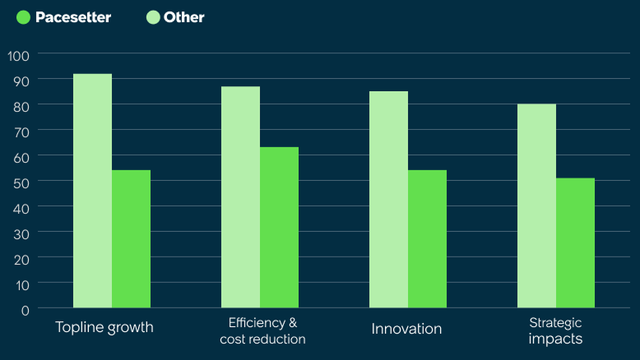

When we compared Pacesetters to other survey respondents, the gap in performance between the two was massive. Their efforts to incorporate AI into their digital workflows had propelled organizational improvements so significantly that all those who had yet to digitize were left in the proverbial dust.
We see a similar “AI gap” between Pacesetters and other nonprofits when it comes to how they are using AI to improve performance across management and operations as well as stakeholder engagement. Two-thirds are midway or advanced in using AI to improve their performance, about 10 times as many as other nonprofits. In three years, that number will rise to nine out of 10 Pacesetters.
Today, 93% of pacesetters are midway or advanced in implementing an end-to-end IT platform, more than five times as many as other nonprofits.
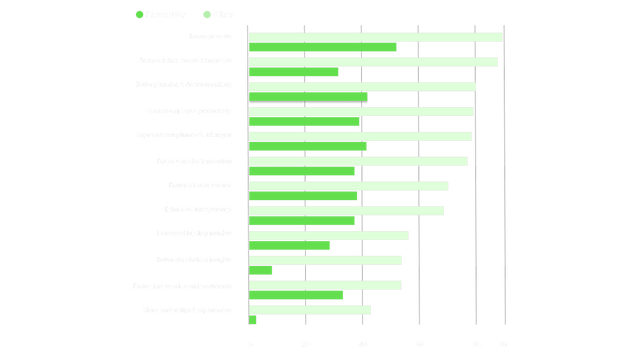
When it comes to nonprofits, one size does not fit all. Their social missions are diverse, and the challenges they face vary widely based on their size and operating budget.
Small to midsize respondents (those with an operating budget of less than $500 million) are most concerned about inadequate funding for digital transformation efforts, lackluster planning and execution, and a lack of commitment from their leadership. Larger ones are more worried about external challenges, including regulation and compliance requirements, data privacy and security concerns, and finding the right technology vendors and partners.
Unsurprisingly, large to very large organizations are doing more than smaller ones to develop digital skills, talent, and capabilities. For example, 61% of them are building IT Centers of Excellence (vs. 15% of smaller peers). On the other hand, smaller nonprofits faced fewer internal and external challenges, including a smaller incidence of organizational or departmental silos (13% vs. 22% for larger nonprofits) and cybersecurity risks (3% vs. 16%).

- Inadequate budget
- Poor project planning and execution
- Lack of leadership commitment
- Regulations and compliance requirements
- Growing data privacy, security, and technical risks
- Finding the right technology vendors and ecosystem partners
serve approximately 3.6 billion beneficiaries annually. Our analysis shows
that digital transformation has already helped nonprofits serve over 57.1
million additional beneficiaries across the globe.
If all people-focused nonprofits were Pacesetters, they would be able to
serve an additional 103.1 million beneficiaries per year.
nonprofits across the globe to be approximately $1.5 trillion, of which an
average of 77% goes to helping the nonprofit achieve its mission. Digital
transformation has already helped nonprofits devote approximately $35.5
billion in additional revenue per year to their core mission.
If all nonprofits were to become as digitally transformed as Pacesetters,
nonprofits would be able to devote another $19.6 billion per year to helping
beneficiaries.

Pacesetters excel at using digital technology to provide seamless personalized experiences to beneficiaries, donors, and volunteers. They engage stakeholders through mobile apps, map digital journeys to eliminate pain points, and analyze stakeholder needs.
A key differentiator between Pacesetters and other nonprofits is the use of an end-to-end IT platform. Such a platform galvanizes performance by using AI, automation, data, and other advanced technologies to integrate workflows, processes, and functions.
Pacesetters excel at using AI to drive performance and mission impact. This includes GenAI, which Pacesetters use to generate documents and predict trends.
Pacesetters digitize and automate tasks and processes while providing staff with better digital experiences, training platforms, and tools.
Pacesetters develop clear implementation plans and metrics to measure performance. They create a culture of change, upskill staff and bring in new talent, build IT Centers of Excellence, and tap outside resources.
Technology, cyber, privacy, and ethical risks increase as nonprofits become more digitally transformed. To mitigate these risks, pacesetters take many steps to enhance IT governance, compliance, and cybersecurity, from bringing in cybersecurity technologies to using AI to detect anomalies.


Transformation Report