


For the past few years, the enterprise AI conversation has largely been about assistance. A chatbot drafted an email, summarized a document, or recommended the next step. Now, models reason further and can take on work nobody would have entrusted to AI before.
It’s significant progress, but as AI is assigned more work across more systems, fragmentation becomes a challenge. Without a common experience and a governed foundation underneath it, more intelligence doesn’t necessarily translate into more value.
Enterprises are feeling that tension. The questions I hear most often from business leaders are:
- How do we turn all this intelligence into tangible outcomes?
- How do we stay in control as AI keeps changing?
Twenty years running enterprise workflows gave ServiceNow a head start on addressing both.
With the ServiceNow AI Platform Brazil release, available today, we’re advancing what AI can do across the enterprise. We’re delivering agentic AI that carries work forward, grounded in the workflows enterprises already run and built with governance at its foundation.
The Brazil release extends this across three frontiers:
- Software, where AI takes on more of the development lifecycle
- The desktop, where work moves past the boundaries of any one app
- The enterprise, where AI agents across vendors act as a connected ecosystem
Turning an idea into working software means understanding requirements, planning, building, testing, identifying and resolving issues, and deciding whether the product is ready to ship. AI presents a much bigger opportunity beyond just code generation, extending to the amount of development work a team can take on.
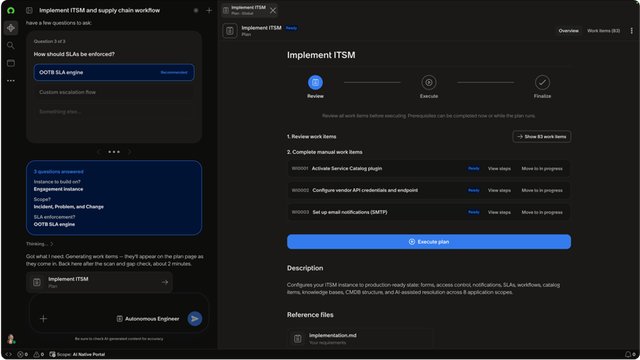
That’s the impetus behind our new Autonomous Engineer. Developers can now move from building alongside AI to delegating more of the development process for AI to execute. Give Autonomous Engineer a well-defined unit of work, and it creates a structured plan, builds in parallel with AI agents in the background, and generates and runs tests.
Developers review the results and still hold responsibility for architecture, quality, and production readiness. Now, thanks to Autonomous Engineer, they can have more availability for the complex problems where their judgment matters most.
The desktop is where much of the everyday work comes together, but that work rarely stays within one application—at least for me it doesn’t. Preparing for a meeting might mean pulling information from ServiceNow, checking email, reviewing files, gathering updates, and building a presentation deck. Today, employees still have to connect the dots themselves, moving between systems and bringing the pieces together.
ServiceNow Arc changes that model. It’s the industry’s first personal AI agent purpose-built for the enterprise. Employees can delegate everyday work, and Arc independently sees tasks through to completion while operating within enterprise guardrails. Arc runs on a secure NVIDIA OpenShell runtime or an employee’s desktop.
A couple of things about Arc have me especially excited for our customers:
- Governance: Arc is governed by ServiceNow Super Intelligence Control Tower, including its newly expanded capabilities to help govern AI across the enterprise. That means Arc can work independently while the enterprise stays in control, with IT having the ability to define what Arc can access and do.
- Where work runs: Cost comes up in nearly every conversation I have with enterprise leaders about AI, and for good reason: Sending every task to a frontier model doesn’t scale across a workforce. In our lab testing, Arc handled 95% of everyday background tasks (such as pulling action items from a meeting transcript) on local models running on NVIDIA RTX Spark, saving frontier models for the work that truly needs them.
No enterprise will run one AI agent or one model. That’s why we built an open platform centered on customer choice and flexibility. Our customers are already combining ServiceNow with AI agents, models, tools, and systems from other vendors across their environments. We're committed to giving them a governed way to put all of them to work together.
Action Fabric connects approved ServiceNow and third-party AI agents to enterprise workflows, external tools, and each other, with identity, permissions, policy, and auditability managed consistently. It extends ServiceNow workflows and governance beyond the platform to wherever the agents operate.
This means organizations can put the AI agents they choose to work without giving up the controls they rely on. This helps turn a growing collection of AI agents into a connected ecosystem.
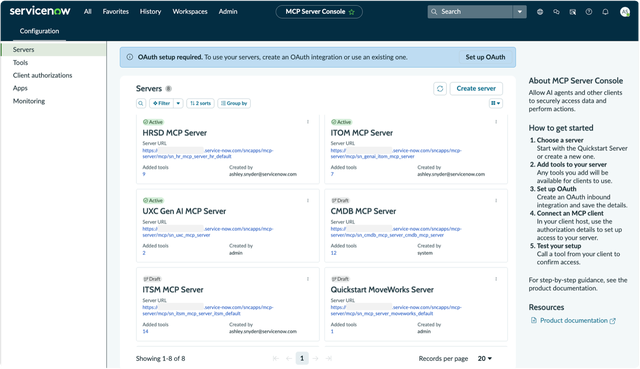
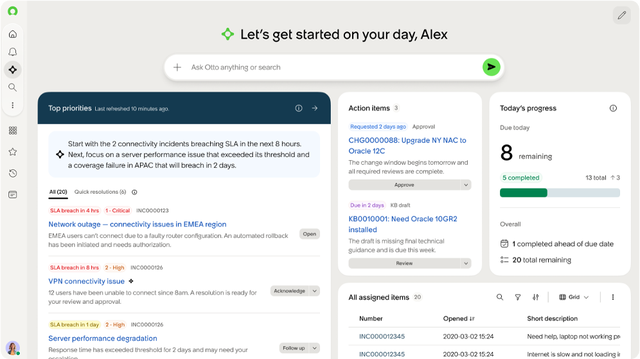
As AI is assigned more everyday business work, the human experience needs to get simpler, not more difficult. People need to see what AI is doing, bring the appropriate context forward, step in when needed, and shape what happens next, without navigating an ever-growing pile of AI agents and interfaces.
That’s the role of our new Lux experience for the ServiceNow AI Platform. Lux brings a more intuitive, consistent way to work across ServiceNow, unifying how people navigate, search, receive updates, and move between their work.
We’re continuing to make that experience work better for everyone. The Brazil release includes more than 1,300 accessibility enhancements, helping to make our platform easier for more people to use.
Taken together, the innovations in the Brazil release expand what AI can do across the software, desktop, and enterprise frontiers—from software development to everyday work to connected AI agents across an organization. Lux helps bring that work together into an experience that’s more contextual, more coherent, and easier for people to shape.
That’s how we move toward an enterprise where AI can take on more of the work without adding more complexity for the people behind it.
Find out more about the latest innovations in the Brazil release.