





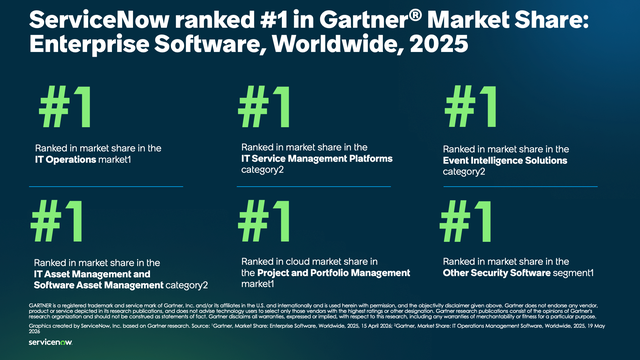
I’m thrilled to announce that for the second consecutive year, ServiceNow has ranked No. 1 by market share across six technology workflow segments in the 2025 Gartner® Market Share reports:
- IT Operations¹
- IT Service Management Platforms²
- Event Intelligence Solutions²
- IT Asset Management and Software Asset Management²
- Project and Portfolio Management¹
- Other Security Software¹
Many organizations are evaluating whether a unified platform can simplify workflows compared to multiple point solutions. Thousands of enterprises consolidated their IT workflows on ServiceNow last year. This year, they're doing it again, and they’re doubling down. When one platform runs your IT service management, security, operations, portfolio management, and asset management, the business case for six individual point solutions falls apart.
Across all six categories, the story is the same: Routine requests still consume half the service desk’s day.
AI-generated code and faster release cycles are adding new categories of issues faster than teams can absorb them. Alert volumes are too large to track manually. Security findings pile up faster than teams can act while AI is expanding the vulnerability surface in ways that most security programs weren’t built to handle. Asset estates are too complex to govern. Strategy and execution are misaligned.
As this is happening, leadership is watching closely to see if IT can deliver significant return on investment with AI.
These challenges share a common root: Processes and knowledge are locked in people's heads, in tools that don’t connect, and in the gap of what AI is currently capable of and how IT teams operate.
We believe six No. 1 placements validate that our dedication to autonomous service operations, autonomous IT and security, and data orchestration is resonating and that these investments are the natural extension of the trust customers have already placed in us. Here’s a look at the priorities defining the next chapter of how IT operates and why we believe ServiceNow is uniquely positioned to lead it.
There’s a meaningful difference between AI that completes tasks and AI that handles a job.
Most AI tools help with something specific and then hand it back. ServiceNow Autonomous Workforce, a collection of AI specialists, is deployed with defined roles, assigned skill sets, and the scope, authority, and governance to execute work from start to finish. It builds on the capabilities of ServiceNow AI Agents to help organizations go beyond task-based to role-based autonomous AI.
This matters because enterprise work requires deterministic outcomes: governance, security, and auditability. AI models without workflows are probabilistic and can give different answers to the same question.
When a critical system goes down at 2 a.m., for example, “probably the right resolution” isn’t good enough. If regulators ask whether proper controls were followed, “most likely” is compliance failure waiting to happen. Autonomous Workforce can resolve that tension by combining probabilistic intelligence with deterministic workflow orchestration through AI Control Tower.
Each AI specialist inherits your organization's permission sets and policies from day 1, learning from every resolved incident within governed parameters. In IT operations, they correlate alerts and initiate remediation before outages surface. In security, they triage vulnerabilities and create change requests without manual handoffs. In service management, the L1 IT Service Desk AI Specialist resolves common incidents end to end. AI does the work. The team owns the results.
What's missing for most IT teams looking for this level of AI automation is the connective tissue that lets people, data, and workflows operate as one. ServiceNow provides that across service, operations, and security simultaneously. The AI specialists running those domains are built to work as a team, not in parallel silos.
Consider what that looks like in practice. An employee reports a service disruption through any channel: portal, chat, or voice. The L1 IT Service Desk AI Specialist picks it up, self-assigns the ticket, analyzes the request, checks known issues and device history, and diagnoses the root cause.
If the issue points to an infrastructure problem, the AIOps AI Specialist is already on it, correlating alerts across your monitoring tools, identifying the underlying cause, and initiating remediation. If the disruption traces back to a missing software entitlement or an expired license, the Software Asset Management Operations AI Specialist is already working on identifying the gap, analyzing usage patterns, and reclaiming or fulfilling the license automatically.
The issue is resolved. The employee is notified. The ticket is documented. No human touched it.
The request avalanches consuming IT teams' time get resolved automatically, freeing people to drive strategy and deliver business outcomes. AI helps service operations shift from reactive to preventive, assisting organizations in scaling to an autonomous and secure environment that’s self-driving, self-healing, and self-defending. At ServiceNow, our own Autonomous Workforce helps us handle 90% of employee IT requests autonomously.
Many IT leaders have concerns that AI agents will act on incomplete or siloed data, creating more chaos than they resolve. They need a way to see everything AI is doing, confirm it’s acting within policy, and showcase how it’s delivering value.
To help make that possible, we:
- Start with AI visibility: AI Control Tower automatically discovers every AI agent, model, and Model Context Protocol (MCP) server across any cloud, software as a service (SaaS) platform, or custom deployment, with continuous monitoring so nothing operates outside your line of sight.
- Ground every AI decision in context: Context Engine, ServiceNow's organizational intelligence layer, gives every AI agent the full picture of your business before it acts. It maintains a continuously updated map of every service, asset, and system in the environment, capturing relationships, dependencies, and decision history in real time. Every AI specialist acts on the appropriate issue, in the appropriate way, with the correct priority, moving AI from probabilistic suggestions to consistent, precise execution.
- Show AI’s value: Every AI agent and agentic use case is connected to business services, so the outcomes AI delivers are traceable and demonstrable to leadership.
- Keep AI secure and compliant: Every identity (human and nonhuman), every asset, and every device is protected with out-of-the-box support for the EU AI Act, the National Institute of Standards and Technology (NIST), and other major AI compliance frameworks. When a violation is detected, a workflow fixes it automatically, with a full audit trail.
That’s how AI moves from isolated potential to trusted execution at scale.
We believe Gartner’s recognition across six categories reflects a consistent response to where IT teams are today. The goal ServiceNow customers are working toward is aspirational but achievable: zero support incidents, zero outages, zero asset issues, zero breaches, and zero misaligned investments—five outcomes on one connected platform.
That destination is what connects all six of the categories we ranked in. And it’s closer than most organizations realize.
We feel that holding the No. 1 position across six distinct technology workflow categories for the second consecutive year is evidence that what we're delivering is working in production for enterprises solving real problems.
We're proud of this recognition, and we're clear-eyed about what it demands: continued investment in the capabilities our customers depend on and a relentless focus on making AI that earns its place in their organizations.
Find out more about how ServiceNow can help lead your IT reinvention.
¹ Gartner, Market Share: Enterprise Software, Worldwide, 2025, 15 April 2026
² Gartner, Market Share: Enterprise Infrastructure Software, Worldwide, 2025, 12 May 2026
GARTNER is a registered trademark and service mark of Gartner, Inc. and/or its affiliates in the U.S. and internationally and is used herein with permission. Gartner does not endorse any vendor, product, or service depicted in its research publications, and does not advise technology users to select only those vendors with the highest ratings or other designation. Gartner research publications consist of the opinions of Gartner’s research organization and should not be construed as statements of fact. Gartner disclaims all warranties, expressed or implied, with respect to this research, including any warranties of merchantability or fitness for a particular purpose.