





A few years into the AI era, most enterprises tell a remarkably similar story. They've deployed AI agents, automated tasks, and watched a few workflows get faster. Executives are confident; budgets keep growing.
Then leadership asks about the autonomous systems that were supposed to free people from routine work, and the room goes quiet.
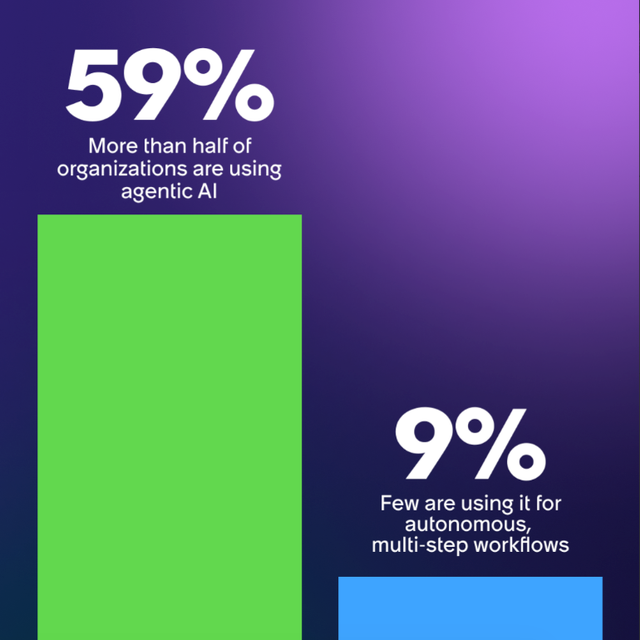
Nearly 60% of enterprises now use agentic AI, according to the ServiceNow Enterprise AI Maturity Index 2026. But only 9% are using AI to its full potential by running autonomous, multistep workflows. The rest are throwing AI solutions at one-off problems. This distinction is not a technicality.
Among today's businesses, most AI agents are simply underutilized. A customer service rep gets a drafted email reply that they can approve, or a procurement analyst gets a requisition that's already filled in.
Real autonomy looks nothing like that. An autonomous agent carries the work from start to finish—routing it, transforming it, and deciding on it—without stopping for a signature at every step. Rather than making people faster at the jobs they have, autonomous workflows change those jobs entirely.
The Enterprise AI Maturity Index gives a sense of how rare that leap still is. Among the leaders we call Pacesetters—the roughly one in five organizations furthest ahead in AI maturity—36% use agentic AI to run multistep workflows autonomously. Only 2% of other businesses make the same claim.
Amit Zavery, ServiceNow's president, chief product officer, and chief operating officer, has watched this divide open across industries. "Buying AI and building for it are not the same thing, and the gap between the two is where competitive advantage is won or lost," he says.
Underneath the momentum, he adds, sits an uncomfortable fact: "Most organizations are still automating yesterday's work instead of reimagining tomorrow's."
Employees feel this even when they can't name it. An AI agent wired into a single procurement workflow delivers a local win only. Give that agent a view across procurement, inventory, and financial planning, however, and it starts to change how capital moves through the business.
"The organizations pulling ahead with AI are not the ones that moved first. They’re the ones that asked a better question," says Holly Briedis, head of global industries and solutions at ServiceNow. "They didn't ask ‘how do we use AI to do this faster?’ Instead, these leaders asked ‘should this work exist at all?’”
The Pacesetters figured this out a while ago, and the contrast with everyone else is stark. According to the Enterprise AI Maturity Index, 64% of Pacesetters use digital technologies to integrate and optimize their data, compared to 14% of other organizations.
Similarly, close to three-quarters of Pacesetters have established policies for who owns and controls their data, and two-thirds use AI to clean up how data is migrated and managed.
The conventional wisdom is that governance is a tax on speed. The enterprises actually running autonomous workflows have discovered the opposite. For them, governance is the scaffolding that lets them move fast without losing track of what their AI agents are doing.
"The pattern I keep seeing isn't a technology gap,” says Vijay Kotu, ServiceNow’s chief analytics officer. “It's a deployment gap. Organizations are moving agents into production faster than they're building the capabilities to manage them.”
The numbers bear this out. Among Pacesetters, more than two-thirds build trust and transparency into their AI from the start. And more than half run AI agents through testing and risk assessment before anything goes to production, according to our research.
“The core risk isn't an individual agent failing. It's that connected agents amplify each other's errors as readily as they amplify each other's value,” Kotu says.
There's one more pattern in the numbers, and it might be the most telling. Today, only 9% of organizations use agentic AI to run autonomous, multistep workflows, while another 9% use agentic AI to build workflows that weren't possible before.
Looking two years ahead, the story is mostly the same. Only 20% expect to reach autonomous, multistep workflows by then. After years of heavy spending, a ceiling that low should set off alarms in any boardroom.
For Bhavin Shah, who leads Moveworks and AI at ServiceNow, the failure is rarely about money or nerve. "Most organizations have not failed at AI because they lacked ambition or budget. They failed because they bolted AI onto broken infrastructure and then expected employees to figure it out," he says.
"When people have to work for the system rather than the system working for them, they don't use the AI. They work around it. And the moment they work around it, ROI [return on investment] plummets," Shah adds.
None of what separates Pacesetters from their competitors is glamorous: data modernization, governance, process redesign, an AI-ready workforce. But this unglamorous groundwork lets them move as fast as they want.
Find out how the ServiceNow AI control tower can help you reinvent business.