



It’s a common refrain among business leaders: Across industries and around the world, organizations are feeling a new wave of energy, and pressure, because of AI. But the question these executives keep coming back to isn't about technology. It's about how they can prepare their people for what’s next.
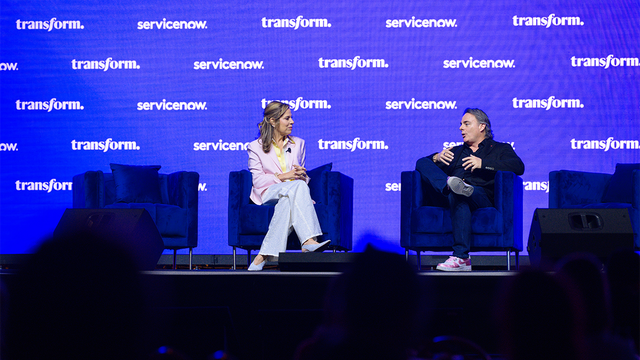
At Transform 2026, Jacqui Canney, chief people and AI enablement officer at ServiceNow, spoke about what this kind of transformation requires with Lars Schmidt, an expert in talent strategy, organizational transformation, and HR innovation. Here are the highlights from their conversation.
Note: This interview has been edited for brevity.
He put together AI enablement with the chief people officer role, and he also gave me accountability for enabling our customers, partners, and communities. It was a much wider scope, and I don't take that lightly. We need 3 million learners on our technology, adopting and using AI in the flow of their work. That’s good for the world and good for business.
When I think about what that truly means, it's the largest change management effort I've ever seen in my career. And if we don't put this in the “people” lane, I think we'll miss it big.
I see this as an acceleration of all our roles, moving from just being in the HR people lane into truly building thought leadership, bringing people along, and resetting our workforce to make them future-proof.
Make sure HR and IT are true partners as you build solutions. The best use cases come from people who know the work. - Find your team captains and empower them to prioritize and champion use cases.
J: You have to figure out how to work within that hierarchy to some degree. But you should start to test. I've tried to pivot the team to focus on outcomes and a product mindset: putting the people at the center of what we do and working within a structure.
The org chart and hierarchy will eventually deteriorate. My role has shown the disintegration in a good way. But you have to have the courage and the freedom. You have to make it safe to try.
- Establish a collaborative AI operating model to capture ideas, evaluate them, and review them for compliance, risk, and ethics.
J: I stepped back and thought, “If we just started our company today, what would we do differently for HR?” We started to document that journey. I appointed a team captain, and he said, “Let's start with collecting the use cases that our people know, the things that bother them most about their jobs today.”
We collected a thousand use cases right off the bat. And we were able to use a rubric to decide what to prioritize. That rubric helped my team gain a lot of confidence and try things. We went with 28 of the thousand use cases.
We've tried to create a flywheel of confidence. I think showing that enthusiasm, celebrating that work is really important, along with prioritization. And then we monitor those use cases so that I can see what's driving return on investment (ROI) and what's not. And I can see the use cases across the company, like a control tower.
Think about what would be your high-value use cases that align with your business strategy. - Implement an AI control tower to help track ROI and progress.
L: When AI adoption stalls, is it a technology problem or a culture problem?
J: It’s a culture issue. And it was a culture issue before AI: on-premises to the cloud, cloud to mobile, whatever you’ve been through. Adoption, comfort level, culture—that’s what holds us back. But it’s also our greatest strength and opportunity. The human capital you can unleash when you get this right—we call it a human capital renaissance.
We did a full assessment of our company's AI capabilities and made it very personalized. Our board took that assessment too, because this has to come from the top.
If someone is pushing for capacity, my challenge back to them is: What are you going to do with that capacity? What's the end game?
We get so many notifications a day, and that's a lot to process. Leaders who lead with wisdom, not just efficiency, choose their use cases more carefully. They think about what they value and how they treat their workforce. That's not a technology question. This curation of wisdom is what I'm seeking in a lot of our leaders.
Start at the top. Culture change doesn't scale without leadership modeling it first. - Prioritize adaptability. It’s the most important skill your people need right now.
L: Why does skills-based development progress stall, and how do you think about it differently now?
J: I’ve been part of a lot of skills redesign and reskilling efforts, and they have real merit. But because of AI, we can now offer more personalized learning journeys.
Start with the work you’re redesigning and the skills needed to deploy it successfully. Then look at what capabilities your people already have. An assessment has been really valuable for us, and we do it frequently. We don't use it as a penalty. We use it as a growth opportunity.
The tools exist now to close gaps through new experiences, outcome squads, practice, peer development, and simulations. You can personalize someone's journey from wherever they are today to where you need them to be, and where they want to be. That's what's different this time.
Close the skills gap by training your people to know, work with, build, and lead with AI. - Personalize the journey. People need a path from where they are today to where the work is going.
Get more insights in ServiceNow’s playbook for HR and business leaders: How to make AI work for people.