





The workflow automation market is a $26 billion industry built on a singular, rigid premise: If this happens, do that. This logic has served enterprises since the mid-1980s but today is the invisible ceiling for every AI deployment.
The problem isn’t AI. It’s the operating model underneath it. Enterprises are trying to launch 21st-century AI agents into 20th-century linear workflows. The result is predictable: a high-speed pileup where the technology moves fast but the process is stuck in reverse.
You’ve probably experienced it. An AI tool drafts a complex contract in seconds, only to sit in a manual approval queue for days because the workflow wasn't designed for machines that can think.
The numbers confirm the gap. McKinsey’s 2025 state of AI survey found that 88% of organizations use AI in at least one business function, but “most organizations have not yet embedded [AI tools] deeply enough into their workflows and processes to realize material enterprise-level benefits.”
BCG's AI Radar 2026 tells the same story from a different angle: 94% of companies are increasing AI spending this year, but only 15% are focused on the large-scale structural change needed to make it work.
This tells us that adoption is almost universal, but transformation is anything but.
“People have had a mess in the enterprise for six decades: legacy systems, lack of integration,” ServiceNow Chairman and CEO Bill McDermott told a Morgan Stanley conference in March. “You have to take multiple trips across multiple systems and functions to actually fulfill a workflow.”
The reason is hiding in plain sight. Of 25 attributes tested across organizations of all sizes, McKinsey found that workflow redesign, not budget, talent, or model selection, has the single biggest impact on whether they see a financial return from AI. The question for business leaders now is what workflows should look like if they're designed for AI from the ground up.
The distinction between companies getting meaningful value from AI and those that aren’t is efficiency versus transformation.
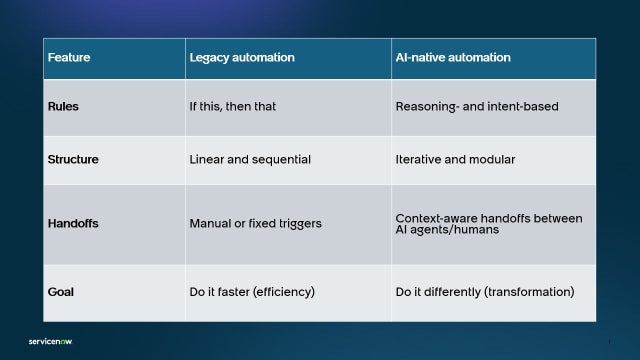
Legacy automation was designed to do the same things, only faster. AI-native workflows are built to do things differently, including questioning whether certain steps should exist at all.
This is the frame that should guide every workflow redesign decision.
Traditional workflows were created for a world where humans are the only ones who can think. In that model, we work linearly, step by step, because that’s how we manage things without getting overwhelmed. But AI doesn't work that way. In fact, it thrives in the chaos of simultaneous tasks.
In an AI-native workflow, tasks that were once sequential run in parallel. Take onboarding, for example. Instead of a relay race between HR, IT, and a manager to grant software access, the system deploys several AI agents at once. One verifies eligibility, another checks training requirements, and a third pushes a one-touch approval to the manager.
What previously took days is now done in minutes, not because each individual step is faster, but because the architecture eliminated the wait between them.
Speed without coordination, though, creates a different kind of chaos. That’s where orchestration comes in.
At ServiceNow, AI Control Tower acts as the oversight layer coordinating AI agents. It provides real-time visibility into each step—eligibility checks, training validation, and manager approvals—so nothing falls through the cracks.
At the same time, it enforces rules such as compliance or access policies across all parallel actions, helping to ensure consistency. While the AI agents execute tasks simultaneously, AI Control Tower keeps everything aligned, governed, and performing smoothly.
Most business leaders know their workflows are outdated. Knowing how to redesign them is another matter.
There are a few reasons for this gap:
- Operational debt: The “We’ve always done it this way” mantra creates process sludge. It’s the byproduct of workarounds and rigid traditions that, although once useful, now slow the organization down.
- No workflow map: If you can’t visualize exactly how work moves through your teams and systems, you can’t pinpoint where AI can transform your work. Mapping reveals the flow of work, identifies data dependencies, ensures AI has the context to act, and defines human-in-the-loop handoffs and new AI-augmented roles.
- Dirty data: AI models lack the company-specific judgment required for high-stakes workflows. Closing this gap requires comprehensive data-cleaning, unification, and labeling efforts that many companies haven't completed.
- No clear use case: Many organizations treat AI as an add-on feature rather than a functional solution. Without a specific problem point to solve, such as a lag in contract approvals, AI becomes a solution in search of a problem. Success requires moving past generative AI tools and identifying exactly where linear workflows are slowing the business.
According to the ServiceNow Enterprise AI Maturity Index 2026, only 20% of organizations expect to use agentic AI to create autonomous, multistep workflows over the next two years. For the other 80%, transformation will stay out of reach.
Redesigning workflows is a significant organizational shift, the complexity of which is compounded in part by the size and age of the enterprise.
To move beyond marginal productivity gains, enterprises should start treating AI as a core architectural layer. This requires a transition from retrofitting—squeezing AI into 20th-century processes—to radically redesigning. But how? According to the 2026 Workflow Automation Outlook by Deloitte and ServiceNow, enterprises should follow these guidelines:
- Redefine process design. Map the processes and identify bottlenecks. Break down roles into tasks. Automate low-complexity tasks and augment more complex tasks with AI.
- Rethink workflows. Workflows should be adaptive, end-to-end systems rather than linear processes. Design frameworks that can learn from outcomes, using AI to navigate services that span business functions.
- Empower each builder. Redesigning workflows shouldn’t be a top-down initiative. Accelerate innovation with low-code and no-code tools that let users prototype, test, and deploy intelligent workflows that operate within your safety guardrails.
Here’s how traditional and AI-driven workflows stack up:
PwC’s 2026 AI Business Predictions offer a useful framework for prioritization, which advises going narrow and deep before going wide. Rather than spreading AI thinly across the organization, the organizations seeing the best results identify a small number of high-value workflows where the payoff is likely to be greatest.
They then apply the talent, technical resources, and change management of the organization to those specific processes first.
One question to consider when redesigning workflows is what happens to the people working alongside these systems.
AI-native workflows don’t eliminate human judgment; they relocate it. The routine, rule-based decisions get automated while the more consequential ones get escalated to humans with better business context.
What changes is where people spend their time. Instead of managing handoffs and approvals, people will shift to strategic oversight, handling exceptions and making decisions that require experience and institutional knowledge.
Deloitte's 2026 State of AI in the Enterprise found that just 34% of organizations are truly reimagining their businesses and that the AI skills gap is the biggest barrier to integration, with education cited as the top way companies have adjusted their AI strategies. Companies, thus far, are training people on tools rather than redesigning the roles those people live in.
The tide may be starting to change as higher education begins to recognize this as a critical skill set. Boston University’s Questrom School of Business, for one, has introduced graduate programs dedicated to process mapping and workflow redesign.
According to the school, these are “the skills that determine whether AI outputs actually change how work gets done. Students learn to identify where decisions occur, where bottlenecks form, and where AI can meaningfully augment or automate specific steps without creating new points of failure elsewhere in the process.”
More broadly, universities are merging graduate-level AI and business programs, acknowledging the crucial link between technology and strategy. While science and engineering departments still lead the way, AI degrees within business schools exploded by 1,200% between 2022 and 2025, according to Master’s in AI. And more programs are launching every year.
The primary hurdle for AI success has shifted from technology limitations and budget constraints to organizational readiness and cross-functional collaboration. Meaningful value can be realized only if work is redesigned around the partnership between people and AI, rather than automating one-off tasks.
The ServiceNow Enterprise AI Maturity Index illustrates the point. About one-fifth of companies surveyed are categorized as Pacesetters: organizations that build around AI, connecting data, workflows, and governance across the whole enterprise so that AI can complete work end to end. The results:
- They’re more likely to use AI to improve or create new products, services, and revenue channels.
- They see higher productivity.
- They scale better and faster.
- They reduce risk more effectively.
The workflow automation market was built on a simple idea: If this happens, do that. That was enough when it was only humans who could think. Now that machines can reason, that approach is becoming a roadblock.
The companies that break through, like Pacesetters, move differently, replacing rigid chains of steps with systems that adapt, decide, and act. The future of AI won’t be defined by which companies use it and which don’t. It will come down to which ones redesigned for it and which simply retrofitted for it.
Find out how ServiceNow can help you redesign your workflows for AI.