




Every Monday morning, a service operations lead at a global insurer would log on to her work computer and find 400 cases waiting for her attention. Most of them were resolvable within a few minutes, but it took a lot of time and effort to work through all of them.
Today, her team handles 40 cases. The other 360 are cleared overnight, routed and resolved by AI agents running a workflow she helped design. Now she can focus on the work that requires her experience and judgment: the edge cases, the policy calls, and the customer situations no model has seen before. She isn’t doing less work; she’s focusing on the higher-level work that requires human skills.
Similar scenarios are becoming commonplace as organizations bring AI, agentic AI, automation, and other technologies into their workflows. The data in the ServiceNow 2026 Workforce Skills Forecast supports this transformation.
We worked with our research partners at Pearson to model how skills demand will evolve globally by 2031. Our list of questions included:
- Which skills will grow in demand?
- Which skills will diminish in demand?
- What do these results mean for how organizations plan, upskill, and reskill?
Our analysis reveals a clear pattern: Across 12 countries and nine industries, demand will rise for technical skills to support emerging technology and human capabilities such as leadership and collaboration. Together, these forces define a human renaissance where technology reshapes tasks but human capability determines value.
This raises a key question: As work evolves, how can individuals develop the skills necessary to be valuable and successful? Many leaders recognize the need to act, yet few know where to start. As tech adoption outpaces efforts to improve employee skills, there’s a growing gap between existing skills and the capabilities organizations and individuals need to succeed.
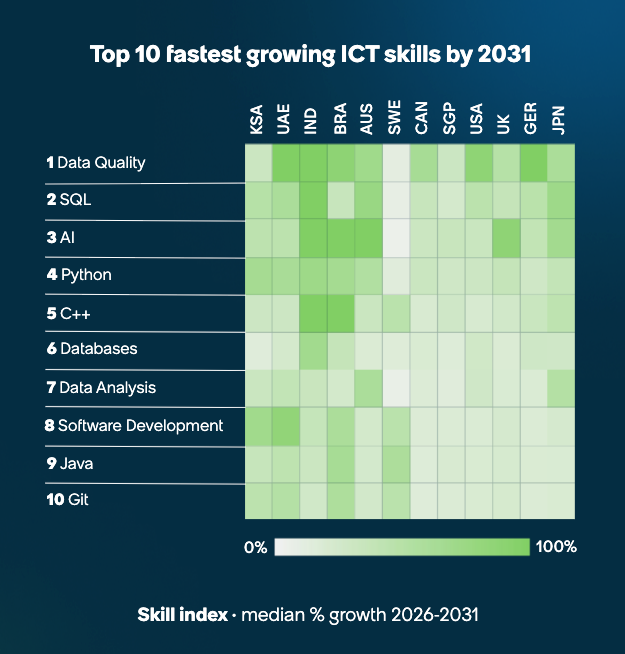
AI is automating routine tasks and unlocking new ways of working across functions, from customer service to operations to software development to healthcare. These changes are transforming work and the technical skills required to build, operate, and govern the systems AI runs on.
By 2031, the fastest-growing skills will be linked to data quality, software development, analytics, and AI, according to our research.
This reflects the pace of emerging technology adoption. While technical skills have the highest growth rate, demand continues to favor distinctly human strengths too. As work becomes more complex and technology-enabled, the capabilities that allow people to coordinate, decide, and lead change at scale become more valuable, not less.
Agentic solutions free people to focus on more strategic and supervisory work, exercising the judgment, creativity, and empathy that only humans provide. The fastest-growing skills in this category across all markets are mentorship, collaboration, project management, team management, and strategic leadership.
This is more than a skills shift. It's a redefinition of what creates value at work. Organizations need both technical skills and human capability.
While headcount growth may suggest stability across many sectors, these numbers mask a broader skills transition as roles are reshaped by evolving technology. Even the most rapidly growing fields—such as healthcare, telecommunications, media and technology, and professional services—demand an increasing mix of both technical and power skills.
With digital processes absorbing transactional tasks, skill demand is moving toward leadership, collaboration, and judgment, the capabilities that determine how effectively technology is adopted and applied.
Technology may alter how work gets done, but success depends on human judgment, creativity, and leadership.
In other words, human skills are not a complement to technical investment. They're a prerequisite.
When organizations invest in reskilling and upskilling their employees, three things happen:
- Humans and AI become collaborators, rather than competitors.
- Learning and skills growth accelerate as individuals adapt to new tools and ways of work.
- Creativity and human learning take center stage, as routine work is automated and human potential is unlocked.
This is the human renaissance in action, and it’s already underway in organizations that invest in technology and the people who use it.
For individuals and organizations ready to thrive in the human renaissance, three actions stand out:
Coding, AI, data, and analytics are growing faster than any other category. The specifics will shift, but the direction is clear: Comfort with emerging technology is a baseline expectation, not a differentiator.
The ability to inspire, mentor, and lead through complexity is not a soft add-on to technical expertise. Increasingly, it’s where value lives. The fastest-growing skills in this category—mentorship, collaboration, and strategic leadership—are also the hardest to automate.
Map your current capabilities to related roles, identify the gaps, and focus on short-term learning opportunities to chart your own path.
Organizations have a role here, too, in building the conditions for reskilling and giving people access to structured learning that connects to real work. That's what we built ServiceNow University to do.
The transition from jobs to skills isn't coming. It's here. Technology will keep evolving. Human capability—how people lead, collaborate, and apply judgment—will determine who succeeds.
Find out how ServiceNow can help you thrive in the new world of work.