


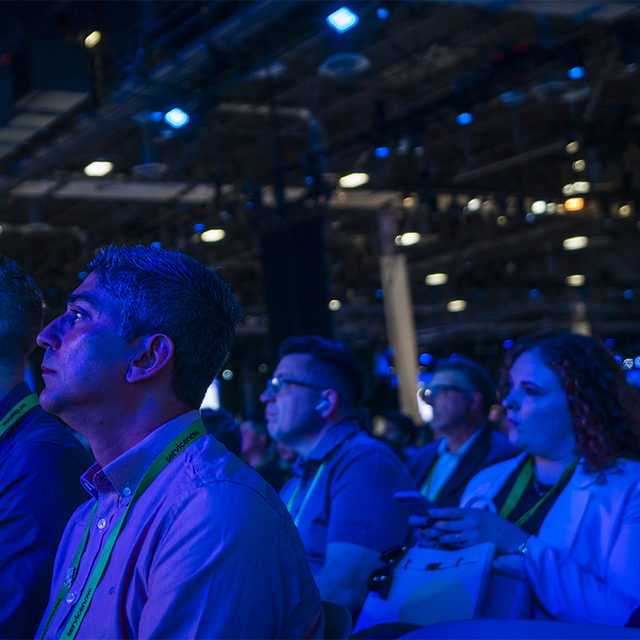
More than 20,000 people convened in Las Vegas for three days of enlightening sessions at Knowledge 2026.
ServiceNow customers in HR gave one clear signal: The conversation has shifted from “How can AI help HR?” to “How do we get to where those demos are real?”
Here's what cut through the noise for employee experience and HR leaders at the event.
AI specialists built for HR
ServiceNow expanded its Autonomous Workforce with AI specialists purpose-built for employee service teams across HR, workplace services, legal, finance, and procurement. These specialists complete end-to-end processes, deflecting requests before they become cases and resolving 91% without reassignment. They use the same platform, governance, and data layer you've already built.
Employees shouldn't need to know which system to go to in order to get their work done. ServiceNow EmployeeWorks puts an end to the swivel-chairing. It handles navigation, triage, and resolution by connecting employees to information and workflows across HR, IT, procurement, and other areas.
EmployeeWorks serves as the conversational front door for employees to unlock secure workflows and governance. Workflow Data Fabric powers your AI agents and workflows with AI-ready, instantly actionable data. It’s one platform, not a patchwork of systems.
ServiceNow has one robust architecture for your AI transformation strategy that senses, decides, acts, and governs. AI Control Tower is now included across every product and package.
TD's employee experience transformation: TD deflects more than 500,000 service desk calls annually and automates nearly 1 million catalog requests for more than 100,000 employees across IT, HR, and risk. This is the operational proof point behind the platform story.
Booking.com's HR AI journey: In perhaps the most robust session in the employee experience track, Booking.com covered what it takes to move from AI strategy to AI production. The recorded discussion highlights the importance of robust governance and measurement, as well as how to balance agentic acceleration with foundational data quality.
General-purpose AI breaks down in enterprise environments without context, guardrails, and system connectivity. EmployeeWorks combines conversational AI with deterministic workflows so that employees can find information and act.
CVS Health proved EmployeeWorks at scale by reducing live agent chats by 30% across its 300,000 colleagues and deflecting 300,000 calls.
Here are two sessions to share with any customer:
- Ditch the busywork. Free your people: Don’t miss the latest HR service delivery spotlight.
- ServiceNow EmployeeWorks: AI that gets work done: See ServiceNow EmployeeWorks in action during this immersive product session.
1. The measurement gap is the next battle
Most HR teams are deploying AI but can't prove it's working yet. It's critical to track and monitor key metrics such as case deflection, resolution time, and knowledge effectiveness to ensure measurement is aligned with return on investment and strategic planning.
Employee self-service is largely solved. The unsolved whitespace is for those people generating the most requests with the least support: the managers. They spend time handling policy questions instead of career conversations and staring at screens instead of coaching people.
AI that starts tasks is everywhere. But ServiceNow Otto actually completes tasks. The unified AI experience routes requests across systems, executes through workflows, and closes the loop without handing work back to you or your team. Otto is built for HR leaders who are tired of AI that adds steps instead of eliminating them. It knows your org, your policies, and your processes, so every request gets done.
Saran Mandair, vice president of global IT at Docusign, put a number on ambition. Docusign extended the automation philosophy it brings to its customers to its own IT operations and set a clear target for what autonomous service delivery should look like. "Our goal is to autonomously handle 90% of all tickets so our human agents can focus on the most critical work," he said.
Mark Wittenburg, chief information officer for the City of Raleigh, framed the people side of the equation that AI earns trust by being useful, not just present. Raleigh's virtual agent, Ral-E, hit a 98% deflection rate across internal operations. "With ServiceNow AI specialists documenting IT tasks and automating routine work, we've saved the equivalent of a full month of time while empowering employees to focus on meaningful service," he said.
Amit Zavery, ServiceNow president, chief product officer, and chief operations officer, set the stakes from the main stage on Day 2. "Advisory AI has run its course,” he said. “Enterprises need AI that senses, decides, and securely acts in accordance with organizational guardrails."
The scoreboard from Knowledge 2026 is impressive:
- 500,000 deflected calls at TD
- A 98% deflection rate in the City of Raleigh
- 30% fewer live agent chats at CVS Health
Find out how ServiceNow Autonomous Employee Experience can free your teams to focus on work that matters.